
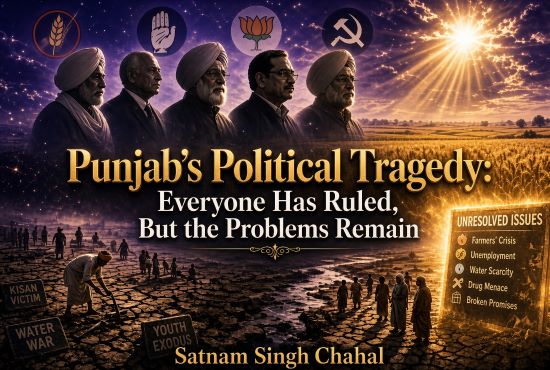
Punjab has witnessed almost every major political party take its turn in government. Congress has ruled Punjab for long periods and has also governed at the Centre. The Shiromani Akali Dal has governed Punjab several times and shared power with the BJP at the Centre. The BJP has been a dominant force in national politics and has been part of Punjab’s political equations. In 2022, the Aam Aadmi Party arrived with the promise of providing a completely different model of governance.Yet Punjab continues to struggle with many of the same questions.This is perhaps the greatest political tragedy of Punjab: governments changed, chief ministers changed, alliances changed, slogans changed—but the problems remained.
There is an old political joke in Punjab: “The government changes every five years, but Punjab’s problems have permanent residency.” Unfortunately, the joke is becoming increasingly difficult to distinguish from reality.
1966: A New Punjab, New Expectations
The reorganisation of Punjab in 1966 created a new political and administrative framework, accompanied by enormous expectations among the people. Punjabis hoped that the new state would provide greater political focus, economic development and a stronger voice for Punjab’s interests.But several fundamental questions remained unresolved for decades. Chandigarh, river waters, territorial issues, Centre-state relations and other political concerns continued to occupy Punjab’s political landscape.
The tragedy is that many of these questions are still being discussed generations later.Punjab did not suffer from a shortage of resolutions. It suffered from a shortage of final solutions.
The political instability and violence of the late 1970s and 1980s pushed Punjab into one of the darkest periods of its modern history. Militancy, Operation Blue Star, the assassination of Prime Minister Indira Gandhi and the anti-Sikh violence of 1984 left deep wounds.Thousands of families suffered devastating losses. Punjab’s economy and social fabric were badly affected.Eventually, peace returned, but the return of peace did not automatically resolve Punjab’s economic and political problems.The question should have been straightforward: What would Punjab do with peace?
Would it build a modern economy? Would it create employment for its youth? Would it diversify agriculture? Would it develop industries? Would it deal with emerging drug addiction? Would political parties work together on long-term issues?Unfortunately, Punjab continued to move from one political cycle to another.
1997: SAD-BJP Alliance Promises Stability
The Shiromani Akali Dal-BJP alliance came to power in 1997, presenting itself as an alternative to Congress and promising stability and development.The alliance later became one of the most important political partnerships in Punjab.There were periods of infrastructure development and economic activity, but Punjab’s fundamental problems did not disappear. Agriculture remained under pressure, government finances remained stretched and employment opportunities remained inadequate for the growing educated population.The migration of young Punjabis began increasingly to become a social phenomenon.Punjab was producing educated young people but not enough opportunities for them.
The irony was painful: Punjab’s young people were becoming qualified to build the world while increasingly believing they could not build their future at home.
2002: Congress Returns
Congress returned to power in Punjab in 2002.Once again, people expected change.But Punjab’s financial problems were becoming increasingly difficult to ignore. Government salaries, pensions, subsidies, welfare commitments and administrative expenditure placed enormous pressure on state finances.Punjab’s debt problem cannot honestly be attributed to one government or one political party.It is a problem accumulated over decades.But that creates an even more uncomfortable question:
If every government knew the problem was growing, why did so few governments seriously attempt to stop it?
2007–2017: A Decade of SAD-BJP Rule
The SAD-BJP alliance returned to power in 2007 and secured another term in 2012.During this period, Punjab witnessed significant political controversies, debates over corruption and governance, concerns about law and order and, most importantly, an increasingly serious drug crisis.Drugs became one of the defining political issues of Punjab.Political parties accused each other.Politicians held press conferences.Committees were formed.Investigations were announced.Promises were made.
But the question remained:
Why did the drug crisis become so deeply entrenched despite successive governments claiming they were fighting it?The political argument often became: “Who brought the drugs?”Perhaps Punjab should have asked a more important question:
“Why did nobody stop them?”
2017: Congress Returns With Another Promise of Change
Congress returned to power in 2017 under Captain Amarinder Singh.Once again, Punjab heard the familiar word: change.Promises were made concerning jobs, drugs, agriculture, corruption and governance.But political instability and internal disputes eventually became major features of the government’s final years. The Chief Minister changed, party leadership changed and political equations changed.And Punjab continued to wait.
There is a bitter lesson here:
A government can have five years to govern, but political parties can spend much of those five years preparing for the next internal battle.
2022: AAP’s Political Earthquake
Then came 2022.
The Aam Aadmi Party won a massive mandate, defeating the traditional political establishment.
The message from voters was unmistakable:
“Enough. Give someone else a chance.”
AAP did not merely campaign as another political party. It presented itself as an alternative to the established political system.People were promised better governance, action against corruption, jobs, improved education and healthcare, action against drugs and a new political culture.For millions of voters, 2022 was not simply another election.It was an experiment.
The people of Punjab were asking:
Could a new political force finally break the cycle?
2022–2026: The Old Problems Meet the New Government
Four years into the AAP government, Punjab’s fundamental problems remain deeply relevant.The drug crisis continues to cause concern. Punjab’s debt remains a major financial challenge. Young people continue to look overseas for education and employment. Agriculture faces structural difficulties. Industrial investment remains a major concern. Law and order remains a politically contentious issue.This does not mean that nothing has happened since 2022.It means that Punjab’s problems are so deep that no government can solve them through announcements alone.And this is where Punjab needs to become more demanding of every political party.A government can announce a scheme. It can hold a press conference. It can lay a foundation stone. It can inaugurate a project. It can publish a full-page advertisement. But eventually, the accountant arrives.
And the accountant asks only one question:
“Who is going to pay?”
Punjab’s Debt: The Political Credit Card
Perhaps the biggest challenge facing the next Punjab government will be the state’s accumulated debt and financial obligations.Punjab’s debt was not created by one Chief Minister or one political party. It is the product of decisions taken by successive governments over decades.But debt has one peculiar characteristic.It does not care who created it. Somebody still has to repay it.Punjab sometimes resembles a family that has been using one credit card to pay another.One government says:
“We inherited the debt.”
The previous government says:
“We inherited it from them.”
The government before that says:
“We inherited it from the government before us.”Meanwhile, the bill continues to arrive at the same address.
Punjab.
The 2027 Question
As Punjab approaches the 2027 Assembly election, political parties will once again prepare their manifestos.There will be promises of jobs, investment, agricultural reform, better education, improved healthcare, action against drugs, industrial development and welfare schemes.But this time voters should ask different questions.How much will these promises cost?
Where will the money come from?
How much additional borrowing will be required?
Which expenditures will be reduced?
How will state revenue be increased?
How many jobs will actually be created inside Punjab?
What is the ten-year economic plan?
How will Punjab repay its existing obligations while financing new development?
These are not anti-government questions.They are basic questions that every responsible government should be prepared to answer.Can Punjabis Trust Political Parties Again?The answer is complicated.Many people may have lost confidence in political promises, but they have not lost faith in democracy.They continue to vote because they continue to hope.They want jobs for their children. They want farmers to survive. They want their streets to be safe. They want drugs out of their villages. They want industries to return. They want their children to have a reason to stay in Punjab.So perhaps Punjabis do not always vote because they completely trust a political party.Sometimes they vote because they refuse to give up on Punjab.And that is why political parties continue to receive opportunities.
The Real Opposition Is Punjab’s Financial Reality
Punjab’s greatest opposition is not necessarily Congress, BJP, SAD or AAP.Punjab’s greatest opposition may be its own financial reality.Debt cannot be defeated by slogans.Drug addiction cannot be defeated by advertisements.Unemployment cannot be defeated by foundation stones.Agricultural distress cannot be solved through election speeches.Industrialisation cannot happen simply because an investment summit is organised.And Punjab’s long-standing political issues cannot be resolved by passing them from one government to another.
The Political Joke Punjab Can No Longer Afford
The political script has become almost predictable.One party says:
“The previous government destroyed Punjab.”
Another says:
“No, the government before that destroyed Punjab.”
A third says:
“Both of them failed.”
And the fourth says:
“Give us five years and we will fix everything.”
Punjab responds:
“Fine. But who will fix the debt accumulated during those five years?”Then the election arrives.The same voters stand in line again.They choose.Not necessarily because they believe every promise, but because democracy requires a choice.And perhaps that is Punjab’s political dilemma: people may distrust the political class, but they cannot afford to abandon hope.
Punjab Needs a Different Political Contract
Punjab does not need another manifesto filled with attractive promises.It needs a measurable political contract.Every party seeking power in 2027 should publish a detailed ten-year economic and governance plan.It should explain how the state will increase revenue, control unproductive expenditure, manage subsidies, create jobs, attract investment, reform agriculture, tackle drugs and reduce its debt burden.Every major promise should carry a price tag.Every major project should have a completion deadline.Every major expenditure should be open to public scrutiny.And every government should publish an annual report showing exactly which election promises have been fulfilled.Most importantly, the next government should not be allowed to spend five years simply saying:
“We inherited the problem.”
Of course it inherited the problem.
That is precisely why people elected it—to solve the problem.
The Final Question
Punjab has changed governments.It has changed Chief Ministers.It has changed alliances.It has changed political slogans.It has changed election promises.But the debt remains.The drug crisis remains.Youth migration remains.Agricultural distress remains.Industrial concerns remain.And many long-standing political questions remain unresolved.So the real question before Punjab in 2027 should not simply be:
“Which party should win?”
It should be:
“Which party has a credible plan to pay for Punjab’s past while building Punjab’s future?”
The next government will inherit something much more difficult than an empty treasury.It will inherit the accumulated bill of decades of political decisions.And when the next Chief Minister enters the office, Punjab should not ask for another slogan.Punjab should ask for the calculator.After decades of political promises, Punjab can no longer afford politics without arithmetic.As one sharp political observation puts it:
“Politicians leave office after five years. Punjab’s debt does not.”
And another:
“Punjab has had governments that know how to win elections. What Punjab desperately needs now is a government that knows how to balance the books.”The 2027 election should therefore be more than another contest for power.It should be a referendum on political credibility, financial responsibility and Punjab’s right to have a future beyond debt, drugs, unemployment, migration and perpetual promises.Because Punjab has already given almost everybody a chance.
Now the parties owe Punjab an answer.
Disclaimer: This article and accompanying images are for informational and illustrative purposes only. Some visuals may be AI-generated or digitally enhanced and may not depict actual events or persons. Views expressed are based on publicly available information and analysis