
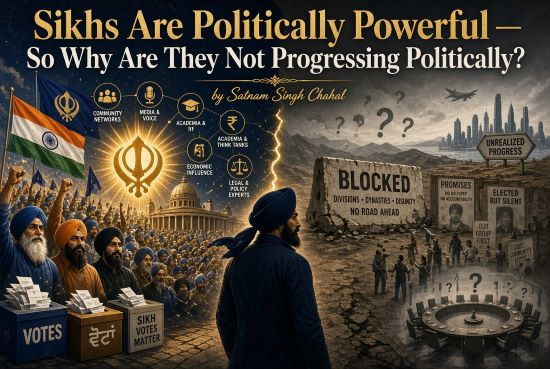
 There should be no hesitation in saying that Sikhs have earned a remarkable reputation for courage, discipline, hard work, honesty, sacrifice and service. From the battlefield to business, from agriculture to professional life, Sikhs have repeatedly demonstrated their ability to compete, lead and contribute. Yet there is an uncomfortable question that the community must ask itself: if Sikhs possess so much talent, determination and organisational ability, why has their political influence not progressed at the same pace?
The problem is not that Sikhs lack political participation. Sikhs have every constitutional and democratic right to join any political party they choose , whether the party is regional or national, left, right or centrist. No Sikh should be questioned merely because he or she chooses a particular political platform. Political freedom is a fundamental democratic principle.
The real problem begins when an individual’s political choice is presented as the collective choice of the Sikh community.A Sikh politician joining a political party is perfectly legitimate. But claiming the Sikh community’s name, history, sacrifices and religious identity to obtain political importance for oneself is an entirely different matter. The community cannot become a political ladder for individual ambition.
For decades, Sikh politics has struggled with this contradiction. Political organisations and leaders have often claimed to speak on behalf of the Sikhs, while Sikh voters themselves have demonstrated that they do not necessarily vote as one political bloc. Academic research has long documented the complicated relationship between Sikh identity, regional politics and different political parties in Punjab.This is where the community needs a serious political awakening.A Sikh does not become more Sikh because he joins a Sikh-labelled party. And a Sikh does not become less Sikh because he joins a national party.
The test should be much simpler: What has the politician actually done for Punjab? What has he done for farmers, workers, students, businessmen, women and young people? What has he done to protect Punjabi language and culture? What has he done to strengthen education, employment, industry and infrastructure? What has he done to ensure justice and accountability?These questions should matter more than party flags.
The greatest danger is personality-based politics masquerading as community politics. When leaders repeatedly suggest that their personal political success represents the success of the entire Sikh community, they create an illusion of unity while actually dividing the community between followers of different personalities and parties.And the irony is extraordinary.
Sikhs are perfectly capable of building billion-dollar businesses, succeeding internationally, running farms, driving industries, excelling in professions and helping strangers thousands of miles away. But when it comes to politics, too often the community allows a handful of individuals to define its political priorities.That needs to change.
The Sikh community does not need politicians who merely carry a Sikh identity. It needs politicians who carry political competence, integrity, courage and accountability.There is another uncomfortable reality: political representation is not simply about how many Sikh faces appear in legislatures. It is about whether those representatives can influence policy and defend legitimate interests effectively. A recent National Commission for Minorities study also pointed to the limited sustained institutional bridge between the Sikh community and the Union government, despite Sikh leaders having held important national offices.
That should be a warning.The answer is not to demand that every Sikh support the same party. That would itself be undemocratic. The answer is to develop politically educated, politically independent and politically accountable voters.Sikhs should be able to support the BJP without becoming BJP’s Sikh face.They should be able to support Congress without becoming Congress’s Sikh representative.
They should be able to support AAP without claiming that AAP represents every Sikh.They should be able to support SAD without accepting the argument that one party owns the Sikh vote.And they should be able to reject all of them.The Sikh community belongs to no political party. Political parties belong to the democratic process.This distinction is crucial.A politician can join whichever party he wants. But once he enters that party, he should have the honesty to say: “I am a Sikh who belongs to this political party,” rather than implying, “I represent the Sikhs because I belong to this political party.”
That difference may sound small, but politically it is enormous.