
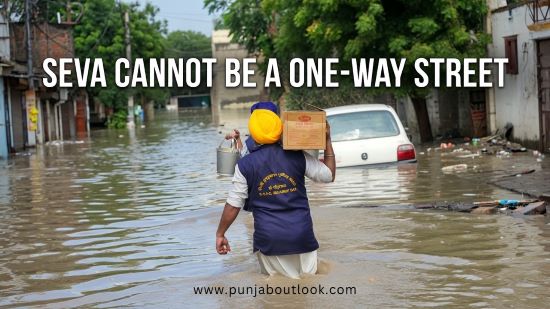
 The Sikh community has given the world one of the most powerful traditions of voluntary service seva. From langar to disaster relief, from feeding strangers to helping victims of war, floods, pandemics and displacement, Sikhs have repeatedly demonstrated that humanity comes before identity. A person does not have to be a Sikh to receive food, shelter, medical assistance or compassion from a Sikh volunteer. Yet there is an uncomfortable question that the Sikh community must now ask itself: Are we becoming a community that constantly gives to others but does not have a strong enough system to stand behind its own people when they are in trouble?
The answer should not be that Sikhs should stop serving humanity. Seva must remain universal and unconditional. But alongside universal seva, the Sikh community must develop a much stronger culture of community solidarity. Helping others and helping our own people are not contradictory principles. They are complementary responsibilities. A community that is strong enough to help the world should also be strong enough to ensure that no vulnerable Sikh family feels abandoned.
The roots of Sikh humanitarianism go back to the very foundations of the faith. Guru Nanak Dev Ji challenged social divisions and emphasized equality, sharing and service. The institution of langar became one of the most revolutionary examples of this philosophy. People from different religions, castes and social backgrounds could sit together and share the same food. Sikhism created a tradition in which feeding the hungry became an act of faith rather than merely charity.
The tragedy of the 1947 Partition tested that spirit in the most devastating way. Millions were displaced, families were separated and communities suffered unimaginable violence. Sikh families themselves became victims of displacement and loss, while Sikh institutions and ordinary individuals also helped refugees and people affected by the catastrophe. The Partition remains an important reminder that communities survive terrible periods not simply through political leadership but through ordinary people standing together.
The tradition continued during subsequent humanitarian crises. When the Indian Ocean tsunami struck on December 26, 2004, Sikh organizations and volunteers participated in relief activities and provided assistance to people affected by the disaster. The victims were not asked about their religion before receiving help. That has always been one of the great strengths of Sikh seva: human suffering is enough to qualify someone for assistance.
The same spirit was dramatically visible during the farmers’ movement beginning in November 2020. Sikh organizations, gurdwaras, volunteers and ordinary families mobilized enormous resources to support farmers gathered at Delhi’s borders. Langars operated continuously, while volunteers provided food, tea, medical assistance, sanitation facilities and other necessities. Sikh institutions and diaspora communities also contributed financially and materially to sustain the enormous humanitarian effort.
Then came the COVID-19 pandemic. During 2020 and 2021, Sikh gurdwaras and organizations across India and the diaspora became important centres of humanitarian assistance. They distributed meals, groceries and essential supplies to people who had lost employment or were unable to meet their basic needs. During India’s devastating second wave in 2021, Sikh volunteers became particularly visible in providing oxygen cylinders, concentrators, food and emergency assistance to people desperately searching for help.
Again, the beneficiaries were not necessarily Sikh. That is precisely what makes Sikh seva so respected around the world. A hungry person is fed because he is hungry. A person without oxygen is helped because he is struggling to breathe. A disaster victim is given food because he is suffering. No religious test is placed before humanitarian assistance.
The Sikh humanitarian tradition has also travelled with the diaspora. In 2025, Sikh Volunteers Australia travelled long distances to flood-affected communities in New South Wales and provided thousands of hot meals to people displaced by devastating floods. Similar Sikh volunteer initiatives have responded to bushfires, floods and other emergencies in Australia and other countries.
But these examples lead to an important question that should not be ignored: When the Sikh community itself experiences hardship, does the same level of solidarity exist?
When Sikh volunteers feed flood victims, people applaud. When Sikh organizations provide food during a pandemic, people appreciate it. When Sikhs provide langar during a protest, the world recognizes their generosity. When Sikh volunteers provide emergency assistance after a natural disaster, their humanity receives international attention.
But when Sikh families themselves experience serious financial hardship, when Sikh businesses collapse, when Sikh students struggle, when Sikh seniors become isolated, when Sikh immigrants face exploitation or discrimination, or when Sikh communities face hate and insecurity, the response can sometimes be fragmented.
There are, of course, many non-Sikhs who have stood with Sikhs in difficult circumstances, and their friendship and solidarity should always be appreciated. But a community with a worldwide network of gurdwaras, charitable organizations, professionals and successful businesspeople should not have to depend entirely upon outside assistance when its own members are in crisis.
This does not mean that Sikh seva should become conditional. Give and take should not mean, “I will help you only if you help me.” That would turn seva into a commercial transaction and destroy its spiritual meaning. Rather, the principle should be that while Sikhs continue to serve humanity without discrimination, they must simultaneously build a system in which the Sikh community is capable of supporting its own vulnerable members.
This is where the concept of sangat becomes particularly important. Sikhism has never been solely about the individual. The sangat represents collective strength and responsibility. If one member of the community is suffering, the community should not simply offer sympathy. It should ask: What can we practically do to help?
Every gurdwara should consider developing a transparent emergency assistance program for members of the community. Such programs could help families facing sudden financial crises, support elderly people living alone, assist students, provide employment guidance, offer legal assistance to vulnerable immigrants and help families affected by disasters or other emergencies.
The Sikh diaspora also possesses an enormous reservoir of professional talent. Doctors, lawyers, accountants, engineers, educators, business owners and technology professionals could contribute volunteer hours to community service programs. Young Sikhs could be encouraged to dedicate a certain number of hours every year to seva. Sikh businesses could participate in employment and mentorship initiatives. Wealthy individuals could invest not only in buildings and monuments but also in people and institutions that protect vulnerable members of the community.
The Sikh community should also think beyond the gurdwara as merely a place of worship. A modern gurdwara can become a genuine community resource centre—a place where a struggling family can find food, information, companionship, employment guidance, emergency assistance and referrals for professional services. A newly arrived immigrant should know where to go if he or she is being exploited. A Sikh senior should know that someone will check on them. A student facing financial difficulties should know that the community has not forgotten them.
The timeline of Sikh humanitarian service from the upheaval of 1947, through the 2004 tsunami, the 2020 farmers’ movement, the 2020–21 COVID crisis, and humanitarian responses continuing into 2025 and beyond demonstrates something extraordinary. Sikhs have repeatedly shown that they are willing to serve humanity during its darkest moments.
The challenge for 2026 and the years ahead is to convert that extraordinary spirit of individual seva into a stronger and more organized culture of community solidarity.The Sikh community should therefore continue to open its langars to the world, but it must also make sure that no Sikh family goes hungry. It should continue helping disaster victims, but it must also ensure that a Sikh family struck by disaster has somewhere to turn. It should continue defending human rights everywhere, but it must also defend the dignity, safety and welfare of vulnerable members of its own community.
A community cannot survive on goodwill alone. It needs institutions, resources, volunteers, planning and, above all, a sense of collective responsibility. Sikh communities across North America, Britain, Australia, Europe and elsewhere have the financial and professional resources to build such a system.The time has come to make that a priority.Because seva cannot be a one-way street. Sikhism teaches us to serve humanity without discrimination, but Sikh history also teaches us the importance of sangat, collective responsibility and standing shoulder-to-shoulder during adversity.The ultimate test of any community is not how generously it behaves when everything is going well. The real test comes when its own people are in trouble.
And when that moment comes, every Sikh family should be able to hear the same reassuring words:
“You are not alone. The sangat is standing with you.”
Disclaimer: This article and accompanying images are for informational and illustrative purposes only. Some visuals may be AI-generated or digitally enhanced and may not depict actual events or persons.Views expressed are based on publicly available information and analysis.