
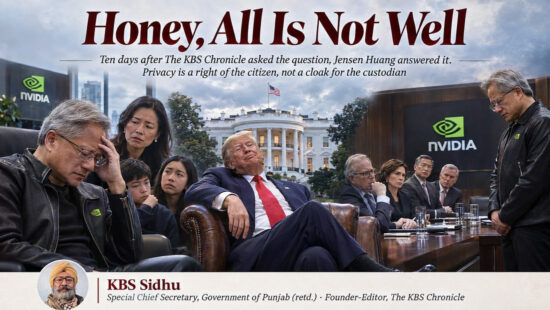
 On Friday, 30 October 2026, a day after The New York Times reported that American intelligence agencies had concluded that a Singapore-based executive named Alice Huang was gathering information for Beijing, this Chronicle ran a piece under a title some readers thought cheeky, Honey, Is All Well?
We were careful, perhaps more careful than the story deserved. We noted that the Times had not used the words “honey trap”, and advised readers abroad not to borrow them. We recorded, without a raised eyebrow, Nvidia’s assurance that its chief executive’s dealings with Ms Huang were “not unusual or unexpected” for a man who meets thousands of customers a year. A few kind readers called it responsible journalism, which it was, and it was also the polite version of what anyone who has read an intelligence report could already see written on the wall.
On Sunday, 8 November, Jensen Huang wrote to his employees, “I was unfaithful to my wife.” He apologised to his family, his colleagues, his board and his shareholders, said he had fallen short of the trust placed in him, and promised to earn it back. The honey, it seems, was in the well all along.
What the Board Bought, and Who Paid for It
The Nvidia board moved the same evening. A committee of independent directors, assisted by outside counsel, will investigate whether its founder was the target of a foreign intelligence effort. The board said it had no reason to believe that national security or company secrets were compromised, and that it retained confidence in Jensen Huang and his team. Its statement did not mention the affair; only Huang’s own letter did.
The board, in other words, bought time, and the price was paid in Washington. Within hours, President Trump told reporters on his way back from Palm Beach that he had not spoken to Huang about the matter, that Huang was a fine and honourable person, that he should stay on, and that he would happily take him along on the forthcoming Asia trip, China included. He had not, he said, heard that Huang had done anything wrong. Asked whether he wished he had acted on the intelligence, prepared last spring in a memo overseen by Secretary of State Marco Rubio, the President said no.
A board that removed a chief executive whom the President had just pronounced fine, honourable and fit to fly to Beijing would be picking a fight with the White House, over a matter the White House had already decided to ignore. Nvidia’s directors chose not to pick it.
The calendar helped too. Americans voted in the midterm elections on Tuesday, 3 November. The polls have closed and the results are in, and nothing a President says about a chip baron’s private life will move a vote for another two years. Three House committees will hear Huang behind closed doors on 18 November, and Democrats are calling for more. Hearings, however, punish slowly, and the electoral cost of standing by Jensen Huang has, for now, fallen to zero.
The markets have been less forgiving than the President. Nvidia, which had already shed nearly nine per cent the previous week as investors trimmed their AI bets, fell around five per cent in pre-market trading on Monday while its rivals rose. The company reports its quarterly results on Tuesday, 17 November, and its founder faces the House committees the next day. Jensen Huang will thus explain himself to shareholders and to legislators on successive days, and the shareholders vote every trading day.
MICE, and the Letter That Never Changes
The intelligence trade has an old acronym for why people betray their trust: MICE, for Money, Ideology, Coercion (or Compromise) and Ego. Money leaves a bank trail. Ideology takes years to cultivate. Coercion breeds resentment. Ego is the cheapest door of the four, since it needs no bribe, leaves no paper and is opened from the inside.
Jensen Huang runs a company worth around five trillion dollars, sits on the President’s science council, has flown on Air Force One, and wears a leather jacket the world recognises at a glance. There is nothing left for such a man to buy except the one thing power makes scarce, which is someone who appears to see the man rather than the office. That is vanity, and beneath vanity lies biology. No export-control list can classify either, and no firewall can block them.
Nvidia told the world it had “counted every one” of the chips that went to Megaspeed, Alice Huang’s former employer, which has bought nearly $4.8 billion of Nvidia equipment. No doubt it did, though nobody was counting the evenings.
The Garb of Privacy
Huang’s defenders will say that an affair is a matter between a husband and his wife. Up to a point that is true. The affair may be private, but the access it gave was a public matter.
Once a woman whose company was among Nvidia’s largest customers was assessed by her lover’s own government to have been recruited by China’s Ministry of State Security (MSS, Beijing’s civilian intelligence service), the matter left the bedroom and entered the briefing room. In such a case privacy works as a garment, and what it covers is risk.
I would propose a simple test, call it the Three Keys, for when a private act stops being private:
First key: does the person hold access that others do not, to secrets, to policy or to markets?
Second key: does the other party, or whoever stands behind her, have an interest in that access?
Third key: has the relationship been kept from those entitled to know, such as a board, a security officer or a government?
Three yeses, and the matter is public, whatever the participants may feel about it.
None of this licenses the gossip that will now attach to Lori Huang, married to him for 41 years and the one person in this story who has done nothing wrong. Our quarrel is with the keys.
The Indian Ledger
India has its own reasons to read this story closely.
Our Supreme Court, in Justice K.S. Puttaswamy v. Union of India (2017), held privacy to be a fundamental right, and rightly so. The same judgment held that the right is not absolute and must yield, through a proportionate law, to a legitimate aim of the State. National security is the most legitimate aim there is.
Our own service rules understood this long before the judgment. A government servant who marries a foreign national must report the fact to the government. Nobody in the service ever thought of it as an intrusion, because the domestic life of a man with access to the State’s secrets was understood to be not wholly his own. Anyone who has served as a District Magistrate in a border district has read intelligence reports almost daily, and has seen honey-trap advisories go round ministries and cantonments with weary regularity. The trap is old, though the bait keeps changing.
What has changed is who holds the keys. In 1990 they were held by officers, generals, ministers and a few scientists. Today they are also held by the promoters and chief executives of private firms that run our data centres, our payment rails and our telecom networks, and that will soon run the “sovereign AI” the government is buying from companies such as Nvidia. A section officer in a sensitive ministry is vetted, while the private custodian of critical national infrastructure is not.
That gap can be closed without voyeurism. A confidential declaration to a designated security authority, of the kind officers have always made, would do. It need not be a press release, and it need not be a morality code. It would simply recognise that when a person’s private actions can affect the public at large, they are no longer private.
The Well, Revisited
Washington had the memo and chose not to warn Huang. The board had the facts and chose to keep him. The President had the briefing and chose to call him fine. Each choice can be defended on its own terms, and together they show how a great power can be undone by one man’s vanity while its institutions call that vanity private.
Honey, all is not well, and it was not well on 30 October either, when we said so politely.
Share The KBS Chronicle
About the author: KBS Sidhu, IAS (retd.), 1984 batch, Punjab cadre, retired as Special Chief Secretary, Government of Punjab. He is Founder-Editor of The KBS Chronicle and Convener of the Shiromani Punjab Forum.
Honey, Is All Well? A Suspected Chinese Asset and Nvidia’s Jensen Huang
KBS Sidhu
·
Oct 30
Honey, Is All Well? A Suspected Chinese Asset and Nvidia’s Jensen Huang