
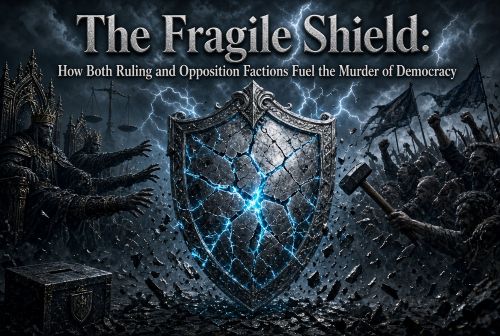
 The health of a modern democracy relies on a delicate, adversarial equilibrium. In theory, the ruling party governs with a mandate given by the electorate, while the opposition provides constructive scrutiny, acting as a check on executive power. However, across various global political landscapes, critics and political scientists increasingly argue that both factions are actively contributing to the erosion—or what some dramatically term the “murder”—of democratic norms. Rather than acting as caretakers of the system, political entities on both sides are regularly accused of prioritizing partisan survival over institutional integrity.
When a ruling party turns its power against the system that elected it, the democratic framework begins to erode from the inside out. Political analysts point to several distinct methods by which governing majorities systematically weaken institutional guardrails. To secure long-term power, ruling regimes frequently weaponize law enforcement and judiciaries to target political rivals. This includes the strategic deployment of tax investigations, anti-corruption bureaus, or police forces to harass opposition members. Critics also highlight how governing parties pack judicial benches or influence courts to eliminate checks on executive power.
Instead of engaging with critique, majoritarian governments sometimes use legislative trickery or suspension powers to silence alternative voices. A prominent example occurred when opposition representatives within the Jammu & Kashmir National Conference (JKNC) regional government characterized their sudden suspensions from the legislature as a literal “murder of democracy” designed to eliminate floor debates [BJP Jammu & Kashmir]. Furthermore, when a ruling power commands a supermajority, it can reshape the electoral landscape to its advantage. In El Salvador, President Nayib Bukele’s party utilized a 90% congressional majority to scrap presidential term limits [Opposition leaders say ‘democracy in El Salvador has died …]. Opposition lawmakers declared that democracy had died, warning that such legal maneuvers lay the groundwork for an autocracy disguised as a republic [Opposition leaders say ‘democracy in El Salvador has died …].
While ruling parties wield structural power, opposition groups are not merely passive victims. Observers note that opposition factions can severely damage democratic legitimacy when they abandon legislative negotiation for total obstructionism or extra-constitutional tactics. When opposition parties fail to achieve their goals through legislative debate, they may resort to mass street protests that risk descending into lawlessness. This shift weakens the central role of parliament. Editorial reviews of political unrest often point out that when leaders focus on creating high-security confrontations over constructive policy debate, they compromise the dignity of the very democratic institutions they claim to protect.
A frequent strategy among modern opposition groups is the preemptive or retrospective delegitimization of election outcomes. By constantly declaring systems to be completely rigged without pursuing standard legal remedies, they inadvertently convince the public that voting is futile. This rhetoric chips away at citizen efficacy and trust in the peaceful transfer of power. Additionally, when political groups label the ruling party as an existential enemy rather than a temporary adversary, democratic consensus fractures. Experts warn that incendiary, tit-for-tat rhetoric from both sides of the political aisle creates an ecosystem where political violence becomes normalized [10 Political Violence Experts on What Comes Next for America – POLITICO].
The erosion of democracy is visible across multiple operational areas. In legislative forums, ruling parties push fast-track legislation and limit floor time, while opposition parties counter with total boycotts and disruptive walkouts. Regarding institutional trust, governing factions pack courts and weaponize investigative bodies, while opposition groups openly question the legitimacy of foundational state agencies. Public engagement also suffers as ruling parties characterize critics as threats to national security, while opposition groups escalate protests near sensitive government areas, risking property damage or civic disorder.
Democracy does not usually collapse due to a single event or a single party’s malice. Instead, it suffers a slow decay when both sides abandon the unwritten rules of mutual tolerance and institutional forbearance. When the ruling party views governance as a tool for total dominance, and the opposition views politics as a zero-sum war of attrition, the democratic framework is caught in the crossfire. Sustaining a healthy democracy demands that governing majorities respect dissent, and that opposition groups respect the civic boundaries of peaceful protest.
Disclaimer: This article and accompanying images are for informational and illustrative purposes only. Some visuals may be AI-generated or digitally enhanced and may not depict actual events or persons. Views expressed are based on publicly available information and analysis