
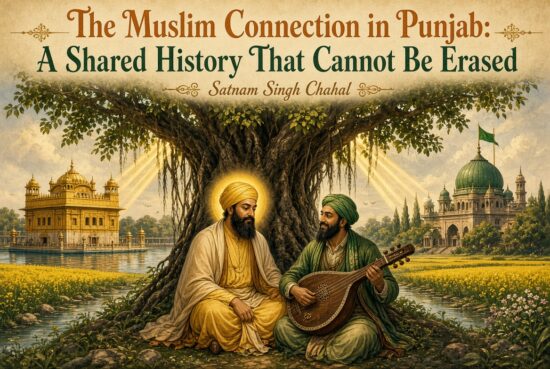
Punjab is often described through the lens of Sikhism, agriculture, courage and sacrifice. But Punjab’s story is much larger than any single community. For centuries, Muslims have been an integral part of Punjab’s social, cultural, political and economic history. Their contribution is deeply woven into the language, literature, architecture, music and traditions of the region.
The Government of Punjab itself describes the state as a land of ethnic and religious diversity and notes that Punjab was home to numerous Sufi schools of Islam. The Muslim connection with Punjab, therefore, is not a recent development or an outside influence. It is part of Punjab’s historical identity.
Punjab’s relationship with Islam cannot be understood merely through politics or population statistics. Sufi traditions became deeply connected with Punjabi culture. Figures such as Baba Farid occupy an important place in the spiritual and literary history of the region. His verses became part of the Guru Granth Sahib, creating a remarkable example of how spiritual traditions crossed religious boundaries.
Punjabi poetry, folk music and oral traditions were also profoundly influenced by Muslim poets and Sufi thinkers. Waris Shah’s Heer remains one of the greatest works of Punjabi literature, while the poetry of Bulleh Shah continues to be read and sung across Punjab and beyond.This shared heritage demonstrates something important: Punjab’s culture was never created by one community alone.
The tragedy of 1947 transformed Punjab forever. The former province was divided between India and Pakistan. The western, predominantly Muslim areas became part of Pakistan, while the eastern areas became part of India. The division brought enormous displacement and communal violence.Millions of people were forced to leave homes that their families had occupied for generations.Muslims who moved west left behind villages, businesses, mosques, shrines and memories in Indian Punjab. At the same time, Sikhs and Hindus who moved east left behind their ancestral homes in what became Pakistani Punjab.
The political border was new. The history was not.Muslims remain an important minority in Indian Punjab. According to the 2011 Census, Punjab had 535,489 Muslims, alongside a total population of 27,743,338. The official Census tables provide religion-wise population data for Punjab down to district, sub-district and town levels.That community is part of modern Punjab’s social fabric, with Muslims living, working and contributing across different parts of the state.
The discussion should therefore move beyond the simplistic question of “Hindu, Sikh or Muslim.” Punjab’s real story is about how different communities lived alongside one another, influenced one another and built a common Punjabi culture.There is also a political dimension to the Muslim connection.Punjab’s Muslim population is smaller today than it was before Partition, but Muslims remain citizens with the same constitutional rights as every other Punjabi. Political parties may seek their support, and Muslim voters may support whichever party they believe represents their interests.But Muslims should not be reduced to a vote bank.
The same principle applies to Sikhs, Hindus, Christians and every other community. A mature democracy should judge citizens as citizens rather than permanently dividing them into religious voting blocs.One of the greatest dangers facing Punjab today is historical amnesia.A younger generation can easily grow up knowing Punjab only through the politics and borders of the present. But the Punjab of history was much broader. Its villages, cities, poetry, shrines, markets and traditions were shaped by people belonging to different faiths.The Muslim contribution to Punjabi culture should neither be exaggerated for political purposes nor erased for ideological reasons.
It should simply be acknowledged.The same Punjab that produced Sikh Gurus and Sikh warriors also produced Sufi saints and Muslim poets. The same Punjabi language carried the poetry of Sikh, Hindu and Muslim writers. The same soil holds memories belonging to communities that were separated by Partition.The Muslim connection in Punjab is therefore not merely about the number of Muslims living in the state today.It is about history.
It is about Baba Farid’s spiritual legacy, Waris Shah’s poetry, Sufi traditions, historic mosques and shrines, Punjabi literature, shared villages and the generations that lived together before 1947.Punjab does not become less Sikh by acknowledging its Muslim history.In fact, understanding that history makes Punjab’s story stronger.
The lesson for today’s Punjab should be simple: remember history without hatred, acknowledge contributions without political manipulation, and protect the rights of every citizen without compromising the distinct cultural and religious identity of Punjab.Punjab’s past cannot be rewritten according to today’s politics. Its history belongs to everyone who helped build it.
Disclaimer: This article and accompanying images are for informational and illustrative purposes only. Some visuals may be AI-generated or digitally enhanced and may not depict actual events or persons.Views expressed are based on publicly available information and analysis