
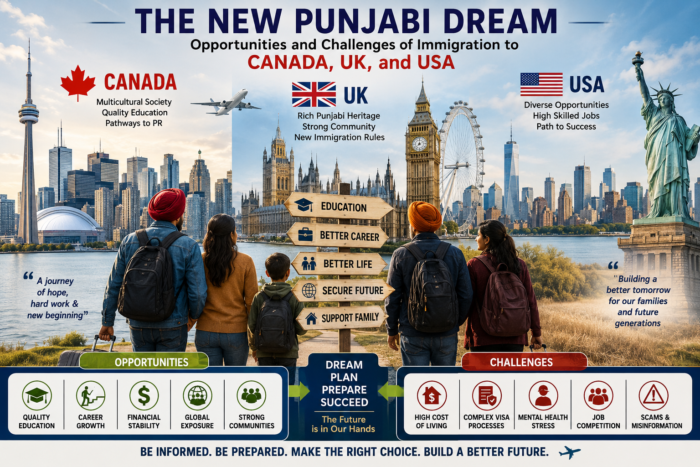
 Immigration has long been a defining feature of Punjabi society. For generations, Punjabis have looked beyond India’s borders in search of better economic opportunities, quality education, and improved living standards. Today, countries such as Canada, the United Kingdom, and the United States remain among the most popular destinations for Punjabi immigrants. While migration has brought prosperity to many families, it has also created new challenges that deserve careful examination.
Canada remains the preferred destination for many Punjabis. Large Punjabi communities have established themselves in cities such as Brampton, Surrey, and Calgary. The country’s multicultural policies, pathways to permanent residency, and strong education system have made it attractive to both students and skilled workers. However, recent changes in immigration policies, rising housing costs, and increased competition for jobs have made the immigrant journey more difficult than it was a decade ago. Many international students struggle with tuition fees, high rents, and uncertainty about obtaining permanent residency after graduation.
The United Kingdom has a long and distinguished Punjabi history dating back more than a century. Punjabi communities have flourished in cities such as London, Birmingham, and Leicester. Punjabis have made significant contributions to British politics, business, healthcare, transportation, and public service. However, tighter immigration rules following Brexit have made it more challenging for some migrants. Visa requirements, sponsorship rules, and rising living expenses have become major concerns for newcomers seeking to establish themselves in Britain.
The United States continues to attract highly skilled Punjabi professionals, entrepreneurs, and students. Areas such as Yuba City, Fresno, and New York City have sizable Punjabi populations. The American economy offers significant opportunities in technology, healthcare, transportation, agriculture, and business. However, the U.S. immigration system is often complex and time-consuming. Long waits for employment-based visas, uncertainty surrounding immigration reforms, and the challenges of obtaining permanent residency can create anxiety for many immigrant families.
One of the most significant concerns affecting Punjabi immigrants in all three countries is the rising cost of living. Housing prices and rental costs have surged dramatically in recent years. Many newcomers discover that earning a decent income does not necessarily translate into financial security. Young immigrants often share accommodations with multiple roommates while trying to save money and support families back home.
Another growing issue is the increasing reliance on international education as an immigration pathway. Thousands of Punjabi students travel abroad each year with dreams of building successful careers. While many succeed, others encounter misleading information from recruitment consultants, unaccredited institutions, or unrealistic expectations about employment opportunities. Some students find themselves burdened by debt and struggling to secure jobs that match their qualifications.
Mental health has emerged as an important topic within immigrant communities. The pressure to succeed, separation from family, financial obligations, and cultural adjustment can lead to stress, anxiety, and depression. Unfortunately, many immigrants hesitate to seek professional help because of social stigma or lack of awareness about available services.
The issue of family reunification also remains a concern. Many immigrants spend years navigating sponsorship applications and immigration procedures to bring spouses, parents, or children to join them. Delays in processing times can create emotional hardship and strain family relationships.
Despite these challenges, immigration continues to offer tremendous opportunities. Punjabis have established successful businesses, excelled in professional careers, and become influential leaders in politics, education, and public life across Canada, the United Kingdom, and the United States. Their contributions have strengthened both their adopted countries and their homeland through remittances, investments, and community development initiatives.
Looking ahead, the Punjabi community must focus on informed decision-making, realistic expectations, and skill development. Prospective immigrants should carefully research immigration pathways, verify information provided by consultants, and understand the economic realities of their chosen destination. Governments, educational institutions, and community organizations also have a responsibility to provide accurate guidance and support to newcomers.
Immigration is neither a guaranteed path to wealth nor a journey without obstacles. It is a complex process that requires resilience, adaptability, and determination. For many Punjabis, however, the dream of building a better future continues to drive them across continents, making immigration one of the most important social and economic forces shaping Punjab today.