
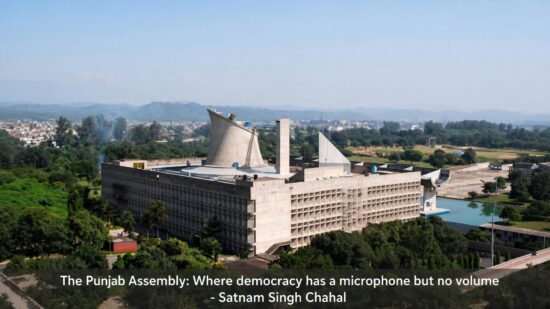
 Once upon a democratic time, the Punjab Vidhan Sabha was considered the place where the elected representatives of Punjab gathered to debate the problems of the state. The government presented its policies, the opposition questioned them, and the people expected their representatives to fight for their interests. Today, however, watching the proceedings of the Assembly sometimes feels less like watching a serious democratic institution and more like watching a Punjabi political comedy—with one important difference: the comedy is being paid for by the people of Punjab.
The characters in this political drama are familiar. There is the Speaker sitting in the most powerful chair in the House, with the authority to decide who speaks and when. There are the Treasury Benches, comfortably seated with the confidence that comes from having the numbers. And then there is the Opposition MLA, arriving with files, documents, statistics, questions and, sometimes, enough patience to survive an entire Assembly session.
And then there is the most important character of all—the microphone. The microphone appears to have developed political intelligence. When a ruling-party MLA stands up, it works beautifully. The sound is clear, the voice travels across the chamber, and the entire House can hear every word. But when an opposition member rises with an uncomfortable question, the microphone sometimes appears to develop a sudden technical problem. The voice becomes faint, the Speaker becomes impatient, and democracy starts looking for its spectacles.
An opposition MLA begins politely: “Honourable Speaker Sahib, I want to raise an important issue concerning Punjab.” Before he can finish, the Speaker may remind him to be brief. The MLA continues, perhaps raising the issue of farmers. Then comes another reminder. He moves to unemployment. Another interruption. He raises the drug problem. “Please come to the point.” He raises Punjab’s debt. “Your time is over.” He raises the concerns of his constituency. “Next member.” Eventually, the MLA looks at his papers, looks at the Speaker, looks at the microphone and perhaps silently asks himself, “Why did my voters send me to Chandigarh?”
The answer, unfortunately, appears to be: to prepare questions. Whether he will be allowed to ask them is another matter.
The comedy becomes even more interesting when the opposition is accused of disrupting the House. The opposition says, “Give us an opportunity to speak.” The ruling benches say, “You are creating disorder.” The opposition says, “We have a serious question.” The answer is, “Please maintain discipline.” The opposition asks, “Can we at least finish our point?” The Speaker says, “Please sit down.” It is a remarkable democratic formula: first don’t let them speak, and then blame them for shouting.It is rather like tying someone’s hands and then complaining that he is not clapping.
Imagine a cricket match where one team is allowed to bat for the entire afternoon while the other team is repeatedly told that its innings will come later. Imagine a boxing match where one fighter is allowed to attack while the other is constantly reminded to maintain discipline. Imagine a school debate where one student is given the microphone and the other is told that his participation is important—but he must remain silent. That is where the humour becomes uncomfortable, because behind every opposition MLA are thousands of voters.
A farmer may have sent his MLA to Chandigarh with a question about agriculture. A young graduate may have sent him with a question about employment. A village may have sent him with a question about roads and development. A family may have sent him with a question about drugs and law and order. A taxpayer may have sent him with questions about government expenditure. These people do not have microphones inside the Assembly. Their elected representatives do.
So when an elected representative is prevented from speaking, the matter should not be treated simply as a dispute between politicians. Behind that MLA stands a constituency. Behind that constituency stand ordinary citizens who expect their voice to reach the government.The journey is almost poetic: from the village to the constituency, from the constituency to Chandigarh, from Chandigarh to the Assembly, from the Assembly to the microphone and from the microphone straight back to silence.
Meanwhile, the Treasury Benches sit peacefully. Why shouldn’t they? They have the numbers. And numbers are certainly powerful in politics. A majority gives a government the ability to pass legislation and implement its programme. But majority numbers should never become a licence to avoid questions. A government may have the majority to win a vote, but that does not automatically give it the majority in every argument.That is precisely why the opposition exists.
An opposition is not an unwanted guest in a democratic Assembly. It is not a disturbance that should be tolerated only when it is quiet. It is an essential part of parliamentary democracy. Without an effective opposition, governments can become too comfortable, and when governments become too comfortable, uncomfortable questions become even more important.This brings us to the Speaker’s chair. The Speaker’s chair does not belong to the ruling party. It belongs to the House. The Speaker is expected to be the referee, not a player wearing the jersey of one side. The Speaker has the difficult responsibility of maintaining order while also protecting the right of elected representatives to express themselves.
There is nothing wrong with stopping disorder. There is nothing wrong with enforcing parliamentary rules. There is nothing wrong with asking members to remain within the rules. But there is a fundamental difference between maintaining order and suppressing legitimate dissent.The Speaker should be able to tell the opposition, “You will have your opportunity,” while telling the government, “You will have to answer.” That is the real balance of parliamentary democracy.Otherwise, Punjab risks developing a new definition of legislative discipline: when the opposition speaks loudly, it is disorder; when the government speaks loudly, it is debate.
Perhaps the Assembly should introduce a new daily programme. Government speaks. Government explains. Government announces. Government responds. Then the opposition prepares to speak. The Speaker reminds them of the rules. The microphone develops a headache. The opposition protests. The opposition is accused of disrupting the House. The government declares that the Assembly has functioned successfully. Everyone goes home.
And democracy?
Democracy goes home wondering whether anybody heard it.The Punjab Assembly does not need choreography. It needs debate. It does not need manufactured agreement. It needs disagreement. It does not need silence disguised as discipline. It needs questions, arguments, scrutiny and accountability.The government should be strong enough to face criticism. The opposition should be responsible enough to make criticism meaningful. And the Speaker should be neutral enough to ensure that both sides receive a fair opportunity to be heard.
The Assembly belongs neither to the Chief Minister nor to the opposition leader. It belongs to Punjab. Every MLA sitting inside that chamber represents someone outside it. That someone may be a farmer, a worker, a student, a teacher, a businessman, a government employee, a mother, an unemployed graduate or an ordinary taxpayer trying to understand what is happening to the state.Those people may never enter the Assembly chamber. Their elected representatives are their microphones.That is why the microphone should not become a political weapon.
Punjab has a long tradition of fearless debate. It is a land where poets questioned kings, reformers challenged injustice and ordinary people raised their voices when they believed something was wrong. The Punjab Assembly should reflect that tradition rather than reduce democracy to a competition between who has the microphone and who has the majority.
There is a simple Punjabi wisdom that applies perfectly here: “Gall kehni hi nahi, gall sunni vi paindi hai.” It is not enough to speak; you must also listen.That is the real test of a democratic government.If the government’s policies are good, let the opposition question them. If the government’s performance is strong, let the government defend it. If its achievements are genuine, let the facts speak. If its decisions are in the public interest, let them survive scrutiny.There is nothing for a confident government to fear from a microphone.
But if questions are repeatedly stopped before they are fully asked, suspicion naturally grows. And suspicion is not good for any government, because governments may control the agenda, the majority and even the microphone—but they cannot permanently control public opinion.The Speaker, therefore, has an opportunity to change the tone of the House. The answer is simple: do not fear the opposition’s voice. Give it space. Let the government answer. Let the opposition challenge. Let the Speaker moderate. Let the people judge.
Because democracy is not a monologue delivered from the Treasury Benches. It is a conversation between power and the people.And if that conversation is interrupted too often, the Assembly may remain full of elected representatives—but the people outside may still feel unheard.So let the microphone remain switched on.
Let the government speak.
Let the opposition speak.
Let the Speaker remain above party politics.
Let the arguments be fierce but fair.
Let the questions be uncomfortable.
Let the answers be honest.
And most importantly, let Punjab hear what its elected representatives came to Chandigarh to say.Otherwise, history may one day record the greatest satire of all:Punjab had a magnificent Assembly building, powerful microphones, elected representatives, television cameras and endless rules—and yet somehow forgot the most basic rule of democracy:Power must listen to the people.
Disclaimer: This article and accompanying images are for informational and illustrative purposes only. Some visuals may be AI-generated or digitally enhanced and may not depict actual events or persons.Views expressed are based on publicly available information and analysis