
 Every year, around this time, a baraat sets out from Gurdwara Ber Sahib at Sultanpur Lodhi, with Sri Guru Granth Sahib enshrined in a flower-decked palki sahib, the Panj Pyare leading and the sangat following on foot and in trolleys. It makes its way to Batala, which greets it, as a bride’s town should, with wedding songs. The occasion is Babe da Viah, the wedding of Guru Nanak Dev Ji to Mata Sulakhni Ji, which Sikh tradition dates to 1487.
Keepers of the Village Ledger
The bridegroom was about eighteen, the son of Mehta Kalu Ji, village revenue accountant of Talwandi Rai Bhoe, now Nankana Sahib. The office was roughly equivalent to today’s patwari, and it would be a mistake to think of it as the bottom rung of the revenue administration. Whoever kept the village land records knew who owned what, who tilled what and who owed what. He was a man of consequence in the village then, and his successor in office remains one even now, as anyone who has served in the revenue department will tell you.
The bride was the daughter of Bhai Mool Chand Chona of Pakhoke Randhawa, who is remembered as having held the same office, and of Mata Chando Rani Ji. Her family, it is said, hoped for a grand wedding; Guru Sahib preferred a simple one.
Kandh Sahib: Built to Fall, Bound to Stand
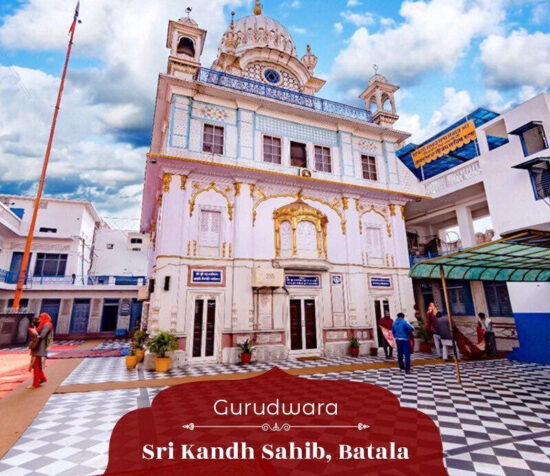
While the marriage party waited, Guru Sahib sat beside an old mud wall, sodden from the rains and leaning dangerously. An elderly woman, fearing for him, urged him to move. His reply, as the sangat recounts it, was that the wall would not fall, and would stand through the ages. It has. A portion of it is preserved and venerated at Gurdwara Kandh Sahib (kandh is simply Punjabi for wall).
Dera Sahib: Four Rounds Around the Word
A short walk away, Gurdwara Dera Sahib marks the site of Bhai Mool Chand’s house, where the marriage was solemnised. The custom of the day called for seven pheras (rounds) around the sacred fire, with Agni as witness. Sikh tradition holds that Guru Sahib declined them, for he did not accept fire as his ishta (the chosen object of one’s worship). Instead he, it is widely believed wrote, the Mool Mantar, the verse with which Sri Guru Granth Sahib opens, in his own hand. He placed it on a low chaunki and, with Mata Sulakhni Ji, walked around it four times. Seven became four, and the fire gave way to the Word, the eternal Shabd.
Sikhs do not read this as a sudden departure. They read it as one more expression of a conviction Guru Sahib had held since boyhood. At Talwandi, as a child, he had declined the janeu (sacred thread) that the family purohit, Pandit Hardyal, came to invest him with. Tradition links that moment to his salok in Asa di Var, which asks instead for a thread of the soul: compassion for its cotton, contentment for its yarn, continence for its knot and truth for its twist (Daia kapah santokh soot, jat gandhi sat vatt, Ang 471). From a thread declined at Talwandi to a fire declined at Batala, the line runs straight.

Two Sons, One Successor
Two sons were born: Baba Sri Chand Ji in 1494 and Baba Lakhmi Das Ji in 1497. Baba Sri Chand Ji took the path of renunciation and is revered as the founder of the Udasi order. Baba Lakhmi Das Ji remained a householder, and through him the Bedi lineage of the Guru’s family continued. When the time came, Guru Nanak Dev Ji bestowed the Guruship on Bhai Lehna, who became Guru Angad Dev Ji. In the Sikh understanding, the Guruship is a light conferred by the Guru’s choice, not an inheritance received by birth.
A Faith That Keeps House
Why should a wedding matter so much to a faith? Because Guru Nanak Dev Ji did not step away from the world; he walked through it. He married and raised a family, kept the modikhana (the state granary) at Sultanpur Lodhi, and travelled for years across the subcontinent and beyond on his udasis (the long journeys of his middle years). In his last years he tilled the land at Kartarpur on the Ravi. His teaching is often summed up in three instructions, kirat karo, naam japo, vand chhako: work honestly, remember the Name, share what you have. On women, a page or two further on in Asa di Var, he spoke without hedging: So kio manda aakhiai, jit jameh rajan, why call her inferior, from whom kings are born? (Ang 473).
Ek Jot, Dui Moorti: The Third Nanak’s Definition
Batala gave the Sikh marriage its precedent. Its definition came later, from the third Nanak, Sri Guru Amar Das Ji (Guru from 1552 to 1574), in his Var in Raag Suhi:
ਮਃ ੩ ॥
ਧਨ ਪਿਰੁ ਏਹਿ ਨ ਆਖੀਅਨਿ ਬਹਨਿ ਇਕਠੇ ਹੋਇ ॥
ਏਕ ਜੋਤਿ ਦੁਇ ਮੂਰਤੀ ਧਨ ਪਿਰੁ ਕਹੀਐ ਸੋਇ ॥੩॥
Dhan pir eh na aakhian bahan ikathe hoe.
Ek jot dui moorti dhan pir kahiai soe.
They are not called husband and wife who merely sit together; they alone are husband and wife who are one light in two bodies. (Ang 788)
Jot is the divine light within; moorti is the embodied form. The verse does not ask either partner to dissolve into the other. It asks that two persons, each remaining whole, be lit by one light: a shared faith, a shared conscience, a shared household. Nor is there any hierarchy in the verse. Neither owns the other; both carry the same light.
Much of Gurbani uses marriage as metaphor, with the soul as bride and the Divine as husband, and the Laavan themselves trace the soul’s journey to that union. Those verses are rightly read allegorically. This salok, however, means what it says, and the third Nanak’s own usage one Ang earlier makes that plainer still.
In the same Var, at Ang 787, he turns the same phrase against sati: Satiaa eh na aakhian jo marhiaa lag jalannih, they are not to be called satis who burn on their husbands’ pyres. The salok that follows adds that they, too, are satis who live in modesty and contentment. In both places, eh na aakhian, “they are not called”, first sets aside what does not deserve the name and then names what does. The Guru who refused to honour the widow’s pyre is here describing the living household. Whatever further layers a reader may find in the verse, that is its first meaning.
It is from Guru Amar Das Ji’s Anand Sahib, whose stanzas close every Sikh wedding to this day, that the Anand Karaj is commonly said to take its name.
From Four Rounds to Four Laavan
The fourth Nanak, Sri Guru Ram Das Ji, composed the four Laavan in Raag Suhi (Ang 773–774). These are the hymns now sung at every Anand Karaj as the couple walks four times around Sri Guru Granth Sahib. Tradition holds that the fifth Nanak, Sri Guru Arjan Dev Ji, was the first to be married with their recitation, when he wed Mata Ganga Ji at her village of Mau, near Phillaur.
Mark the sequence. The Laavan were being sung before there was a Granth to walk around, for the Adi Granth was compiled by Guru Arjan Dev Ji himself and installed at Sri Harmandir Sahib only in 1604. In the sangat’s telling, the four rounds around the Mool Mantar at Batala and the four Laavan sung at Mau belong to one continuous line, a continuum. That line runs to the four rounds around Sri Guru Granth Sahib at every Sikh wedding today, a rite the law itself recognised in the Anand Marriage Act of 1909.
What Still Stands
Consider the two things Batala celebrates. A mud wall that everyone expected to collapse did not. And a household founded that season by Guru Nanak Dev Ji, who never treated family life as a detour from the spiritual path, became the pattern for a faith that sanctifies the grihasth. The third Nanak would put that pattern into words, and the fourth would set it to song.
A household is also a wall of sorts. It stands not because of what it is made of, but because of what it is built around. At Batala, the sangat believes, it was built around the Mool Mantar. Five hundred and thirty-nine years on, both are still standing.
Share The KBS Chronicle