
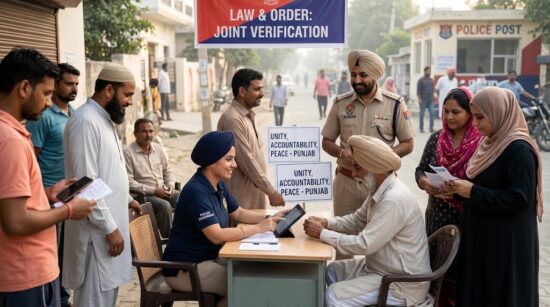
Punjab is facing challenges that cannot be ignored any longer. The state is already struggling with unemployment, drug abuse, mounting public debt, the distress of farming families, youth migration and a growing crisis of public confidence in governance. Against this difficult background, recurring disputes involving migrant workers, questions about identity verification, allegations of unlawful activities and tensions between local residents and newcomers must be handled with urgency, fairness and responsibility. If these problems are neglected or exploited for political purposes, isolated incidents could develop into a wider crisis that Punjab can ill afford.
The central concern is not migration itself. Punjab has a long history of welcoming people who come to earn an honest living, and migrant workers contribute to agriculture, construction, industry, transport, markets and numerous other sectors. Many are hardworking families who live peacefully, support local businesses and have no involvement in criminal activity. They must not be branded as criminals simply because they come from another state. However, welcoming people and ensuring proper verification are not contradictory responsibilities. A government that protects migrants must also protect the safety, rights and confidence of the communities in which they live.
The real question is whether the authorities have established a consistent, transparent and accountable system to verify identities, record employment and residential arrangements where legally required, investigate criminal complaints and prevent disputes from turning into street confrontations. When residents believe that complaints are ignored, when employers and contractors escape responsibility, or when police action appears inconsistent, mistrust can grow. Rumours spread quickly, political rhetoric intensifies and an ordinary dispute can become a larger confrontation. These risks demand professional policing and administrative action before tensions escalate.
Punjab cannot afford another front of instability
Punjab has already paid a heavy price for prolonged social and political instability. Its young people continue to look abroad for employment and opportunities, while many families worry about drugs, law and order, agricultural incomes and the future of the next generation. If neighbourhoods and workplaces become places of recurring confrontation, the consequences could extend beyond immediate violence. Businesses may suffer, workers may become vulnerable to exploitation, public confidence may decline and communities that have lived together peacefully may begin to view one another with suspicion.
The expression that Punjab could become a “war field” should therefore be understood as a warning about the possible consequences of administrative failure, not as a call to hostility against any community. Punjab does not need another conflict between people who share its roads, markets, workplaces and villages. It needs a government capable of maintaining the rule of law without discrimination.
Timeline: How a verification failure can become a wider crisis
Stage 1 — Migration and settlement: Workers arrive in Punjab in search of employment and settle in towns, industrial areas, construction sites and villages. Migration is a normal economic reality, but authorities and employers must ensure that applicable registration, identification and labour requirements are followed.
Stage 2 — Gaps in verification and accountability: Where legally required checks are not conducted, records are incomplete, or landlords, contractors and employers fail to fulfil their obligations, authorities may face difficulties establishing identities and tracing individuals during investigations. The scale of any such gap must be established through official records rather than rumours or assumptions.
Stage 3 — A local dispute or criminal incident: A disagreement, assault, theft or another alleged offence can trigger public concern. At this stage, the police must identify the individuals involved, collect evidence and act according to law. The alleged conduct of one person must never be treated as proof of wrongdoing by an entire migrant community.
Stage 4 — Rumours and public anger: Unverified messages, inflammatory videos and politically motivated claims can transform a local incident into a broader controversy. Social media can spread allegations faster than investigators can establish the facts. Timely police statements and reliable public information are essential to prevent misinformation from taking hold.
Stage 5 — Confrontation and retaliation: If tensions are allowed to escalate, threats, intimidation, group confrontations or retaliatory violence may follow. Both local residents and innocent migrant families can become victims. Police must intervene impartially, protect vulnerable people and prosecute proven offences through due process.
Stage 6 — Political exploitation: Political groups may attempt to use public anxiety to mobilise support, shift blame or target rivals. Leaders across parties must resist collective accusations and disclose verifiable evidence when making serious allegations. Public safety should not become a tool for electoral polarisation.
Stage 7 — Long-term damage to Punjab: If the administration fails to respond consistently, distrust can become entrenched. The resulting harm may affect investment, employment, social relations and confidence in public institutions. Once communities lose faith in one another and in the authorities, restoring that confidence becomes much harder.
Stage 8 — Prevention and accountability: The government must establish a clear verification framework consistent with the law, strengthen local policing, investigate specific complaints promptly and hold responsible employers, contractors or property owners accountable where legal duties have been breached. Regular public reporting can help distinguish genuine security problems from exaggerated claims.
What must the Punjab government do?
First, the Punjab government should publish clear instructions on lawful identity verification and any applicable registration requirements for workers, tenants and employers. Procedures must be uniform, transparent and non-discriminatory. No individual should face harassment merely because of their language, appearance, state of origin or occupation.
Second, police and district administrations should identify areas experiencing repeated, documented incidents and respond through evidence-based policing. Complaints should be registered and investigated according to law, and reliable information about arrests, charges and court outcomes should be communicated without compromising investigations or personal privacy.
Third, employers, contractors and property owners must understand their actual legal obligations. Where verification, record-keeping or reporting duties apply, deliberate non-compliance should carry appropriate consequences. The responsibility for maintaining lawful employment and residential records cannot simply be shifted onto workers or left entirely to informal arrangements.
Fourth, the government should create accessible channels through which local residents and migrant workers can report threats, exploitation, wage disputes and suspected criminal activity. Workers who face intimidation must also have access to protection. Effective security requires cooperation from the public, not fear among innocent people.
Finally, political leaders must exercise restraint. No party should encourage vigilantism, collective punishment or hostility against people from other states. Equally, authorities must not dismiss legitimate public-safety concerns as prejudice without examining the facts. The proper response to a genuine complaint is an investigation, not denial; the proper response to an unsubstantiated allegation is verification, not mob action.
The responsibility of Punjab’s leadership
The question is no longer whether Punjab can afford administrative complacency. It cannot. The question is whether its political leadership will address public-safety concerns before they become a wider social and law-and-order crisis. A responsible government must provide evidence of effective policing, transparent procedures and equal protection under the law—not merely statements after an incident has occurred.
Punjab’s people have every right to demand secure neighbourhoods, accountable institutions and a government that knows who is responsible for maintaining lawful employment and residential arrangements. Migrant workers, in turn, have the right to dignity, fair treatment and protection from collective blame. These principles are not in conflict. They are the foundation of a stable society.
Punjab must not be allowed to become a battlefield of suspicion, political opportunism and communal hostility. The state has already endured too many difficult chapters to permit preventable tensions to deepen its wounds. Verification must be lawful, policing must be impartial, employers must be accountable and criminal allegations must be decided on evidence.
The warning is clear: when administration fails, mistrust fills the vacuum. If the Punjab government wants to protect the state’s remaining social stability, it must act early, publish facts, enforce the law fairly and ensure that neither local residents nor migrant workers are abandoned to fear, rumours or political manipulation.
Punjab needs the rule of law—not a war between communities.
Editorial note: This is a policy analysis of potential risks and preventive measures, not a claim that migrants as a group are responsible for crime or that a state-wide conflict has been established. Specific incidents, official figures and allegations should be independently verified before publication.