
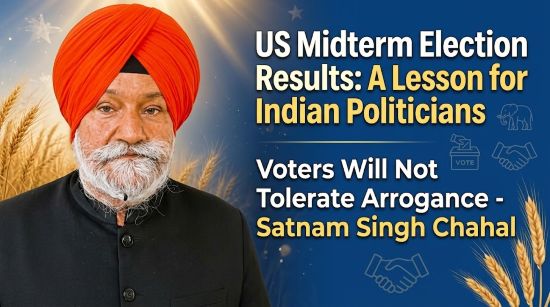
 By Satnam Singh Chahal | Political Analysis-The results of the November 3, 2026, United States midterm elections have delivered an important political message to ruling parties across the world, particularly in India. The election has demonstrated that political power is never permanent and that voters cannot be taken for granted. A party may win an election with a strong mandate, make promises and enjoy public support, but that does not give its leaders the right to govern without accountability. The American election has once again highlighted a fundamental democratic principle: people give politicians the opportunity to serve them, not the authority to treat them with arrogance.
The outcome has been particularly significant for President Donald Trump’s Republican Party, as Democrats made substantial gains and secured control of both chambers of the US Congress. The results reflected growing dissatisfaction among sections of the electorate over the country’s economic conditions, inflation, the cost of living and the direction of government policies. The election also demonstrated that voters can change their political preferences when they feel that their concerns are not receiving adequate attention.
One of the biggest lessons for Indian politicians is that electoral victories should never be interpreted as permanent public loyalty. Political parties sometimes begin to believe that once people have voted for them, those voters will continue to support them regardless of the government’s performance. This attitude can gradually create a disconnect between elected representatives and ordinary citizens. Leaders become surrounded by political loyalists, advisers and officials who may hesitate to communicate the actual mood of the public. As a result, genuine problems remain unresolved while political leaders continue to believe that everything is going well.
There is a fundamental difference between political authority and political arrogance. Authority comes from the democratic mandate given by voters, whereas arrogance develops when those in power begin to believe that nobody has the right to question their decisions. When elected representatives become inaccessible, when government offices fail to respond to public complaints, when peaceful protesters are treated as enemies and when opposition leaders are dismissed without addressing their concerns, dissatisfaction begins to grow. Such behaviour can gradually weaken the relationship between a government and the people who elected it.
The American election also carries an important economic message. Ordinary citizens judge governments not merely by speeches, slogans and political advertisements but by the conditions in which they live. Inflation, unemployment, housing expenses, healthcare costs and the affordability of essential goods directly affect household budgets. People want employment opportunities, economic security and better public services. Governments cannot expect voters to remain satisfied simply by announcing welfare schemes or highlighting achievements if people continue to struggle with their everyday problems.
This lesson is particularly relevant to India, where political parties frequently depend on electoral promises, regional loyalties, caste equations, religious sentiments and personal popularity to secure votes. These factors may influence political choices, but they cannot permanently replace good governance. Voters may support a party because they believe it offers a better future, but they also have the right to reconsider their decision when promises remain unfulfilled or when elected representatives fail to respect public expectations. No political party should assume that its traditional support base will remain loyal forever.
Another important message concerns the treatment of opposition parties. A strong opposition is an essential part of democracy because it represents citizens who may disagree with government policies. Opposition leaders have the constitutional and democratic responsibility to question the government, highlight shortcomings and demand explanations. Disagreement should not automatically be treated as an attempt to destabilise the country. In a healthy democracy, criticism should be answered through facts, transparency and performance rather than personal attacks, intimidation or administrative pressure.
The same message applies to Punjab. Political parties in the state have repeatedly sought public support by promising improvements in employment, agriculture, education, healthcare, law and order, infrastructure and the fight against drugs. However, people ultimately expect measurable results rather than political announcements. A government must be prepared to explain what it has achieved, which promises remain incomplete and why certain problems continue. Farmers, employees, students, business communities and ordinary residents have every right to ask questions and demand accountability from their elected representatives.
Punjab’s political leadership should also understand that public patience must not be mistaken for public satisfaction. People may wait for improvements, give governments time and even overlook certain shortcomings, but that does not mean they have surrendered their democratic right to question those in power. A government that listens to citizens, respects criticism and remains accessible can maintain public confidence through its work. On the other hand, a growing distance between political leaders and ordinary people can create dissatisfaction that eventually becomes visible at the ballot box.
However, the American election should not be interpreted as an unconditional endorsement of every policy of the victorious Democratic Party. Elections involve several issues, and voters make decisions for different reasons. The incoming political leadership will also have to demonstrate its ability to deliver results and remain accountable. The larger democratic lesson is that the same electorate that gives a party power also has the authority to question its performance and change its political choice.
Political leaders across India should therefore carefully examine the message emerging from the United States. A strong majority, a powerful political organisation, financial resources and control over government institutions cannot guarantee permanent public support. The real strength of a political party lies in its relationship with ordinary citizens, its respect for democratic institutions and its willingness to listen to criticism.
Ultimately, the American midterm election results remind every ruling party that voters are not the property of politicians. They are the owners of their democratic rights and the ultimate source of political authority. An election victory is not a licence for arrogance, neglect or misuse of power. It is a responsibility to serve the people with honesty, humility and accountability.
The message for Indian politicians is simple: people may give you their votes to govern, but they will never give up their right to question you. A government that forgets this fundamental truth risks discovering its mistake when voters return to the ballot box.