
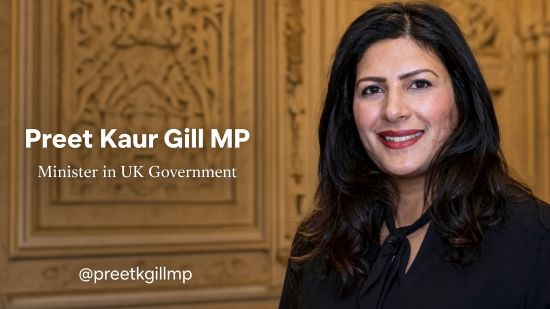
 Birmingham: Labour MP for Birmingham Edgbaston Preet Kaur Gill has welcomed the Government’s decision to bring bus services across the West Midlands under local public control, describing the move as an important step towards creating a more reliable, affordable and community-focused transport network.
The Government and West Midlands Mayor Richard Parker have announced plans to intervene in the region’s bus network following concerns about the future of services after National Express’s parent company indicated its intention to leave the market. The intervention is expected to safeguard up to 750 bus services a day across Birmingham and the wider West Midlands, while protecting around 4,800 jobs.
For thousands of residents, buses are not simply a means of transport but an essential connection to employment, education, healthcare and family life. Gill said protecting the network would help ensure that people could continue to reach work, schools, medical appointments and other essential destinations.
Welcoming the announcement, Gill said the development was “great news for commuters across Birmingham Edgbaston” and welcomed what she described as decisive action to protect the local bus network. She argued that reliable and affordable public transport was essential for connecting people with opportunities and supporting the local economy.
Gill has been a long-standing campaigner for greater public control of bus services. In Parliament, she has repeatedly highlighted the decline of bus provision in the West Midlands and the impact of route reductions and cancellations on communities. In a 2025 parliamentary debate, she said she had witnessed the decline of bus services first-hand and argued that local communities should have greater influence over routes and services.
The MP has also drawn on her personal connection with the bus network. Speaking in Parliament, she noted that she is the daughter of a bus driver, grew up in Birmingham and still relies on the No. 11 route. She has previously campaigned for improvements to services including the X21 in Bartley Green and for the restoration of the 48 route, reflecting her constituency-level focus on bus connectivity.
Under the proposed arrangements, greater powers will be placed in the hands of local leaders to determine routes, fares and service standards. Gill said this would allow the West Midlands Mayor to exercise greater oversight and help ensure that decisions about bus services reflect the needs of local communities rather than being determined primarily by commercial considerations.
The move is part of a wider Labour policy to give local authorities and combined authorities greater powers over bus networks. Gill has argued that the previous deregulated model left communities with too little democratic control over routes and contributed to the reduction of services. She has pointed to Greater Manchester’s Bee Network as an example of how greater local control could reshape bus provision.
The scale of the challenge in the West Midlands has been significant. Gill told Parliament in 2024 that the total length of bus routes in the region had fallen by more than 30% since 2010. She argued that declining services particularly affect people who do not have access to cars and those who depend on public transport to reach employment, education and public services.
Gill has therefore portrayed the transition to public control not simply as a change in ownership or administration, but as an opportunity to redesign the network around passengers. Her stated priorities include more dependable services, better connectivity, affordable fares and routes that respond to the needs of communities.
The announcement also comes at a sensitive moment for the West Midlands bus industry, with uncertainty surrounding the future of services following the planned market changes involving National Express. The Government and regional authorities say the intervention is intended to provide stability while protecting passengers and employees.
For Birmingham Edgbaston, where Gill has repeatedly raised concerns about bus cuts and route changes, the development represents a significant political and transport milestone. She has welcomed the decision as evidence that local communities can have a stronger voice over a service on which many residents depend every day.
The wider test, however, will be whether public control translates into better buses on the ground—more frequent services, affordable fares, fewer cancellations and routes that actually serve the communities that need them. For passengers, public control will ultimately be judged not by policy announcements but by whether the bus arrives on time, reaches the right destination and remains affordable.
For Preet Kaur Gill, the message is clear: the West Midlands bus network should serve the public interest, a