
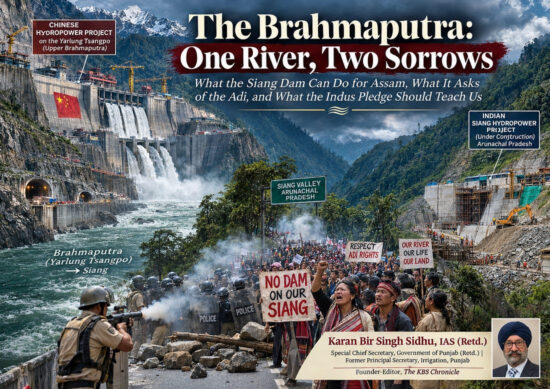
Every schoolchild in the North-East knows the Brahmaputra as the sorrow of Assam. There is now a second sorrow on the same river. The Adi of the Siang valley call her Ane Siang, Mother Siang, and on 2 November they shut down three districts for 36 hours to keep a dam off her. Upper Siang lost its mobile internet. The same day, Chief Minister Pema Khandu wrote to his “Adi brothers and sisters” that nothing has been decided.
In August I wrote in these pages on the 100 BCM (billion cubic metres; about 81 MAF, or million acre-feet) question, and urged that the Siang Upper Multipurpose Project (SUMP) be treated as time-critical. I stand by the strategic worry. But I passed too quickly over plainer questions. What does this dam do, for whom, and at whose expense?
If China Takes the Water, Does Assam Keep Its Fields?
One hears it said, and the Assam Chief Minister has himself suggested, that if Beijing draws water away upstream, Assam’s floods may ease. Only a small part of that holds.
Assam’s flood is manufactured south of the Himalaya. Nuxia in Tibet receives about 405 mm in the monsoon; Pasighat, on the plains, about 4,500 mm in the year. The river runs at 2,000 to 3,000 cumecs (cubic metres per second; about 70,000 to 1.06 lakh cusecs) near the border and at 15,000 to 20,000 cumecs (about 5.3 lakh to 7.1 lakh cusecs) at Guwahati in the monsoon, and almost all of that increase rises on our side of the line. Take away Tibet’s share altogether, and the Subansiri, the Lohit, the Dibang and the Manas would still arrive on schedule.
What China can take is the winter river, when snowmelt and baseflow from the plateau count for most. Mr Khandu says nearly 65 per cent of the Siang’s water originates in China; I wrote in August of 22 to 35 per cent of the Brahmaputra’s total discharge. One measures the Siang, the other the whole river below it.
So a diversion would leave Assam the same August and a poorer January. On present evidence Medog remains a run-of-the-river scheme. Its live storage is now reported at about 5.5 BCM (about 4.5 MAF), though I have seen no disclosure from Beijing to confirm it.
A Bucket Is Only as Good as Its Emptiness
The proposal is for 11,200 MW and about 9.2 BCM of live storage (about 7.5 MAF), or roughly one and a half Bhakras at today’s live capacity. That sounds immense until it is set against the river. At Pandu, near Guwahati, the Assam government records an average annual discharge of about 20,000 cumecs (about 7.1 lakh cusecs). At that rate 9.2 BCM (7.5 MAF) passes in about five days. At the record 72,779 cumecs (about 25.7 lakh cusecs) of August 1962, it passes in some 35 hours.
The dam also sits on one river. It can clip the Siang’s share of a flood peak; it cannot touch a cloudburst over the Subansiri or the Lohit. The honest phrase is flood moderation for part of the valley. How many centimetres it would take off the peak at Dibrugarh or Guwahati is the first number any Assamese should ask for, and I have not found it published.
Now take the sudden release from Tibet, the project’s stated reason for existing. A reservoir absorbs a surge only with the space kept empty. Reuters reported a proposal to hold some 30 per cent of the reservoir permanently free. If that is 30 per cent of 9.2 BCM (7.5 MAF), the cushion is 2.76 BCM (2.2 MAF), almost exactly half the 5.5 BCM (4.5 MAF) reported for Medog. Fuller protection means sitting at minimum drawdown, under half the dam’s height, and a dam at minimum drawdown sells far less power.
The engineer of power wants the reservoir full; the engineer of floods wants it empty. Punjab learnt in the 2025 monsoon, with Bhakra, Pong and Ranjit Sagar all standing, what happens when that quarrel is settled by default.
The mountains add a third party. This is Seismic Zone V, the country of the great earthquake of 15 August 1950. In October 2023, a glacial lake outburst destroyed the Teesta III dam in Sikkim.
Multipurpose, Minus a Purpose
In the vocabulary of my own State, a multipurpose project meant canals. Punjab remembers Bhakra for its wheat before its megawatts. On the Siang the reported purposes are power (about 47 billion units a year), flood moderation and a lean-season flow, at an indicative cost of ₹1.13 lakh crore to ₹1.5 lakh crore. Explainers say the project will “improve irrigation”. I have looked for a command area, a canal alignment or a hectare figure from NHPC (the National Hydroelectric Power Corporation) or from either State, and found none.
Assam’s farmer needs precisely what nobody has offered him. Some 31.05 lakh hectares, about two-fifths of the State, are flood-prone. In an Assam Agricultural University study of 2009, only about 1.24 million of 2.83 million hectares of net sown area carried a second crop, so more than half stayed with one. That study put irrigated area at 15.78 per cent on paper and under 10 per cent in practice. Cropping intensity was still about 147 per cent in 2018-19, with rain-fed sali paddy anchoring the year.
The same field has too much water in August and too little in January. A dependable winter release could help, but only with lift points and a farm plan attached. It is not obvious Assam has even been asked. In September, former Assam Leader of Opposition Debabrata Saikia wrote to the President seeking an independent downstream assessment of peaks, sediment, erosion and dam-break inundation.
On the embankments that are Assam’s actual flood policy, and on the 4.27 lakh hectares lost to erosion since 1950, a dam in Arunachal offers little that I can see.
What Lies Beneath the Reservoir
Think of the dam as an insurance policy. The premium is paid in ancestral land by one community, the cover is claimed on behalf of another, and the schedule of exclusions has not been read out to either.
A March 2026 Shiv Nadar University study estimates that 27 villages could go under and 43 more be affected, though the figures are provisional because the site is unsettled among Parong, Dite Dime and Ugeng-Komkar. A forum of 72 downstream villages has separately sought talks. Arunachal has no Sixth Schedule council to speak for these people, so the voice is the Kebang, the Adi’s customary council.
On 20 August 2025 the Bogum Bokang Kebang assembled at Geku for the first time in some 25 years. It rejected the project and the survey, and gave conditional support to smaller tributary projects. I read that second clause as an opening, and I do not see that anyone in authority has walked through it.
The Adi are not of one mind, and some villages have signed agreements for the survey. Nor can anyone defend the violence at Pasighat in late October. But a family’s burial ground and terraced paddy are not replaced by a ₹2.5 lakh livelihood payment, which October reports said had not begun to flow in any case.
Nineteen Companies for a Study
Why has government failed to carry the people? Read the record in order. The Brahmaputra Board floated Siang reservoirs in 1982. The project became a National Project on 7 February 2008. In February 2014, campaigning at Pasighat, Narendra Modi spoke for smaller dams. On 26 September 2017 the Siang stages were consolidated into one giant. In December 2024 came the order for central forces, and by May 2025 the State police were counting 19 companies from Boleng to Geku.
Through all of this, the official line has been that only a pre-feasibility report is under way. I spent 37 years in government, and you do not send 19 companies to guard a question. People in the valley can count uniforms. A State that has called the Chinese dam a “water bomb” and its own a “strategic necessity” cannot expect to be believed when it calls the same work a mere study.
Three stories are in circulation, each told to a different audience. Delhi hears a counter to China, Assam hears flood relief, and the Adi hear compensation. No published document reconciles them, because no design, site or rule curve yet exists to publish. Meanwhile NHPC’s public relations contract has reportedly grown from ₹8.73 crore to about ₹10.91 crore. Influencers are a poor substitute for a Deputy Commissioner on a village path.
Mr Khandu’s letter deserves credit for its plain promise that decisions will come “only through open discussion and with your consent”. It should now be made to bear weight. Consent under the land acquisition law of 2013 was written chiefly for private and public-private acquisitions, and strategic projects can seek exemptions from public consultation. The promise needs a written definition: whose consent, given how, and recorded where.
Five Things That Need No Concrete
India cannot wait on this dam. China began work on 19 July 2025 and is reported to be aiming at 2033, while SUMP cannot yet finish a survey. The Lower Subansiri, a much smaller project, began in 2005 and was due in 2010, and ran on for years past that. Even with consent tomorrow, this insurance would not be in force on the day the risk arrives.
Stand down the guard. Pause drilling, thin out the central forces, and move the talks to Geku. Offences of violence should be tried; dissent should not.
Commission one independent basin study, with Assam and Arunachal Pradesh as joint clients, and publish it: the peak saved at Dibrugarh and Guwahati, dam-break inundation, sediment, and the smaller tributary alternatives the Kebang left open.
Define consent in writing, through the Kebang and the village, and not by memoranda collected one signature at a time.
Price the empty bucket. If 30 per cent of a reservoir is held empty for national security, the Union Exchequer should pay for that space as a defence cost, and not load it on the tariff. Publish the rule curve, give the Adi a share in the revenue, and attach an irrigation plan for Assam or drop the claim.
Build the warning system now. Gauges across Arunachal, satellite watch over the Great Bend, sirens and rehearsals in the valley, repair of Assam’s embankments, and the demand for data parity with Bangladesh.
The Indus Reads It Back to Us
The Union Jal Shakti Minister, C.R. Paatil, has pledged that not a single drop will go to Pakistan in the coming years, within a year and a half to two on one account. I have supported that direction, and I have drafted a Bill to give it statute. But the Siang should sober the timetable. A project with National Project status for over 18 years has not completed a pre-feasibility report, for want of a drill hole at Beging. What, then, of tunnels and storages on the Chenab, where one official has spoken of work starting no earlier than mid-2027 and taking at least five years?
The politics is already rhyming. The Chenab-Beas Link Tunnel at Koksar, which NHPC tendered and withdrew within days in May, has met boards in Lahaul forbidding surveys without the Gram Sabha’s leave. Lahaul’s tribals planned to raise it with the President during her October visit; Kullu and Manali are uneasy. “No Survey, No Dam” on the Siang and “No dams, no surveys” in Lahaul are one sentence, spoken at opposite ends of the Himalaya. The order of work the Siang now needs (study, consent, then the machine) is the order the Western Rivers still have time to adopt.
India is the upper riparian on the Indus and the lower on the Brahmaputra, and whatever we say on the first will be read back to us on the second. My draft Bill makes drinking water the first charge, and I have argued for a humanitarian floor for those downstream. That is the rule India should hold to on the Chenab, and the rule it must ask of Beijing.
Beijing will answer for its silence on the Yarlung Tsangpo. The silence on the Siang is ours.