
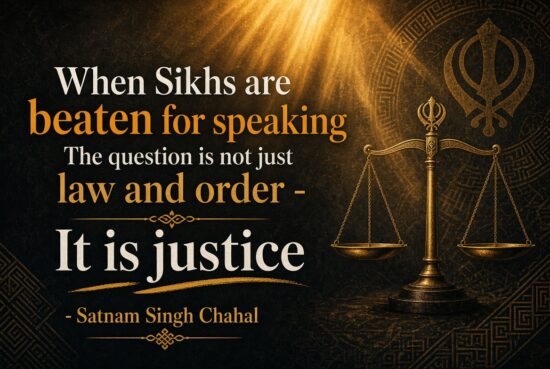
 The violent scenes in Ambala should not be dismissed as just another clash between protesters and police. The incident has reopened a much larger and uncomfortable question: Why do Sikh protesters, religious bodies and community representatives so often find themselves facing police force when they raise issues concerning Sikh dignity, justice and security? The latest confrontation took place in Ambala, where Sikh protesters had blocked the Delhi-Amritsar National Highway demanding action against Gursimran Singh Mand and the release of Sikh youths arrested in connection with an earlier confrontation. Haryana Police used tear gas and lathicharge to clear the highway after the blockade continued for several hours. Several protesters were injured, while at least six police personnel were also injured. The Haryana Sikh Gurdwara Management Committee leadership was caught in the confrontation, with its chief among those reportedly injured. The episode has therefore moved beyond a routine traffic blockade. A Sikh religious-management institution’s leadership was physically caught in a confrontation with the state machinery.
The Ambala flashpoint
The immediate background goes back to August 7, when Gursimran Singh Mand was allegedly assaulted near Gurdwara Panjokhra Sahib. Mand, his son and two policemen reportedly suffered injuries, while Mand’s vehicle was damaged. A case was registered on his complaint against unidentified persons.Sikh groups subsequently alleged that the sequence of events was different and demanded action against Mand and his son over allegations that a vehicle had struck devotees near the gurdwara. Protesters demanded the arrest of Mand and the release of Sikh youths who had been arrested in connection with the case.On August 13, the protest escalated dramatically. Police said protesters attacked police personnel and several policemen were injured. Protesters, meanwhile, faced tear gas and lathicharge as authorities attempted to reopen the highway.There is an important distinction here: the injuries to police officers must also be condemned unequivocally. A democratic protest cannot become an excuse for attacking policemen. But the same democratic principle demands that police force must remain proportionate, accountable and subject to scrutiny.
The larger timeline
October 2015 — Behbal Kalan and Kotkapura: The sacrilege controversy exploded into mass protests across Punjab. At Behbal Kalan, police firing killed two Sikh protesters. At Kotkapura, protesters were subjected to lathicharge, tear gas and water cannons. Years later, the demand for justice remains a powerful part of Sikh public memory.
2016 — The wounds remained open: The killing of Jasjit Singh Jammu during a protest became another symbol of the distrust that had developed between sections of the Sikh community and the police.
2023 — Punjab Police crackdown: The police action surrounding the Amritpal Singh episode generated widespread concern over civil liberties and the treatment of protesters and supporters. Whatever one’s political position on Amritpal Singh or the allegations against him, law enforcement cannot become a substitute for due process.
February 2026 — Mohali: Around 500 special-cadre teachers marched from Gurdwara Sri Amb Sahib towards Chandigarh over long-pending employment and service demands. Police used water cannons and lathicharge at the Chandigarh-Mohali border. Several teachers were injured, and protesters alleged that turbans were dislodged during the police action.
March 2026 — Sikh institutional tensions: A criminal case was registered against former Haryana Sikh Gurdwara Management Committee chief Baljit Singh Daduwal following a dispute involving current HSGMC chief Jagdish Singh Jhinda. The incident reflected continuing tensions within Sikh institutional politics and the involvement of law-enforcement agencies in such disputes.
July 2026 — Delhi: During protests in Delhi, protesters fleeing police action reached Gurdwara Bangla Sahib. Reports of police baton action against demonstrators again raised questions about the limits of force during protests and the special sensitivity surrounding Sikh religious institutions.
August 7, 2026 — Panjokhra Sahib: The confrontation involving Gursimran Singh Mand near the historic gurdwara became the immediate trigger for the Ambala crisis.
August 13, 2026 — Ambala: Sikh protesters blocked NH-44 demanding action against Mand and release of arrested Sikh youths. Tear gas and lathicharge followed. Police personnel and protesters were injured, including members of the HSGMC leadership.
August 14, 2026 — Akal Takht response: The issue reached the highest Sikh religious platform, with the officiating Jathedar of Akal Takht calling for the release of arrested Sikh youths and urging the Haryana government to respect Sikh sentiments.
Punjab can not say this is Haryana problem
Punjab governments of different political colours have repeatedly faced Sikh anger over police action, sacrilege cases, delayed justice and the handling of religious issues.That history matters because Punjab is not merely another state for Sikhs. It is the geographical and emotional centre of Sikh history, institutions and identity.When protesters at Behbal Kalan waited years for justice, when religious controversies remained unresolved, when teachers marching from a gurdwara faced water cannons and lathis, and when Sikh activists repeatedly complain about excessive police action, the cumulative effect becomes larger than any individual incident.It creates a dangerous perception: that a Sikh carrying a demand for justice is sometimes treated first as a law-and-order problem and only afterwards as a citizen.That perception must be confronted.
Outside Punjab ,The question becomes even more sensitive
Sikhs do not live only in Punjab. They are citizens throughout Haryana, Delhi, Uttar Pradesh, Rajasthan, Uttarakhand, Maharashtra and every other part of India. They are also a major global diaspora.Therefore, when a Sikh religious institution’s leader is injured in a police confrontation in Haryana, the incident immediately resonates far beyond Ambala.The issue is not whether every Sikh protest is automatically peaceful. It is not.The issue is whether every Sikh protest should automatically be viewed through the prism of extremism, separatism or security.That would be equally dangerous.A Sikh demanding justice is not automatically a separatist. A Sikh wearing a turban is not a security threat. A Sikh organisation raising a religious grievance is not automatically an anti-national organisation.Likewise, a police officer performing lawful duty is not automatically an enemy of the Sikh community.Both stereotypes must be rejected.
The two sided test of Democracy
The Ambala confrontation also presents a difficult but necessary test for the Sikh community.Blocking a national highway for several hours is not a minor act. It affects thousands of ordinary citizens, emergency services, commercial transport and commuters. Protesters have constitutional rights, but those rights do not provide unlimited permission to obstruct public infrastructure or assault police officers.At the same time, the state cannot respond to every difficult protest with batons and tear gas.The democratic formula is simple: Protesters must remain peaceful. Police must remain proportionate. Governments must remain accountable.When any one of these three principles collapses, democracy suffers.
The bigger danger -Normalising the baton
The most disturbing part of the Ambala episode is not simply that lathis were used. It is that society can gradually become accustomed to seeing them.First comes a protest. Then barricades. Then negotiations fail. Then tear gas. Then lathis. Then injuries. Then FIRs. Then political accusations. Then committees. Then promises of inquiry. And finally silence.That cycle has repeated too many times in Punjab and beyond.A democracy cannot survive if every grievance ends at a police barricade.
Sikh safety can not be a political sloagn
The Ambala incident should become an opportunity for a serious national conversation about Sikh safety, dignity and equal citizenship.The governments of Punjab, Haryana and the Centre must ensure that Sikh religious institutions and their representatives are treated with respect, while also ensuring that no individual or organisation is above the law.There should be an independent review of the Ambala confrontation, including the circumstances leading to the blockade, the arrests, injuries to protesters, injuries to police personnel, use of tear gas and lathicharge, and whether the force used was proportionate.CCTV footage, police body-camera footage if available, medical records and videos from the scene should be examined rather than allowing competing political narratives to become the only record of what happened.
The message from Ambala should not be Sikhs versus police
That would be the wrong conclusion.The real message should be: Sikhs are citizens. Police officers are citizens. Religious institutions deserve respect. Protesters must obey the law. Governments must answer legitimate grievances. And nobody neither the state nor the protester should be above accountability.The Ambala violence should not become another entry in a never-ending diary of confrontation.From Behbal Kalan to Kotkapura, from Punjab’s streets to Mohali, from Delhi to Bangla Sahib, and now from Panjokhra Sahib to NH-44 in Ambala, the timeline shows a recurring problem: grievances are allowed to build until confrontation becomes inevitable.That is not good governance. That is not community safety. And it is certainly not justice.Punjab and Haryana cannot afford another generation that believes the only language governments understand is the language of protest and the only answer governments have is the language of the lathi.The time has come to replace the baton with dialogue, confrontation with accountability and suspicion with equal citizenship.Because Sikhs should not have to choose between silence and the street merely to be heard.