
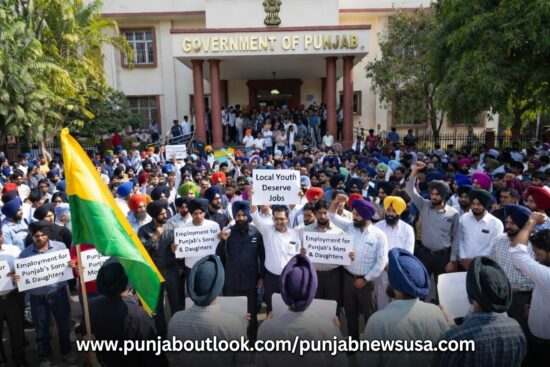
 Editor’s Note: This feature is the first in a special series examining Punjab’s changing economic, social, and political landscape. The purpose of the series is to encourage informed public discussion through fact-based reporting and balanced analysis. The views described in this article represent positions expressed by different stakeholders in the public debate. They should not be interpreted as advocating discrimination against citizens from any part of India. Sustainable solutions must uphold both the aspirations of Punjab’s youth and the constitutional values of equality and fairness.
Across Punjab, a new political and social debate is gathering momentum. Unemployed graduates, student organisations, employee unions, and sections of civil society are increasingly demanding that the Punjab Government give greater priority to residents in government recruitment. Their central argument is straightforward: Punjab’s taxpayers invest in the state’s institutions, yet many educated Punjabi youth remain unemployed or are forced to migrate abroad, even as they perceive increasing competition for public-sector jobs.
The issue is no longer confined to protests outside government offices. It has entered political speeches, legislative debates, social media campaigns, and public discussions across villages and cities. With the next Assembly election approaching, employment policy could become one of the defining issues of Punjab politics.Punjab has produced generations of highly educated young people. Universities and colleges continue to graduate engineers, teachers, nurses, agricultural experts, lawyers, and other professionals. Yet many struggle to find stable employment within the state.
The consequences are visible everywhere:
Record levels of migration overseas.Growing dependence on study visas.Increasing financial pressure on families funding foreign education.Rising frustration among unemployed graduates.
Repeated protests demanding recruitment to vacant government posts.Many families ask a difficult question: If Punjab cannot provide opportunities for its own educated youth, how can it retain its talent?
Supporters of greater local preference argue that Punjab should protect opportunities for young people who have lived, studied, and paid taxes in the state.
Their concerns include:
Large numbers of vacancies remaining unfilled for years.Delays in recruitment examinations.Intense competition for a limited number of government jobs.Continued migration of skilled Punjabi youth.The belief that public employment should contribute directly to Punjab’s social and economic development.For many protesters, the issue is less about excluding others and more about ensuring that Punjab’s own young people have a fair opportunity to build careers at home.
Punjab’s migration story is well known.Every year thousands of students leave for Canada, Australia, New Zealand, the United Kingdom, the United States, and Europe. Many families sell agricultural land, mortgage property, or take large loans to finance overseas education.Entire villages now have significant numbers of young people living abroad. While remittances support many households, the long-term loss of skilled workers has raised concerns about Punjab’s future workforce and economic vitality.Supporters of local employment policies argue that stronger opportunities within Punjab could reduce this outward migration.
Employment protection for local residents has become a recurring political issue.Leaders from different parties have, at different times, advocated stronger domicile requirements, Punjabi language qualifications where legally permissible, or higher levels of local recruitment.Although the proposals vary, the common political message is that unemployment among Punjab’s youth requires urgent attention.Whether these proposals can be implemented within India’s constitutional framework remains a separate legal question.
India’s Constitution guarantees equality before the law and equal opportunity in public employment.This means that broad restrictions excluding citizens from government jobs solely because they belong to another state may face constitutional challenges unless specifically authorized by law.At the same time, some states have introduced lawful requirements related to local language proficiency, residence for particular categories of employment, or special constitutional provisions applicable to those states.Any policy adopted by Punjab would therefore need to comply with constitutional principles and be capable of surviving judicial scrutiny.
Supporters of reform often point to examples where states have adopted measures intended to strengthen opportunities for local residents.Different states have experimented with varying approaches, including:
Local language requirements.Residence-based preferences where legally permitted.Incentives for industries employing local youth.Skill-development programmes tied to regional employment.Punjab’s policymakers are increasingly being asked whether similar models—or a version adapted to Punjab’s legal framework should be considered.
Industry groups emphasize another reality.Punjab’s economy has long depended on workers from many parts of India, especially in agriculture, construction, manufacturing, logistics, and services.Many employers argue that migrant workers have made significant contributions to the state’s development and that labour shortages could affect production and investment.They stress that the debate should distinguish between government recruitment and the broader labour market.
The demands voiced by many organizations generally include:
Filling long-pending government vacancies.Transparent and timely recruitment.Greater opportunities for qualified local youth.Expansion of skill-development programmes.Employment-oriented industrial policy.Fair and merit-based selection processes.These demands are often presented as part of a wider strategy to reduce unemployment and slow the migration of educated young Punjabis.
The discussion extends beyond election promises.It touches on questions of economic planning, demographic change, education, industrial growth, and the future of Punjab’s workforce.Whether or not a domicile policy is ultimately adopted, there is broad agreement that Punjab needs stronger job creation, improved investment, faster recruitment, and policies that encourage young people to build their futures within the state.
The debate over jobs for local residents reflects a larger challenge facing Punjab: retaining talent while creating enough opportunities for the next generation.Public frustration over unemployment is real. So too are the constitutional protections that apply across India. Any durable solution will need to balance the aspirations of Punjab’s youth, the requirements of the Constitution, and the needs of a modern economy.As political parties prepare for future elections, employment is likely to remain one of the most closely watched issues in the state. The decisions made in the coming years may shape not only Punjab’s labour market but also its social and economic future.
Disclaimer: This article and accompanying images are for informational and illustrative purposes only. Some visuals may be AI-generated or digitally enhanced and may not depict actual events or persons.Views expressed are based on publicly available information and analysis.