
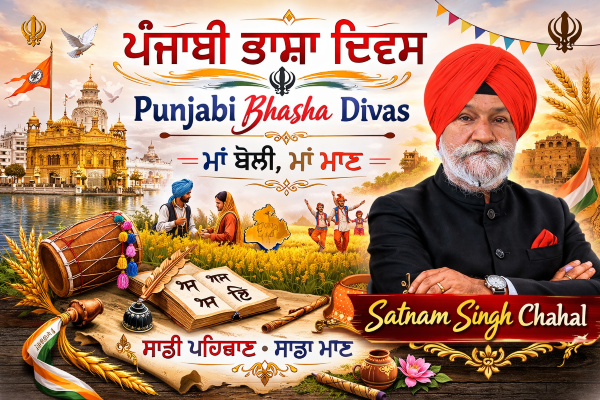
 Despite a 57-Year-Old Act Mandating Punjabi in Courts, Offices and Schools, the Language Is Being Systematically Ignored While Governments Celebrate Its Glory. Every February, on Punjabi Bhasha Diwas, politicians drape themselves in the colours of pride. Poets are felicitated. Resolutions are passed. Slogans ring out in packed auditoriums. And then, the next morning, government officers across Punjab return to their desks and continue writing their files, orders, and correspondence in Hindi or English. This is the great hypocrisy at the heart of Punjab’s relationship with its own mother tongue.
The Punjab Official Language Act, 1967, one of the most clearly worded pieces of legislation in the state’s history, declared Punjabi in Gurmukhi script as the sole official language of Punjab. Amended and strengthened in 2008, it went further, mandating that all civil and criminal courts, revenue tribunals, government offices, public sector undertakings, schools, colleges, and universities must conduct all official work exclusively in Punjabi. The 2008 amendment even established State and District Level Empowered Committees to enforce compliance, and the 2022 amendment introduced financial penalties and fines of up to ₹5,000 for officials found violating the Act.
On paper, it is a formidable legal fortress built around Punjabi. In practice, it is a monument to governmental neglect. Walk into any Deputy Commissioner’s office in Punjab today. Correspondence arrives in Hindi. Orders are issued in English. Court documents are drafted in languages that a common Punjabi farmer cannot read. The very officials sworn to uphold the law of the land are its most casual violators, and they face no consequences.
The State Level Empowered Committee, chaired by the Education Minister and mandated to meet every six months, has met so irregularly that most citizens have never heard of it. District Level Committees, required to convene every two months, exist largely on paper. The Director of Languages, Punjab, the officer empowered to inspect offices and recommend punishments, operates with little authority and even less political backing. Meanwhile, the numbers tell a devastating story. Linguists and demographic researchers tracking language use across South Asia have noted a consistent decline in the intergenerational transmission of Punjabi among urban families in Punjab itself. Young professionals in Chandigarh, Ludhiana, and Amritsar increasingly conduct their daily lives socially, professionally, and digitally in Hindi or English. Punjabi, in its own homeland, is becoming a ceremonial language: worn on special occasions and stored away the rest of the year.
The Punjabi diaspora abroad has, in many ways, shown more commitment to the language than the state that gave birth to it. In Canada, the United Kingdom, and Australia, Punjabi community organizations run language schools, produce literature, broadcast radio programs, and lobby governments for official recognition. Back home, children in elite private schools in Chandigarh are actively discouraged from speaking Punjabi in classrooms, as if fluency in the mother tongue were a mark of social inferiority. Organizations like NAPA and numerous Punjabi literary bodies the Sahit Sabhas, the Punjabi Sahitya Akademi have for decades raised alarms about this creeping erosion. Annual conferences are held. Memoranda are submitted to Chief Ministers. Demands are made for the Act to be implemented in letter and in spirit. The response from successive governments Congress, Akali-BJP, AAP has been uniformly ceremonial: warm words, no action.
The 2008 amendment to the Act was hailed as a watershed moment. It gave teeth to the law. It created enforcement machinery. It named names and assigned responsibilities. Fourteen years later, not a single senior official in Punjab is known to have faced meaningful disciplinary action under Section 8-D of the Act for failing to use Punjabi in official work.The question that must be asked loudly, and without apology, is this: Who is responsible? The failure is not merely bureaucratic it is political. No Chief Minister has made the implementation of the Punjab Official Language Act a genuine governance priority. No party has campaigned on it, enforced it, or held its own ministers and officers accountable for violating it. The Act exists to serve politicians as a rhetorical device on Punjabi Bhasha Diwas and for nothing else.
If Punjabi is to survive as a living, thriving language of administration, education, courts, and commerce in its own state, then celebration must give way to accountability. The Empowered Committees must meet. Inspections must happen. Fines must be levied. Officials who persist in using Hindi or English for official correspondence in Punjab must face real consequences under the law that already exists.A language does not die in a day. It dies in a thousand small surrenders each unsigned Punjabi file, each court order written in English, each school that teaches children to be ashamed of their tongue. Punjab is making those surrenders, one day at a time.