
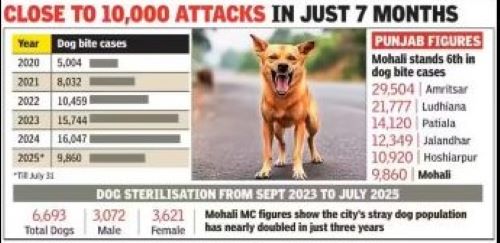
 Dog bite cases in Punjab have seen a threefold rise over the past five years. From 1.10 lakh cases in 2020, the state reported a staggering 3.34 lakh dog bite cases in 2025, the highest ever recorded in a single year. Till January this year, the state has logged 32,875 cases.
The latest data, presented by health officials during a two-day civil surgeon conference, revealed that Punjab reported nearly 915 dog bite cases every single day in 2025.
Year-Wise Rise in Dog Bite Cases
The data paints a clear and deeply concerning picture of a steadily worsening situation. The state recorded 1,10,472 cases in 2020, which rose to 1,26,842 in 2021. The year 2022 saw the state recording 1,65,133 cases, followed by 2,02,439 cases in 2023. In 2024, the state logged 2,13,521 cases, followed by 3,34,736 cases in 2025.
Canine Menace — Year-wise Dog Bite Data
Year Reported Cases
2020 1,10,472
2021 1,26,843
2022 1,65,133
2023 2,02,439
2024 2,13,521
2025 3,34,736
2026 (till January) 32,875
District-Wise Breakdown: Amritsar Worst Affected
According to the Punjab health department data, a copy of which is with Hindustan Times, Amritsar was the worst-affected district with 58,221 cases in 2025. Ludhiana was second with 41,086 cases, followed by Patiala with 26,194 cases.
Nature of Bites: Grade-2 and Grade-3 Cases
Health department officials said that 2.63 lakh cases were categorised as Grade-2 dog bites, while 58,270 cases were Grade-3.
A health department official said a Grade-2 dog bite involves contact of the dog’s teeth with the skin without laceration, resulting in marks, scrapes or minor bruising, and requires only anti-rabies vaccination (ARV).
Grade-3 bites involve one or multiple transdermal bites or contamination of mucous membranes with saliva and require administration of anti-rabies serum (ARS) along with vaccines.
The Challenge of Incomplete Vaccination
The officials rued the fact that despite free treatment available at all government health institutions, only 70% of the patients complete all four doses of ARV.
“Despite free treatment, people often do not complete the entire vaccination schedule. We have to repeatedly call victims and request them to come for their remaining doses.” — Dr Amandev Singh, Assistant Professor, Department of Community Medicine, Government Medical College, Patiala
Dr Amandev Singh added that nearly 80% of the dog bite cases involved stray dogs, highlighting the growing menace of bites in cities.
Health officials also said that the availability of anti-rabies vaccines has now been extended to Aam Aadmi Clinics across the state.
Stray Dog Menace: Children Under Attack
Kamal Anand, an RTI activist from Sangrur who recently filed a complaint with the chief minister over the stray dog problem, said dog bites have become a terrifying daily routine.
“Children in Sangrur are being attacked and bitten by stray dogs while authorities look the other way. The municipal council and the district administration are failing miserably in their duty. Our streets are no longer safe for our children.” — Kamal Anand, RTI Activist, Sangrur
Anand added that the animal birth control (ABC) programme has failed miserably in the state due to official apathy. He said the stray dog population has surged across cities and towns, people are vulnerable, and officials are turning a blind eye to the menace.
Absent SOPs and Gaps in the Health System
The Punjab health department is yet to issue standard operating procedures (SOPs) for the government doctors on whose diagnosis the compensation for dog bite cases would be fixed, as a senior health official noted.
A senior health official, requesting anonymity as he is not authorised to speak to the media, said from district hospitals to Aam Aadmi Clinics, anti-rabies vaccines are available at every level.
“People must visit the nearest health facility immediately after a dog bite. Rabies is 100% fatal, but it is completely preventable with timely treatment.” — Senior Health Official, Punjab
Conclusion
The data presented at the two-day civil surgeon conference is a stark reminder that the stray dog menace in Punjab is no longer a peripheral concern but a full-blown public health emergency. With 3,34,736 cases recorded in 2025 alone — nearly 915 every day — and with the animal birth control programme widely seen to have failed, the need for urgent, coordinated government action has never been more pressing.
Until the state government issues clear SOPs for doctors, scales up its ABC programme, ensures complete vaccination coverage for all bite victims, and holds local bodies accountable for managing stray dog populations, the numbers will only continue to rise.(Courtsey HT)