
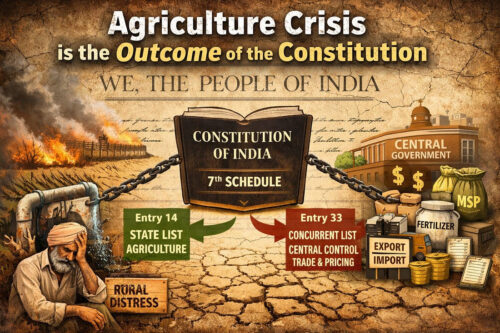
 Punjab’s agricultural crisis has moved far beyond the boundaries of farming. It is now financial, economic, environmental, social, and, most critically, psychological. Farm incomes have stagnated even as indebtedness rises. The rural economy is under severe strain. The recent tragic suicide of two farmer brothers near Kotkapura, driven by debt exceeding ₹50 lakh, is not an isolated incident; it is a grim reflection of a collapsing system.
Groundwater levels are falling at an alarming pace, in many areas turning unfit for drinking too. Soils are exhausted. Environmental degradation from stubble burning to chemical contamination has reached dangerous levels. Socially, agriculture is losing its centrality, with youth steadily moving away in search of uncertain livelihoods.
Yet the most decisive barrier is economic, which has now become deeply psychological. Punjab is trapped in a deep fear of change, shaped by decades of policy inconsistency, broken promises, and repeated betrayals by policymakers. The decades-long economic squeeze has been persistently highlighted by Bhupinder Singh Mann after his aggressive parliamentary interventions, by Sharad Joshi through his report of the Task Force on Agriculture, and in recent OECD analyses. This has led to a constant and unending trust deficit among farmers towards what is increasingly seen as an anti-farmer system.
Farmers are not unwilling to reform; they are unwilling to take risks in an unpredictable system. In such a setting, caution is not conservatism—it is survival. Punjab is not just trapped in a cropping pattern; it is trapped in a mindset shaped by decades of perceived deceit.
The Core Distortion: MSP, CACP and NFSA
At the heart of Punjab’s crisis lies the wheat–paddy cycle, sustained by a pricing regime that has fundamentally lost its balance. The Minimum Support Price system, recommended by the Commission for Agricultural Costs and Prices (CACP), is deeply shaped by the procurement compulsions of the National Food Security Act (NFSA).

The consequence is stark. Prices are no longer determined by cost, demand, or sustainability; they are determined by what the State needs to procure for food security. Wheat and rice receive assured procurement and policy-backed prices, while crops critical for diversification receive no comparable support.
This is not merely a distortion—it is a structural misalignment.
The result is a locked equilibrium: farmers continue with paddy not because it is optimal, but because it is the only economically predictable option, with free power driving tubewells that extract billions of litres of water each year, turning Punjab into a desert. MSP, conceived as a safety net, has become a policy signal gone wrong, often not even covering the basic cost of production. A legal MSP guarantee, without correcting this distortion, will not solve the crisis—it will institutionalise it and put a permanent stamp on the MSP determination system driven by CACP and NFSA.
State Subject, Central Control: A Constitutional Contradiction — Core to the Crisis
Punjab’s inability to reform agriculture in isolation is not accidental—it is constitutional. The crisis of agriculture is, in many ways, embedded in this structure.
Agriculture is a State subject under Entry 14, State List (Seventh Schedule). Yet, in practice, the State exercises limited control over the factors that determine agricultural viability. Input costs—fertilisers, seeds, diesel, and technology—are largely shaped by central policies and regulatory frameworks. Output prices are determined through the MSP regime, guided by the Commission for Agricultural Costs and Prices and procurement compulsions. Trade policy—including exports, imports, and stock limits—falls under Entry 33, Concurrent List (Seventh Schedule), giving the Union decisive control over market outcomes.
The result is a structural contradiction: States bear responsibility for agriculture, but the Centre shapes both price signals and market conditions.
So, in reality, how is agriculture a State subject?
This creates a structurally flawed system: States bear responsibility, while the Centre controls both inputs and outputs. The consequence is predictable—policy incoherence, conflicting incentives, and diffused accountability.
It is therefore unsurprising that Punjab’s own agricultural policy, under discussion for years, remains in limbo. Even when frameworks are proposed, they falter due to lack of alignment, funding clarity, and institutional backing.
In such a framework,
“any agricultural policy framed in isolation—whether by a State or by the Centre—is bound to fail.”
Agriculture in India is inherently federal and must be governed accordingly.