
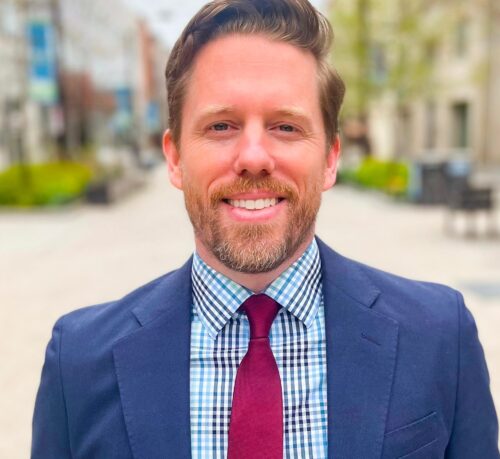
In the summer of 1999, less than a month after graduating high school, I started boot camp at the Recruit Training Command (RTC) just north of Chicago. I was 17 years old. On this side of a PhD in the social sciences, I can articulate the structural conditions of why I, as a minor, joined the armed forces: despite the neoliberal boom of the 1990s, life in working-class, postindustrial Ohio offered little in the way of opportunity, and the military, ever eager to capitalize on economic inequality, recruits heavily from high schools like mine. That’s not to say I didn’t go willingly. The military seemed to me to provide the easiest path towards seeing the world, attending college, and charting my own course in life. All told, that’s exactly what four years in the Navy allowed me to do—although my relationship to the military and to military service has evolved over time.
Today’s brief essay is the first sketch of a map of that evolving relationship to my identity as a veteran. My identity as a veteran is not something I hide but also not something I often foreground, partly because I was so young (I earned an honorable discharge before my 22nd birthday) and partly because its disclosure entangles me in an exhausting set of assumptions from both conservatives and liberals, and both veterans and non-veterans, that I’d rather avoid on all but the rarest of occasions. But not talking about this part of my experience, I now realize, does a disservice to myself, to my readers, and even to how I write about our current political moment. To address this significant gap in my own thinking, I will focus much of the week leading up to Memorial Day discussing the relationship between military service, immigration enforcement, and the often overlooked role of veterans in trying to protect the best parts of American democracy from the worst parts of American tyranny.
As Antonio Gramsci once wrote, our path toward political self-awareness is rooted in our ability to identify the traces of history that shape who we are—and I have endeavored to do that over the years, in my own private way.¹ My enlisted years straddled the terrorist attacks on September 11, 2001. I left the military in May 2003, the same month that President Bush declared “Mission Accomplished” on the deck of an aircraft carrier, just months after the U.S. began holding “enemy combatants” in the legal black hole of Guantánamo Bay, and shortly before the revelation of prisoner torture at Abu Ghraib. I was stationed at Roosevelt Roads, Puerto Rico, at the time, a base that shuttered shortly after I left and reopened just last year. I was a cop. Technically, I was what they called a 9545, a Navy Law Enforcement Specialist. My job for three years was to drive Harbor Security boats in the waters around the naval station and, for several weeks a year, around the eastern third of Vieques Island, home to what was then the Navy’s main East Coast bombing range for ships and pilots. It’s unavoidable that the confluence of these experiences at such a young age shaped how I’ve come to think about military power, foreign policy, and human rights.
I credit those years with cultivating a sense of discipline and responsibility, work ethic and personal ownership, a commitment to a collective mission over personal preference, and a deep respect for civil and military service that I still believe is one of the most sacred traditions of our country. Perhaps for these reasons, I never felt fully at home in the individualism (and some might say, narcissism) of both academia and political activism, and have always sought to build teams rather than work in isolation. At the same time, the military’s narrow focus on mission execution often negates truly non-militarist alternatives and reifies Realpolitik statecraft to the point that it is unable to question the underlying conditions of its own existence or the implicit value considerations embodied in the mission it is given. The military is all how and no why—and I knew my propensity for why questions would ultimately place limits on how long my tenure would last.
This is not to say that the military is homogeneous or monolithic. That’s a common mistake. There’s a tremendous amount of diversity of people and ideologies represented in our armed forces; that’s the beauty of it. It remains to this day one of the few places in American society where, say, a young white male is almost assured to take orders from a woman or a person of color (or both)—a phenomenon that is still rare in the business world. The military is home to a whole range of ideological positions on U.S. foreign policy, the Israel-Hamas war, the war on Iran, undocumented immigration, gay and trans rights, abortion, climate change—you name it. To this day, I probably have not been in a room more authentically diverse than the boot camp bunk room with 110 random kids from across America thrown together for three months of training. Whatever my critiques are of the U.S. military as an institution, I have never wavered in my respect for people who choose to serve, not only for their service, but also because so many of them take that experience with them into other parts of civil service in our federal, state, and local governments, our schools, and businesses and organizations.
After I left the military, I began a circuitous journey of reconciling military service to what came next. In the aftermath of the questionable wars in Afghanistan and Iraq and the growing anti-war movement among veterans, I increasingly found answers to my why-questions in a deeper understanding of the political economy of war, neocolonialism, and the interdependence of geopolitical conflict, economic inequality, and social inequities. As grateful as I am to the military for lessons I learned then, I credit a rigorous graduate program in geography at Ohio State University for cultivating a sensitivity to the complex relationships between spheres of life that are often kept analytically separate. It was here that I fell into the topic of immigration for precisely this reason: I quickly recognized in this topic the potential to explore questions that cut across every domain of society. Immigration is not a truly independent field of scholarly inquiry, and yet every social science has something important to say about immigration. Immigration is about class, race, gender, economics, history, culture, law, and politics.
It also follows that every border enforcement project and deportation scheme intersects with each of these domains, as well. Mass deportation is already having negative effects on key sectors of our economy; it affects people differently based on their identities; it resonates with some of the worst periods of human history; it’s upending our politics. To study immigration enforcement, therefore, is to encounter a cross-section of themes, people, and systems at moments of crisis and to develop an evolving set of tools (interviews, FOIA requests, data) that can translate these crises into new understandings, with the hope that these findings will inform how we build a more just society. I believe that protecting American democracy is more than just about serving on the front lines; protecting democracy is also about using the valuable tools of critical thinking and research to inform the national debate so we can avoid the polarizing effects of disinformation, bigotry, and extremism.
Despite my claim of sensitivity towards interconnection, one thing escaped my attention until the past year: the effects of immigration enforcement on active-duty military and veterans. Over the past year I have been alarmed to see the growing number of stories of service members, veterans, and their families who have been arrested, detained, and deported. I started a notebook just so I could follow the stories of veterans who were being deported and understand how and why it was possible for veterans to be targeted like this—even after being honorably discharged from military service. The short answer, which has taken me longer than it should have to absorb, is that the current administration’s targeting of veterans is an acceleration of a much older bipartisan failure. The legal architecture that makes a noncitizen veteran deportable for a decades-old conviction was built and left in place across multiple administrations of both parties, and successive Congresses have repeatedly declined to repair even its most obvious dysfunctions.
Military service is complicated, but when honestly entered into, it is a form of sacrifice that the country itself has long described as sacred, and the threshold for what is owed in return has to be correspondingly high. It ought to be completely inconceivable to anyone in this country, and especially to anyone whose politics purport to be pro-American, that any veteran be arrested, detained, or deported, irrespective of what they have done or who they are. Understanding how we prevent this from happening meant also learning about the organizations that have more expertise than I do in where the immigration system needs to be fixed.
I learned about the growing international network of organizations like Repatriate Our Patriots, the Deported Veterans Support House in Tijuana, and #AfghanEvac just to name a few. And I learned about coalitions of fellow veterans like the Chamberlain Network, which are as serious as I am about using our military experience to keep doing good for our country. I will share more of what I learned this week and host conversations with several of these organizations so you can learn along with me. Watch for another announcement shortly with details about upcoming conversations and ways you can get involved.
If you or someone you know is an active-duty service member or veteran who also cares about the impact of mass deportation on veterans and their families, please reach out and share this post with them. I’m eager to hear your stories and perspectives. And I want to be explicit: that invitation extends to veterans whose conclusions on these questions differ from mine. What I most want to understand is the actual range of veteran thinking on this issue, articulated by veterans themselves, rather than the version of it that tends to get ventriloquized by politicians and pundits who have never served.