
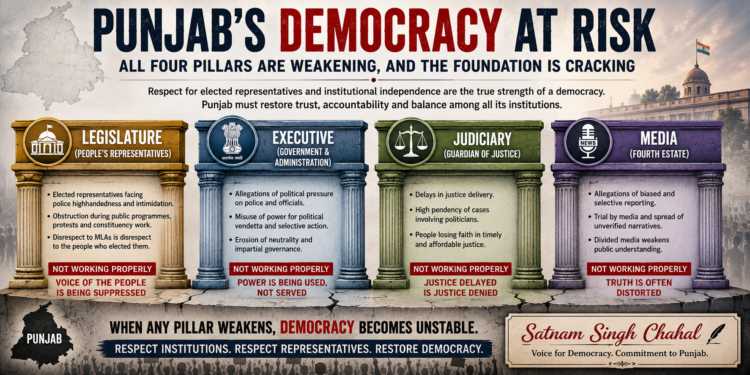
 The strength of any democracy depends upon the proper functioning of its four pillars: the legislature, executive, judiciary, and media. In a democratic system like India, elected representatives are chosen by the people to raise public issues, question the government, and protect citizens’ rights. However, when police officials or administrative officers allegedly mistreat elected representatives themselves, serious questions arise about the health of democracy and governance. Punjab, once considered politically vibrant and institutionally strong, has increasingly witnessed controversies where opposition leaders, MLAs, journalists, and even ruling party representatives have accused the police and administration of misuse of power, political pressure, or selective treatment. These incidents have created fear among ordinary citizens that if lawmakers themselves are not treated respectfully, common people may face even greater difficulties while seeking justice or administrative help.
The recent controversy involving Majitha constituency MLA Ganieve Kaur Majithia has once again sparked debate across Punjab regarding the conduct of police officials and the treatment of elected representatives. Majitha has remained one of Punjab’s politically sensitive constituencies for decades, represented earlier by senior Shiromani Akali Dal leader Bikram Singh Majithia and currently by Ganieve Kaur Majithia. Allegations that police officials misbehaved with or obstructed an elected MLA have raised concerns among many citizens who believe that democratic values are weakening in the state. Many political observers feel that elected representatives, regardless of party affiliation, deserve institutional respect because they represent the voice of thousands of voters from their constituencies.
Punjab politics over the last several years has witnessed repeated confrontations between opposition parties and police authorities. Different political parties, irrespective of ideology, have accused governments of using police machinery for political purposes. During protests, election nomination disputes, farmer agitations, and local body elections, there have been repeated allegations that police acted selectively or under political influence. Recent reports from Punjab’s civic election controversies showed opposition parties accusing the administration and officials of intimidating candidates and rejecting nominations under pressure. Such developments have increased political bitterness and weakened public confidence in neutral governance.
The Behbal Kalan firing incident of 2015 remains one of the most controversial examples in Punjab’s recent political history. Protesters demanding justice over sacrilege incidents clashed with police forces, resulting in police firing and civilian deaths. The incident created massive anger across Punjab, with opposition parties accusing the then government and police administration of suppressing democratic protests. Even years later, the matter continued to dominate Punjab politics because people believed accountability was delayed. This case became a symbol of how state power and policing can become deeply controversial when public emotions and political interests collide.
Between 2017 and 2021, Punjab continued witnessing allegations of political vendetta involving police and vigilance agencies. Whenever governments changed, leaders from opposition parties often claimed they were being selectively targeted through inquiries, summons, or legal cases. Political competition increasingly shifted from ideological debates to legal and administrative battles. Supporters of affected leaders alleged that governments were using police agencies to weaken opponents, while ruling parties defended these actions as anti-corruption drives or law enforcement measures. This growing perception of political policing damaged the image of institutional neutrality.
The period between 2021 and 2022 witnessed intensified controversy surrounding senior Akali leader Bikram Singh Majithia, who faced investigations and legal action in drug-related and disproportionate assets cases. His supporters described these actions as politically motivated, while opponents insisted that accountability was necessary. Regardless of political positions, the episode demonstrated how police investigations involving political figures quickly become highly polarized in Punjab. Every action by law enforcement agencies began to be viewed through a political lens rather than purely legal considerations.
During 2023, several former ministers and MLAs from opposition parties complained about repeated vigilance summons and police pressure. Former Congress MLA Kuldeep Singh Vaid was investigated in disproportionate assets cases, becoming another example of how former lawmakers increasingly found themselves under scrutiny by investigative agencies. Opposition parties argued that such investigations were selective, while governments maintained they were acting against corruption. This cycle of accusation and counter-accusation further deepened political divisions and public cynicism toward institutions.
The years 2025 and 2026 saw political tensions intensify further during municipal elections and local governance disputes across Punjab. Opposition parties accused officials in Majitha and other constituencies of attempting to reject nominations and misuse administrative authority. At the same time, even ruling party MLA Raman Arora publicly accused police officials of creating hurdles during a religious event, proving that friction between police and elected representatives was not limited only to opposition parties. These incidents strengthened concerns that institutional relationships in Punjab are becoming increasingly confrontational and politicized.
Such incidents damage public confidence in democratic governance. The police force in a democracy is expected to remain politically neutral and act according to law rather than political pressure. When accusations emerge that officers are insulting MLAs, blocking opposition leaders, or selectively acting against political rivals, it weakens democratic traditions. Elected representatives may belong to different political parties, but they carry the mandate of the people. Mistreatment of any MLA or MP is often viewed by supporters as disrespect toward the voters themselves, creating anger and mistrust among the public.
Another serious concern is the weakening trust in institutions. Citizens often feel that the legislature blames the executive, the executive blames political pressure, the judiciary faces delays in justice delivery, and the media itself is divided along political lines. Many people in Punjab now openly question whether all pillars of democracy are functioning independently or whether political influence has entered every institution. This growing distrust can become dangerous for society because democracy survives not only through elections but through public faith in fairness, accountability, and justice.
The role of the media is also under constant scrutiny in Punjab. Supporters of different parties accuse sections of the media of selective reporting and biased coverage. Some incidents involving police actions receive extensive attention while others remain ignored depending upon political affiliations. Social media has further intensified polarization because political narratives spread rapidly before facts are fully verified. As a result, many citizens are increasingly confused about whom to trust. This information war has added another layer of tension to Punjab’s already charged political environment.
Punjab has historically played a major role in defending democratic values, whether during the freedom struggle, the Emergency period, militancy years, or farmer movements. The people of Punjab have repeatedly shown courage in raising their voices against injustice and protecting civil liberties. Therefore, incidents involving alleged mistreatment of elected representatives, including the controversy surrounding Majitha MLA Ganieve Kaur Majithia, carry larger symbolic importance. These are not merely isolated political disputes; they represent broader concerns regarding accountability, institutional independence, and respect for democratic norms in modern Punjab.
A healthy democracy requires balance and mutual respect among institutions. Police officials must act professionally and without political bias. Politicians must avoid using police agencies for vendetta politics. The judiciary must ensure timely justice, and the media must report impartially and responsibly. Without these safeguards, public faith in democracy gradually weakens. Punjab today stands at a critical stage where restoring institutional credibility has become essential for maintaining social harmony, political stability, and democratic dignity. The future strength of democracy in Punjab will depend not only on elections but also on whether institutions regain the trust and respect of the people.
Referances from:en.wikipedia.org,timesofindia.indiatimes.com,