
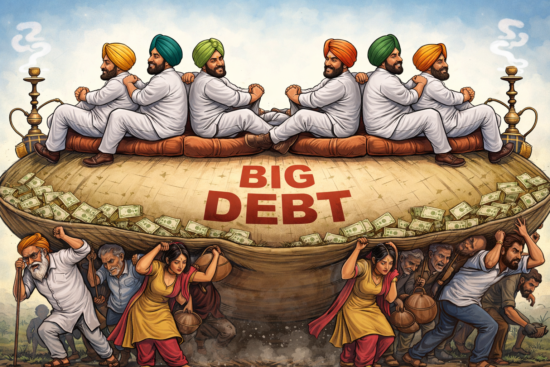
 Punjab today stands at a critical crossroads, burdened by mounting debt and economic strain, while questions are increasingly being raised about the priorities and accountability of its political leadership. The phrase “leaders scratching each other’s backs” has become a common sentiment among critics who argue that those in power appear more focused on internal political comfort and mutual support than on addressing the deep-rooted challenges facing the state.
Over the past few years, Punjab’s financial condition has worsened significantly. With a rising fiscal deficit and a growing dependence on loans, the state’s debt has reached alarming levels. Interest payments and loan repayments are consuming a substantial portion of the revenue, leaving limited resources for development, infrastructure, education, and healthcare. Despite this grim financial reality, there is a perception that the urgency required to tackle these issues is missing at the highest levels of governance.
Critics argue that instead of making tough policy decisions or introducing structural reforms, political leaders are often seen engaging in mutual praise, political shielding, and internal adjustments that protect their positions. This “back-scratching” culture creates an environment where accountability takes a backseat. Leaders defend each other publicly, controversies are brushed aside, and real issues affecting the common citizen are overshadowed by political narratives and image management.
Meanwhile, the lifestyle and public image of some leaders appear disconnected from the struggles of ordinary people. While farmers grapple with debt, youth face unemployment, and small businesses struggle to survive, there is visible frustration over what is seen as a lack of austerity or sacrifice among those in power. The optics of comfort and privilege, especially in times of economic distress, further deepen public resentment.
Another concern is the absence of reciprocal support beyond political circles. While leaders may support each other within their own networks, there is little evidence of broader institutional or public backing when it comes to difficult reforms. Economic revival requires cooperation between government, industry, farmers, and civil society. However, when governance appears insular and self-serving, trust erodes, making it harder to mobilize collective effort.
Punjab’s situation demands more than political alignment it requires bold leadership, transparency, and a willingness to prioritize long-term stability over short-term political gains. Measures such as improving revenue generation, curbing unnecessary expenditure, tackling corruption, and investing in job creation are essential. Equally important is restoring public trust by demonstrating accountability and empathy toward the struggles of the people.
In conclusion, the perception that Punjab’s leaders are “scratching each other’s backs” while the state sinks deeper into debt reflects a wider concern about governance and priorities. If this gap between leadership and public reality continues to widen, it could have serious implications for the state’s future. What Punjab needs now is not comfort within political circles, but courage to confront hard truths and commitment to real change.