
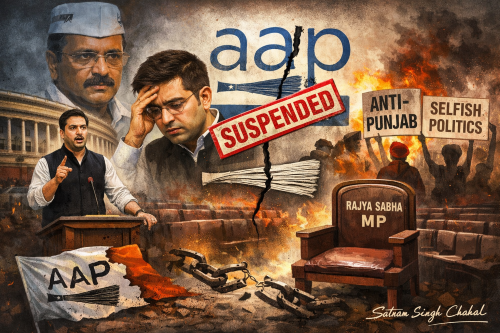
 The political journey of Raghav Chadha has often been described as one of the fastest rises in contemporary Indian politics. As a prominent face of the Aam Aadmi Party, Chadha symbolised youth, articulation, and modern political branding. Closely associated with party chief Arvind Kejriwal, he was once considered among the most trusted and visible leaders of the party, particularly in national forums like the Rajya Sabha. However, recent developments suggesting his marginalisation—amounting to a suspension-like situation within the party have sparked intense political debate.
Over the past months, Chadha’s political presence appears to have diminished significantly. Once a regular voice in parliamentary discussions and media debates, he has reportedly been distanced from key party responsibilities. His removal from influential roles and reduced opportunities to speak in Parliament have sent strong signals that he is no longer central to AAP’s decision-making structure. While the party has not formally announced disciplinary action, the political message being conveyed is difficult to ignore.
In Punjab, where Chadha serves as a Rajya Sabha MP, criticism against him has grown sharper. Many political observers and opponents have accused him of being “anti-Punjab,” arguing that he failed to strongly advocate for the state’s pressing issues. Concerns such as the deepening drug crisis, farmer distress, rising public debt, and deteriorating law and order situation demanded consistent national-level intervention. Critics claim that Chadha, instead of acting as Punjab’s voice in Delhi, remained aligned primarily with the central leadership of the party, thereby appearing disconnected from grassroots realities.
Alongside this, a narrative of “selfish politics” has also taken shape around Chadha’s career. His rapid rise within AAP is often cited as evidence of his political skill, but detractors argue that his journey also reflects a tendency to prioritize personal advancement and loyalty to the high command over broader regional concerns. Whether this perception is fair or politically motivated remains a subject of debate, but it has undeniably contributed to his current image crisis.
Chadha’s situation also brings attention to a broader pattern within the Aam Aadmi Party. Over the years, several influential leaders, including Prashant Bhushan and Yogendra Yadav, have either exited or been sidelined after falling out with the party’s top leadership. This recurring trend has raised serious questions about internal democracy, leadership style, and the space available for dissent within the party.
At this stage, the road ahead for Raghav Chadha remains uncertain. He may attempt to reconcile with the party leadership and regain his earlier position, or he could try to build an independent political identity, particularly in Punjab. There is also the possibility that continued sidelining may gradually reduce his influence in active politics. Much will depend on how both Chadha and the party leadership navigate this delicate phase.
Ultimately, this episode is not just about one leader’s rise and fall it reflects deeper structural challenges within modern political organizations. In a politically aware state like Punjab, where leadership is constantly scrutinized, such developments carry long-term implications. Whether Raghav Chadha re-emerges stronger or fades from prominence will depend on his ability to reconnect with public issues and redefine his political role in the coming years.