
 Every 13 April, Punjab, India—and indeed the entire civilised world—should remember that the Jallianwala Bagh massacre in Amritsar was just not a colonial “mistake” but a planned, brutal and indiscriminate carnage of unarmed men, women and children. It was directed at a people who had responded to a nationwide call for protest and who still believed they could gather and speak without being slaughtered, under a Crown that never tired of invoking the “rule of law.” How the nation later spoke about the man who avenged that massacre decades later—Udham Singh—and how Mahatma Gandhi chose to describe him, remains a live question for Punjab, one that is reignited each year on the commemorative and deeply emotional anniversary of this egregious colonial act of repression.
From all‑India hartal to a Bagh full of martyrs
In March–April 1919, Gandhi launched his first all‑India experiment with satyagraha against the Rowlatt Act, explicitly calling for a general hartal—closure of shops, suspension of work, fasting and prayer—to register India’s non‑violent refusal of a repressive law. On 6 April, this call resonated across the country; Amritsar, like Bombay, Delhi and Lahore, saw crowds on the streets and a new sense of political awakening.
By 13 April, that tension had not subsided in Punjab. People converged on Jallianwala Bagh—some to attend a political meeting, many simply to enjoy the Baisakhi holiday in what they assumed was a relatively safe open space. General Dyer marched in with troops, armed with machine guns, blocked exits and ordered continuous fire into the densest part of the crowd. The dead and wounded lay in heaps; later analysis of victim rolls shows that Hindus, Sikhs and Muslims all died in large numbers, with Hindus and Sikhs killed in roughly equal numbers and many dozens of Muslims among the martyrs—a rare, brutal moment when all three communities of Amritsar bled together.
The walls of the Jallianwala Bagh, now a national memorial, still carry bullet marks, but no labels. They do not separate Hindu from Sikh, Sikh from Muslim; they simply record that in the city Gandhi’s hartal had helped stir, people of all three faiths were cut down in the same murderous volley.
Udham Singh: the delayed answer to Dyerism
Out of this shared wound came a vow. Udham Singh, a young orphan from Punjab, had seen enough in 1919—whether inside the Bagh itself or in its immediate aftermath—to decide that “Dyerism” must one day be answered. For him the villain was not only Brigadier General Dyer, the man who gave the order to fire, but also Sir Michael O’Dwyer, the Lieutenant‑Governor of Punjab who defended and owned that policy of terror.
It took him twenty‑one years of movement across continents, odd jobs and underground work to reach his target. On 13 March 1940, at Caxton Hall in London, he fired at O’Dwyer during a public meeting and killed him. In court, he gave his name as “Ram Mohammad Singh Azad,” consciously weaving together Hindu, Muslim and Sikh identities with the word “Azad,” and used the dock to condemn the British Empire and justify his act as justice for Jallianwala Bagh. He went to the gallows in Pentonville Prison on 31 July 1940, declaring that he was not afraid to die and was proud to die.
In Punjab’s popular memory, Udham Singh is the man who finally carried the pain of Jallianwala Bagh back to the imperial metropolis. Yet when we turn to Gandhi’s words, the contrast, sadly, in moral tone is stark.
“An insane act”, “madman”, “dangerous example”: Gandhi on Udham
In his first reaction after the assassination, Gandhi wrote that the shooting of O’Dwyer had caused him “deep pain” and that he considered it “an insane act” or “an act of madness.” He insisted that “no cause can be served by murder” and that such deeds, however understandable the anger behind them, “do grave injury to India’s struggle.” In public comment, he also spoke of Udham Singh as a “madman,” reducing a carefully chosen, politically framed act of vengeance to individual derangement.
Gandhi went further in spelling out why he opposed Udham’s deed. He argued that “assassination is the worst form of violence” because it denies the victim any chance of change or remorse. He warned that “if India follows such examples, we shall only descend into chaos,” calling Udham Singh’s shot “a dangerous example which, if imitated, will ruin the country.” Where many Punjabis saw a delayed but precise answer to Jallianwala Bagh, Gandhi saw a precedent that threatened his entire project of disciplined non‑violence.
Even when he acknowledged the emotion behind the act, he turned it sharply: he could understand, he said, the bitterness born of Jallianwala Bagh, but insisted that true courage lay in “suffering, not inflicting suffering,” and that “no Indian can take pride in this deed.” In effect, he tried to quarantine the assassination morally and politically: understandable rage, in his eyes, had taken an unforgivable form.
For a province that had seen its Hindu, Sikh and Muslim children mowed down on 13 April 1919, this language was, and remains even today, hard to digest. To many in Punjab, it sounded as if the pain of preserving India’s moral image in British and world opinion had been placed above the pain of those who had waited two decades for one of their own to strike at the man who embodied Dyerism.
Gandhi, Bhagat Singh and the Delhi Pact: effort or abdication?
The debate over Gandhi’s harsh language for Udham Singh is sharpened when we recall his stance in the Shaheed-e-Azam Bhagat Singh’s case. On paper, Gandhi did take up the issue: he raised Bhagat Singh’s sentence with Lord Irwin more than once in February–March 1931, criticised the Lahore Tribunal as a veiled form of martial law, and spoke of death sentences as “irretrievable acts” that should not be carried out in a heated political atmosphere. In one meeting he even told Irwin that if the government wanted to improve the climate, it should at least suspend the execution.
Yet critics—especially in Punjab—have long pointed out what Gandhi did not do. The Gandhi–Irwin Pact, signed on 5 March 1931, contained no explicit guarantee on Bhagat Singh, Sukhdev and Rajguru, even though Gandhi knew that their legal remedies were virtually exhausted and hanging, nay martyrdom, could come at any moment. He did not make commutation or suspension a non‑negotiable condition for the Pact; instead, he kept his clemency appeals in a courteous, almost apologetic register, careful not to endanger an agreement that brought political prisoners’ release and formal recognition of Congress as an interlocutor.
His final plea on the very day of the executions was moral and personal, but politically weak, and had almost no chance of changing a decision the British, particularly the colonial provincial Government of Punjab, had already taken. Seen from one angle, this was realism: Gandhi believed he could not save Bhagat Singh, but could still save the Pact and the larger “gain” for the movement. Seen from another angle, that of Punjab, this looks like abdication. Gandhi, the one man whose open threat to break off the Pact might have forced the British to think again, chose not to use that leverage.
The contrast of Gandhi ji’s reaction in the case of Udham Singh is telling for Punjab. In Bhagat Singh’s case, Gandhi spoke against the tribunal, offered private and belated pleas, then accepted a Pact that left the gallows untouched; afterwards he helped frame resolutions paying homage to the martyrs. In Udham Singh’s case, he had no treaty to balance and no British concession at stake, yet his public voice was far less sympathetic: he called the assassination “an insane act,” spoke of Udham as a “madman,” and warned that “no Indian can take pride in this deed,” treating it chiefly as a dangerous example that could ruin the country if imitated.
Put bluntly in Punjabi terms: when the fate of Bhagat Singh could still, at least in theory, be influenced, Gandhi was cautious, muted and careful not to wreck the Gandhi–Irwin Pact; when Udham Singh had already paid with his neck for Jallianwala Bagh, Gandhi’s words were sharp, condemnatory and uncompromising.
Consistency and blind spots
To be fair, Gandhi was being true to his own code. He had condemned earlier revolutionary actions in similar language, insisting that no killing—whether of a British official in Delhi, a policeman in Chauri Chaura or a Lieutenant‑Governor in London—could be squared with his belief that the means must be as pure as the ends. He coined “Dyerism” to denounce the mentality behind Jallianwala Bagh, but refused to sanction anything that looked like a mirror image of that violence, even when aimed at its architects.
But consistency is not the same as completeness. In Punjab, his description of Udham Singh’s act as “madness,” his use of “madman” and his insistence that Indians must feel no pride in the deed have long been heard as a refusal to take Punjab’s specific history on its own terms. In those words, the boy from Amritsar who waited twenty‑one years to answer the bullets of 13 April 1919 was turned into a cautionary tale—an example of what the nation must avoid, not a martyr whose motives deserved understanding even from those who disagreed with his method.
Ironies of history: Gandhi’s end and Amritsar’s statue
History has its own austere ironies. Mahatma Gandhi, who steered India to Independence but could not prevent Partition or the vast communal carnage that followed, himself fell to the bullet of a Hindu fanatic on 30 January 1948. A life spent preaching that “no cause can be served by murder” ended on the stones of Birla House with three shots from a countryman who claimed, in his own way, to be acting for “the nation.”
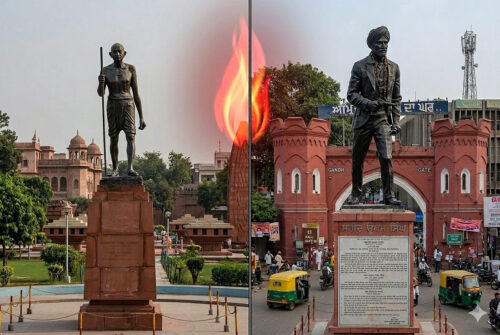
And in Amritsar, this irony is cast quite literally in stone and bronze. Outside the Gandhi Gate, at the very entrance of the spacious Hall Bazaar leading towards the narrow lanes that open onto Jallianwala Bagh, the statue that stands in pride of place is not of Mahatma Gandhi, but of the selfless son of the soil, Shaheed Udham Singh. His collosal figure, rising above the traffic and the noise, reminds every passer‑by that Punjab’s answer to Dyerism did not come from petitions and pacts alone.
That statue, and the story behind it, suggest a future as much as a past. However many official histories are written, Udham Singh’s saga—the indomitable spirit of resistance, the demand for justice, the radical idea of “Ram Mohammad Singh Azad”—will continue to resonate with generations to come in Punjab and beyond. To read Gandhi ji’s words on him honestly, and still claim Udham Singh as our own, is perhaps the most fitting way to honour both the complexity of our freedom struggle and the martyrs of Jallianwala Bagh whose blood first set this long chain of events in motion, culminating in the Independence of the country on 15th August, 1947