
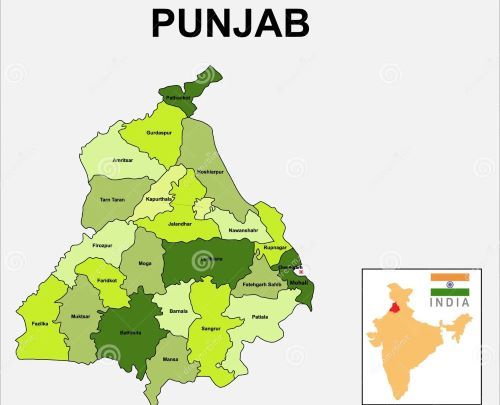
 The recent decision of the Union Government of India to open key positions in the Bhakra Beas Management Board specifically Member (Irrigation) and Member (Power) to officers from across the country has ignited a serious political and constitutional debate in Punjab. The move has been met with strong resistance from the Punjab government, which views it as an encroachment on the rights and interests of the state.
The BBMB, established under the Punjab Reorganisation Act, 1966, has historically been a joint administrative body managing crucial water and power resources of Punjab, Haryana, and Rajasthan. These resources, particularly the Bhakra and Beas river systems, are not merely administrative assets but lifelines for agriculture, drinking water, and electricity generation in the region.
Punjab’s objection is rooted in constitutional and legal provisions. The state government has pointed to Section 48(1) of the Act, which clearly states that land belonging to the erstwhile Punjab shall vest with the successor state in which such land is situated. Further strengthening its position, Punjab has cited Sections 6, 48(1), and 48(6), arguing that ownership, control, and management of these assets should logically remain with the state where they are geographically located predominantly Punjab in this case.
From Punjab’s perspective, the Centre’s move dilutes the federal structure by centralizing authority over institutions that were designed to reflect regional participation and balance. The concern is not merely administrative but deeply political and emotional, as water rights have historically been a sensitive issue in the state. Any perceived dilution of control over river waters and related infrastructure is seen as a direct threat to Punjab’s agrarian economy and sovereignty over its resources.
On the other hand, the Union Government appears to be advocating for a broader talent pool and administrative efficiency by allowing officers from across India to occupy these posts. While this argument may hold merit in terms of governance reforms, critics argue that it overlooks the unique historical, legal, and regional sensitivities attached to BBMB.
This development has once again brought to the forefront the ongoing debate over Centre-State relations in India. It raises critical questions about the interpretation of federalism, the sanctity of state rights under reorganization laws, and the balance of power between the Union and the states. For Punjab, the issue is not just about appointments—it is about safeguarding its rightful control over vital natural resources.