
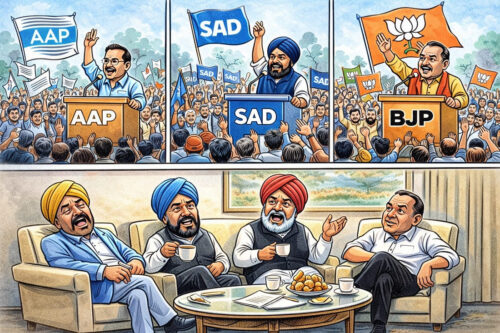
 On 13 April 2026, the Punjab Vidhan Sabha passed the Jaagat Jot Sri Guru Granth Sahib Satkar (Amendment) Bill, 2026 in a special session convened for the purpose. The occasion was not merely legislative. It was, in a deeper sense, an institutional reckoning — a belated acknowledgement that a decade of sacrilege incidents, botched investigations, collapsed prosecutions, and communal anguish had exposed a structural void at the intersection of criminal law, religious sentiments, and state capacity. The Bill, which amends the parent Jaagat Jot Sri Guru Granth Sahib Satkar Act, 2008, proposes a mandatory minimum sentence of ten years’ rigorous imprisonment, extendable to imprisonment for life, with fines ranging from ₹5 lakh to ₹25 lakh for acts of sacrilege — beadbi — of Sri Guru Granth Sahib ji. The definition of sacrilege is deliberately expansive, covering not only physical desecration — damage, defacement, burning, tearing, or theft of the saroop — but also words spoken or written, signs, visible representations, and acts committed through electronic or online means that are calculated to wound the religious feelings of ththe Sikhs worldwide, who hold Sri Guru Granth Sahib ji not only sacred but as the embodiment of the living Guru.
The drafting choice is constitutionally astute in one critical respect. By amending a pre-existing State Act dedicated exclusively to Sri Guru Granth Sahib ji — rather than attempting, as in 2016, to insert a Punjab-specific provision into the Indian Penal Code — the government has sought to sidestep the constitutional objection that previously led to the return of the 2016 IPC (Punjab Amendment) Bill. The parallel draft that had been in circulation since 2025, the Punjab Prevention of Offences Against Holy Scriptures Bill, 2025, which clubbed together multiple scriptures — the Quran, the Bible, the Bhagavad Gita — alongside Sri Guru Granth Sahib ji, has been effectively shelved. The present amendment is singular in its focus, rooted in a distinct and pre-existing State legislative instrument, and the government has publicly maintained that it requires only the Governor’s assent to come into force, without referral to the President.
The penal framework, the investigation provision mandating enquiry by an officer not below the rank of Deputy Superintendent of Police, the coverage of digital and online desecration, and the reported narrowing of the mental illness defence all represent a substantive legislative advance. The question that now governs everything else is when — and in what form — this law comes into force. And that question belongs, constitutionally, to the Governor.
I. The Constitutional Constraint: Article 20(1) and the Prospective Wall
Before the Governor acts, it is necessary to state with precision what the new law, however well-drafted, cannot do. Article 20(1) of the Constitution is an absolute bar. It provides that no person shall be convicted of any offence except for violation of a law in force at the time of the act charged as an offence, nor be subjected to a penalty greater than that which might have been inflicted under the law in force at the time of commission. This is the ex post facto prohibition in its most rigorous Indian constitutional form — binding on Parliament and State Legislatures alike, not subject to suspension even during an Emergency under Article 358.
The practical consequence for the present amendment is unambiguous. The mandatory minimum of ten years, the life sentence ceiling, and the enhanced fines can only be imposed for acts of sacrilege committed after the date the amended Act comes into force. Every incident of beadbi that occurred before that date — Bargari in 2015, Behbal Kalan and Kotkapura in 2015, and the dozens of incidents that have punctuated Punjab’s communal landscape since — must be prosecuted and sentenced under the law as it stood at the time of the offence. The 2008 Satkar Act as originally enacted, read with the applicable IPC provisions, remains the governing instrument for those cases. The new punishment regime cannot reach backwards. There is, however, one immediate procedural consequence of the new sentencing framework that applies prospectively with full force: an offence carrying a mandatory minimum of ten years’ rigorous imprisonment is triable exclusively by a Court of Sessions. Every future sacrilege case registered under the amended Act will therefore go before a Sessions Judge — a higher forum than has typically handled such matters under the existing statutory dispensation — with the attendant rigour of Sessions trial procedure, including more stringent bail conditions and a higher evidentiary threshold at the stage of framing of charges.
This is not a legislative failure. It is a constitutional imperative. The legislature cannot supply, through prospective legislation, the justice that the prosecution machinery failed to deliver in the decade preceding this Bill. The severer sentences are a deterrent for the future, not a remedy for the past. That distinction must be kept clearly in public discourse, which has sometimes conflated the passage of a stricter law with the resolution of pending cases. The two are entirely separate propositions.
II. The Governor’s Three Constitutional Options
The Bill now rests with the Governor. Under Article 200 of the Constitution, and as authoritatively clarified by the Supreme Court in its 2025 advisory opinion on the powers of Governors and the President under Articles 200 and 201, there are precisely three constitutionally valid routes available. There is no fourth option. The Governor cannot sit on the Bill in indefinite silence; unexplained inaction is constitutionally suspect and open to judicial scrutiny.
Option One: Assent. The Governor signs the Bill. It becomes law on the date of assent or on such subsequent date as may be notified. The enhanced punishment regime operates prospectively from that date. This is the cleanest outcome and the one the government anticipates. If the assessment that no Presidential assent is required — on the ground that the Bill amends a distinct State Act and does not occupy the same legislative field as existing central penal law — is constitutionally sound, then assent by the Governor is both legally proper and politically appropriate.
Option Two: Return for Reconsideration. The Governor withholds assent and returns the Bill to the Vidhan Sabha with a message identifying specific reservations — whether on questions of proportionality, the treatment of the mental illness defence in relation to general criminal law principles, the drafting of the intent requirement for speech and online content, or the absence of graded offence categories in the reported text. If the Vidhan Sabha re-passes the Bill, with or without incorporating the Governor’s suggestions, and resubmits it, the Governor is then constitutionally bound to assent. He cannot, at that second stage, either veto the Bill afresh or refer it to the President. The 2025 Supreme Court opinion made this emphatically clear.
Option Three: Reserve for the President. The Governor may conclude that the Bill raises sufficiently serious questions of repugnancy with existing central penal law — particularly the IPC provisions on outraging religious feelings under Section 295-A and related provisions — as to warrant referral to the President under Article 201. This option carries a significant strategic consequence that cuts both ways. On the one hand, it risks a repeat of the 2016 experience, where a sacrilege-related amendment was effectively interred by the Union government’s inaction. On the other hand, if the President assents after reservation, the Act acquires the protection of Article 254(2) and is shielded from repugnancy challenge in any court. Given that the constitutional battle over a state sacrilege law has been fought and lost once before, there is a reasonable argument that presidential assent via the reservation route would create a more durable legal instrument — provided the Union government moves expeditiously and in good faith.
The Governor must choose, and must choose without undue delay. The constitutional clock, post the 2025 advisory opinion, is running.
III. The SOP Framework: An Architecture Worthy of the Law
While the legislature and the Governor occupy the foreground, the most consequential administrative development of this week has been quietly assembled in the background. On 10 April 2026, the Punjab Bureau of Investigation issued Standard Operating Procedure No. 2683/CR/INV-6 — a comprehensive, thirty-two paragraph protocol governing the investigation of sacrilege cases involving Sri Guru Granth Sahib ji and other holy scriptures. Three days later, on 13 April 2026, a detailed Addendum was issued to rectify three significant omissions in the parent SOP: the sanction for prosecution framework under Section 217 of BNSS, 2023, the time-bound investigation regime under the same code, and the certification requirements for electronic evidence under Section 63 of the Bharatiya Sakshya Adhiniyam, 2023.
Together, these two documents constitute the first unified investigative framework for sacrilege cases in Punjab’s administrative history. The significance of this cannot be overstated. For a full decade — through Bargari, through Behbal Kalan, through Kotkapura, through the procession of SIT formations, reconstitutions, and political recriminations — there existed no standardised protocol binding the investigating officer, the SHO, the forensic team, the prosecution, and the supervisory hierarchy to a common procedural architecture. Cases were investigated differently in different districts, evidence was handled without uniform standards, religious maryada was observed inconsistently at scenes of crime, and the pairvi function — the follow-through from chargesheet to trial — was neglected to the point of catastrophe.
The SOP addresses each of these failures systematically. The dual-perimeter cordon at the scene of crime, the mandatory involvement of religious functionaries in the handling of desecrated Angs of Sri Guru Granth Sahib ji, the prohibition on inappropriate language in case diaries, the integration of the e-Sakshya mobile application for tamper-proof recording, the financial trail methodology extending to blockchain analytics and cryptocurrency tracing, the framework for digital sacrilege investigation covering deepfakes and cross-platform content amplification, the mandatory forensic psychiatric assessment for accused persons exhibiting signs of mental instability, the provisions for juvenile accused under the JJ Act — these are not cosmetic additions. They represent a genuine and substantive codification of investigative best practice, aligned with the new criminal law framework under BNSS and BSA, 2023.
The Addendum’s treatment of Section 63 BSA certification for electronic evidence is particularly significant. The failure to obtain proper certification for electronic records — the direct successor requirement to the notorious Section 65B certificates under the Indian Evidence Act — has been responsible for the mid-trial collapse of prosecutions in several high-profile cases nationally. The direction to produce the Section 63 certificate at the chargesheet stage, the requirement to record hash values at the point of seizure, and the detailed chain of custody documentation requirements address a vulnerability that defence counsel have exploited with consistent success.
Critically, this SOP framework operates independently of and in parallel to the new legislation. It applies with full force to investigations under the existing 2008 Act, under Section 295-A and related IPC and BNSS provisions, and under all other applicable statutory instruments. When and if the Jaagat Jot Sri Guru Granth Sahib Satkar (Amendment) Bill, 2026 becomes law, the SOP framework will seamlessly underpin prosecutions under the new regime as well. The architecture is, for once, designed ahead of the legal instrument rather than assembled in its wake.
This work reflects credit on the Punjab Police leadership. Under the overall command of Gaurav Yadav, IPS, Director General of Police, Punjab, the Bureau of Investigation has demonstrated an institutional seriousness commensurate with the gravity of the subject. L.K. Yadav, IPS, Director of the Punjab Bureau of Investigation, who is the issuing authority of both the SOP and the Addendum, deserves particular acknowledgement. An officer who has brought both forensic precision and theological sensitivity to one of the most charged investigative domains in Punjab’s recent history, and who has also acquitted himself with distinction heading the Special Investigating Teams in the Kotkapura and Behbal Kalan police firing cases — matters that directly intersect with the sacrilege episode — L.K. Yadav has produced, in these two documents, a professional benchmark for investigative protocol in religious sensitivity cases.
IV. The Way Forward
Punjab now has, for the first time in a decade, three elements in simultaneous alignment: a pending legislative instrument with credible punitive teeth, a constitutional pathway to its enactment that the government has carefully calibrated to avoid past errors, and a unified investigative SOP framework that binds the entire police hierarchy to a common standard of procedure.
What remains is delivery. The Governor must act without delay and within his constitutional obligation. The question of which of his three options best serves the long-term durability of this law deserves considered judgment — and that consideration should weigh the protection that Article 254(2) affords against the risk that the Union route becomes, as it did in 2016, a dead end.
The SOP, meanwhile, is only as good as its compliance. The Addendum’s closing paragraph, which speaks of police officer non-appearance before trial courts as a “travesty of justice,” is an institutional admission of what undid the Bargari prosecutions. The officers who failed to depose, the witnesses who turned hostile, the chain of custody that was never properly documented — these failures were not legislative. They were human and systemic. No SOP, however well-drafted, can substitute for the will to prosecute.
That will is what Punjab’s Sikh community has been patiently waiting to see demonstrated — not in a Vidhan Sabha special session, and not in a forty-page SOP, but in a courtroom, before a trial judge, with evidence that holds and witnesses who appear. The law and the procedure are now in place. The test, as always, lies ahead.
Share