
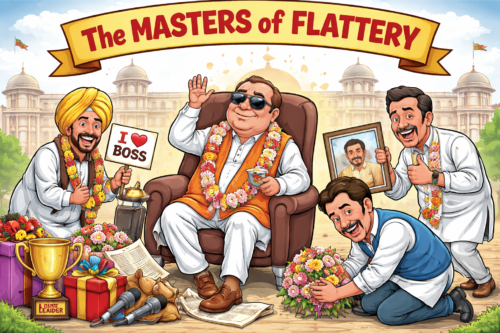
 In the grand circus of politics, where ideologies are often as flexible as yoga instructors and promises evaporate faster than morning dew, there exist two distinct species of entrants. The first arrives with dreams dreams of reform, service, and leaving behind a legacy that might make their village proud or at least earn them a respectful mention at the local tea stall. The second, however, arrives with something far more practical: a well-oiled spine, perfectly suited for bending at the right angles. Today, let us set aside the dreamers those poor souls still reading manifestos and instead celebrate the true artists of survival: the flatterers.
The flatterer does not enter politics with a vision; he enters with a mirror. Not for himself, of course, but to constantly reflect the greatness of his leader. While the service-minded individual spends nights drafting policy proposals, the flatterer is busy drafting WhatsApp messages praising the leader’s “historic” sneeze or “visionary” silence. Where one studies economics, the other studies facial expressions specifically, the leader’sand learns exactly when to nod, when to laugh, and when to clap as if witnessing the invention of fire.
It is often asked: what secret formula propels these individuals to success while the sincere ones remain stuck organizing chairs at public meetings? The answer is simple timing and tone. A true flatterer knows that flattery is not just about praise; it is about precision praise. For instance, when a leader makes a confusing statement, the amateur might stay silent, the critic might question it, but the professional flatterer will immediately declare it “deep and visionary,” leaving everyone else wondering if they simply lack the intellectual capacity to understand such brilliance.
Then there is the sacred ritual of the photograph. Ah, the photograph—the ultimate symbol of political achievement for the second category. While the service-oriented worker dreams of changing lives, the flatterer dreams of changing his profile picture. Months, sometimes years, of strategic smiling, strategic clapping, and strategic tea-serving culminate in that one glorious moment: standing two feet behind the leader in a slightly blurred photograph. This image is then circulated with captions like “Discussed important issues with respected leader,” though the actual discussion may have been limited to “Sir, chai?”
Meanwhile, the missionary-type workers the ones who actually believed politics was about service—are often found in the background, adjusting microphones or distributing pamphlets. They wait patiently for recognition that never comes, occasionally clapping out of habit, occasionally questioning their life choices, and frequently wondering how someone who cannot draft a sentence has managed to draft a career.
The flatterer’s toolkit is vast and ever-evolving. It includes exaggerated laughter at unfunny jokes, instant agreement with contradictory statements, and the rare ability to praise yesterday’s decision and today’s reversal with equal enthusiasm. If the leader says, “We will go left,” the flatterer shouts, “Brilliant!” If the leader immediately says, “Actually, we go right,” the flatterer replies, “Even more brilliant!” Ideology, after all, is a luxury; survival is a necessity.
One must also admire their resilience. Insults? Ignored. Public embarrassment? Rebranded as “learning experience.” Being made to wait outside offices for hours? “An honor.” In fact, the flatterer possesses a superpower that even seasoned politicians envy: the ability to convert humiliation into opportunity. Every scolding becomes “guidance,” every dismissal becomes “motivation,” and every ignored phone call becomes “busy schedule of the leader.”
And so, the ladder of political success is quietly climbed not by those who build it, but by those who know exactly whom to praise while climbing it. The sincere worker, armed with ideas and integrity, often finds himself stuck at the bottom, polishing the very steps others walk upon. Meanwhile, the flatterer ascends effortlessly, occasionally looking down—not to help, but to ensure the camera captures his best angle.
In the end, politics, like life, rewards different skills. Some bring change, others bring applause. And while history may remember the reformers, the present certainly belongs to the flatterers—standing just close enough to power to feel important, yet just far enough to avoid responsibility.
So, if you ever find yourself wondering why sincerity struggles while flattery flourishes, remember this: in politics, as in theater, it is not always the best script that wins—it is the best performance.