
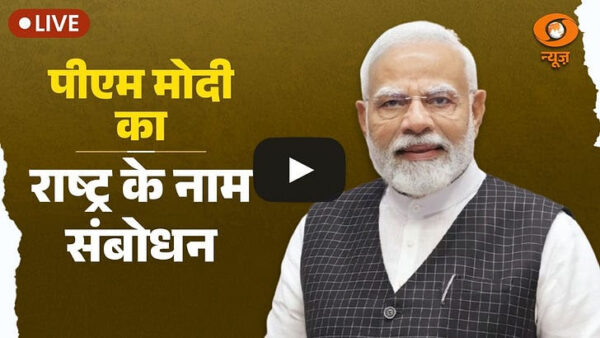
 By any conventional reckoning, last evening was a serious setback for the Modi government. A Constitutional Amendment Bill — requiring a two-thirds majority in both Houses — failed to secure the numbers. Worse, the accompanying delimitation bill had to be quietly withdrawn before the vote, a tactical retreat that exposed the arithmetic reality within the NDA’s own coalition. Yet within twenty-four hours, the Prime Minister was on national television, not to explain or defend, but to prosecute. That tells you everything about the political calculus at work.
Takeaway 1: The Speech Was Not an Address — It Was a Chargesheet
After a perfunctory apology to the women of India — mothers, sisters and daughters — for failing to secure the passage of the Women’s Reservation Bill, Prime Minister Narendra Modi launched a scathing, systematic attack on the opposition that left no doubt about the true purpose of the address. What followed was not contrition. It was the opening statement of the prosecution.
PM Modi did not appear before the nation to mourn a lost vote. He appeared to file charges. The language throughout — “offenders against the Constitution,” “political killing,” “sin,” “punishment,” “they will not be able to escape” — is the vocabulary of a first information report, not a concession speech. Every paragraph named an accused, specified a crime, and promised a verdict — to be delivered by the women of India at the ballot box. The format was prosecutorial from the first sentence to the last.
In that sense, the speech achieved precisely what it set out to do: it inverted the narrative. The government did not lose. The women of India were robbed.
Takeaway 2: Personal Accountability Was Surgically Excised
Nowhere in thirty minutes did the Prime Minister acknowledge that his government failed to manage the floor, failed to build a coalition within the NDA itself, or misjudged the arithmetic before tabling a Constitutional Amendment. The word “miscalculation” does not appear. Nor does any variant of it. The framing was absolute: the government’s intent was pure, its effort was sincere, its cause was just — and it was assassinated by the opposition. This is a political masterstroke of deflection, but it carries a long-term vulnerability. Sophisticated political observers — and there are many — will ask why a government with nearly three years of its term remaining chose to table a bill it knew it could not pass. That question is deferred for now, but not extinguished.
Takeaway 3: The Naming-and-Shaming is Calibrated for Electoral Geography
The four parties specifically and repeatedly indicted — Congress, Samajwadi Party, DMK, and TMC — are not a random selection. Each maps onto a specific electoral battlefield. The Samajwadi Party is the principal adversary in Uttar Pradesh, where assembly by-elections and eventually the 2027 state election loom. The DMK is Tamil Nadu’s ruling party, where a direct contest with the BJP at the parliamentary level remains aspirational but where the Dravidian framing can be usefully disrupted. The TMC is Bengal, where the BJP’s ambition to displace Mamata Banerjee remains its most significant pan-India project. Congress is the ideological umbrella under which all of this is bundled — it is the master villain whose name carries national resonance. The speech is, in effect, a campaign document disaggregated for four different state electorates simultaneously.
Takeaway 4: Women Are Being Conscripted as a Vote Bank, Not Liberated as a Constituency
The emotional register of the speech — “mothers, sisters and daughters,” “their dreams have been crushed,” “a woman may forget many things but she never forgets her humiliation” — is designed to mobilise female voters through a sense of shared grievance. This is the Lakhpati Didi idiom translated into constitutional politics. The BJP has invested enormously in constructing a direct emotional relationship between Modi personally and women voters, particularly in rural and semi-urban constituencies. That relationship — built through direct benefit transfers, LPG connections, Jan Dhan accounts, and Ujjwala — is now being leveraged to absorb the shock of the bill’s failure. The message to women voters is simple: we tried for you; they stopped us; remember them. Whether this conversion of legislative failure into emotional mobilisation succeeds is the central question of the next twelve to eighteen months.
Takeaway 5: The Delimitation Retreat Is Being Airbrushed
The withdrawal of the delimitation bill is politically the more consequential of the two events, and it receives the least candid treatment in this speech. Modi’s assurance that “neither will any state’s share be reduced, nor will anyone’s representation be diminished — rather, the number of seats in all states would increase in equal proportion” is a political commitment whose constitutional and arithmetic feasibility is, to put it gently, contested. The southern states — Tamil Nadu, Kerala, Karnataka, Andhra Pradesh, Telangana — have long feared that delimitation on the basis of current population data would structurally reduce their relative weight in Parliament, precisely because they achieved demographic stabilisation more successfully than the north. The DMK’s opposition to the bill was rooted in this existential anxiety, not mere obstructionism. By dismissing that concern as a “lie” and a “Congress-planted conspiracy,” Modi is speaking to his northern base while further alienating a southern political class that was already keeping its distance. This is a trade-off, not a clean win.
Takeaway 6: The “Dynasty” Frame Is Doing Structural Work
The recurring invocation of “dynastic parties” — used interchangeably with Congress, TMC, SP, and DMK — is not rhetorical padding. It is the BJP’s most durable meta-narrative, and this speech consciously deploys it to explain why these parties opposed women’s reservation. The argument is internally coherent: family-run political enterprises feel existentially threatened by the empowerment of women outside their own bloodlines, because competent independent women would erode the captive social capital on which dynasties depend. Whether or not one accepts this argument — and it has real weaknesses, given that several of these parties have fielded women candidates — it lands cleanly with the BJP’s core ideological audience and provides a satisfying explanatory framework that does not require any engagement with the bill’s actual legal or procedural complexities.
Takeaway 7: The Long-Term Dividend Is Far From Assured
In the short term — the remaining Vidhan Sabha elections in West Bengal and Tamil Nadu — this speech is a mobilisation tool. It gives BJP workers a narrative, gives party spokespersons a script, and gives sympathetic media a frame. In the short term, that is not nothing.
But the longer arc is more uncertain. The women’s reservation issue has been weaponised, promised, deferred, and re-promised over three decades. Women voters in India are not a monolith, and many — particularly those aligned with the SP’s Yadav base or the TMC’s Bengali bhadramahila constituency — will hear this speech as precisely what it is: a party political broadcast dressed in constitutional language. The Vishwanath Pratap Singh precedent of 1990 is instructive: Mandal was a masterstroke of political disruption that produced an immediate electoral dividend but reshaped Indian politics in ways its architect could not control. A promise of women’s reservation that is visibly not delivered — twice, three times — risks a similar dynamic of expectation inflation and credibility erosion, particularly among younger, educated women voters who are increasingly present in the urban electorate.
Takeaway 8: The Closing Passage Is the Most Revealing Sentence of All
“Yesterday we may not have had the numbers, but that does not mean we have been defeated. Our inner strength remains unconquered.”
This is a Prime Minister who has built an entire political persona on decisive majority governance — on the ability to do what predecessors could not, to cut through coalition compulsions, to translate will into legislation. The 2023 Nari Shakti Vandan Act passed on exactly that logic. This speech concedes, in plain Hindi rendered into plain English, that the numbers were not there. For a leader whose brand equity rests on numerical invincibility, that admission — however bravely framed — is the most politically significant moment of the entire thirty minutes. It will not be forgotten by those who are watching.
A Final Caution: The Limits of the Narrative
There is, however, a harder question that no amount of political messaging can entirely dissolve. In a country where eighty crore citizens depend on the government for free food grain — a statistic the Prime Minister himself regularly cites with pride — where millions of families still lack adequate healthcare, quality education, social security, physical security, and functional law and order, the Women’s Reservation Bill, had it passed, would at best have created political space for an arguably elite stratum: women drawn from influential political families and established party hierarchies. To assume that such women, once elected, would have generated within the electorate a durable wave of gratitude toward Narendra Modi personally or the BJP institutionally — one strong enough to sustain itself through to the next general election — is to mistake political theatre for political chemistry.
The precedent is instructive and sobering. When the Narasimha Rao minority government enacted the Seventy-Third and Seventy-Fourth Constitutional Amendments, embedding reservation for women in Panchayati Raj institutions and urban local bodies, it was genuinely historic legislation — far more consequential in reach than anything debated last evening. The Congress did not survive the next Lok Sabha election. Causality between transformative legislation and electoral reward is rarely linear, and to assume it here would be political naivety of a considerable order.
Nevertheless, this is the narrative Prime Minister Modi has chosen to construct, and its ultimate yield is a matter for time, not analysis, to settle. Politics has always been the domain of unintended consequences — positive and negative in equal measure — and it is precisely that unpredictability that makes political stargazing so endlessly absorbing, and sustains a flourishing industry of commentary across television channels, digital platforms, newspapers and magazines. Last evening added fresh material to that industry. Whether it added a chapter to history remains to be seen.
In Summary
This was a tactically impressive speech delivered in politically adverse circumstances. It has converted a legislative defeat into a counter-offensive opportunity, named its enemies with geographic precision, and placed women’s dignity at the centre of a grievance narrative that the BJP intends to carry into the next electoral cycle. But as the Narasimha Rao precedent reminds us, the distance between transformative legislation and electoral reward has never been linear in Indian politics — and a failed bill is an even more uncertain currency than a passed one. Whether this narrative yields durable dividends depends, ultimately, on whether the women of India receive PM Modi’s address as unimpeachable testimony, or come to recognise it for what it arguably is: advocacy.