
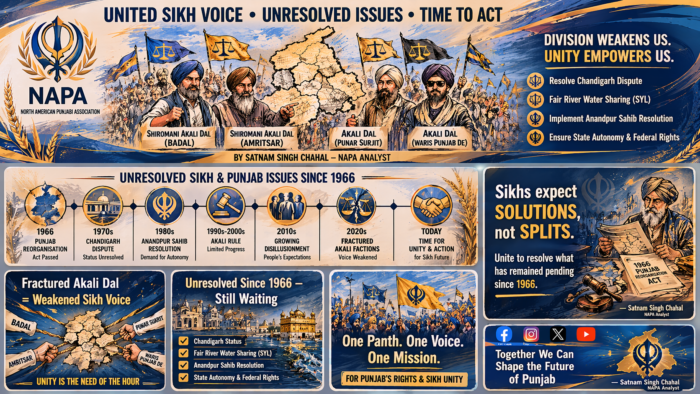
 Punjab’s political landscape today reflects a deep fragmentation within the Akali Dal framework, where multiple factions claim to be the sole representatives of the Sikh community. From the Shiromani Akali Dal to Shiromani Akali Dal (Amritsar), Shiromani Akali Dal (Punar Surjit), and Akali Dal (Waris Punjab De), each presents itself as the guardian of Sikh interests. However, the ground reality suggests otherwise. Instead of acting as a united force, these factions have contributed to division, confusion, and a weakening of Sikh political influence at a time when unity is most needed.
The Akali Dal once stood as a powerful Panthic institution that represented Sikh aspirations beyond electoral politics. It played a historic role in shaping Sikh identity, securing rights, and leading struggles that culminated in significant milestones. However, over time, internal conflicts, leadership rivalries, and ideological differences have fractured this legacy. What remains today is not a unified movement but a collection of competing groups, each asserting legitimacy while lacking collective direction.
The most prominent among them, the Shiromani Akali Dal, has faced sustained criticism for drifting away from core Panthic values. Accusations of dynastic politics and compromises on key Sikh issues have weakened its credibility. While it continues to hold organizational strength, many Sikhs feel that it has failed to deliver on long-standing commitments, particularly those linked to Punjab’s political and constitutional rights.
On the other hand, the Shiromani Akali Dal (Amritsar) projects itself as an ideological alternative, emphasizing Sikh sovereignty, rights, and unresolved historical grievances. Despite its strong rhetoric, it has not been able to translate its vision into widespread political support or practical outcomes. Its influence remains limited, raising questions about the effectiveness of ideological politics without organizational reach.
Similarly, the Shiromani Akali Dal (Punar Surjit) claims to revive the original principles of the Akali movement. However, it struggles with visibility and public engagement. Without a strong grassroots presence or electoral success, its impact on Punjab’s political direction remains minimal, reflecting the broader challenge faced by smaller factions.
The emergence of Akali Dal (Waris Punjab De) has added a new dimension to this fragmented space. Drawing energy from youth sentiment and religious revivalism, it has managed to generate attention and mobilize sections of society. Yet, questions remain about its long-term vision, governance capability, and ability to address complex political and economic issues facing Punjab.
Amid this fragmentation, one critical aspect often overlooked is the unfinished agenda of Sikh and Punjab-related issues dating back to the Punjab Reorganisation Act, 1966. This historic restructuring, which divided Punjab and led to the creation of Haryana and Himachal Pradesh, left several disputes unresolved. Issues such as the status of Chandigarh, sharing of river waters, territorial claims, and federal autonomy continue to remain points of contention even after decades.
Sikhs across Punjab and the global diaspora have long expected Akali leadership—regardless of faction—to collectively address these unresolved matters. These are not merely political issues but are deeply tied to identity, rights, and the future of Punjab. However, instead of presenting a united front to resolve these concerns, Akali factions have remained engaged in internal competition, weakening their ability to negotiate effectively with the central government.
This failure has led to growing frustration among Sikhs, who see their leadership divided at a time when clarity and unity are essential. The expectation was that Akali Dal factions would act as custodians of Sikh interests, working toward solutions for long-pending issues. Instead, the focus has often shifted toward symbolic politics, internal rivalries, and short-term electoral gains.
The result is a dilution of Sikh political power. A community that once spoke with a strong, unified voice now finds itself represented by multiple competing narratives. This fragmentation not only confuses voters but also reduces the overall influence of Sikh leadership in national decision-making processes.
In conclusion, the crisis within Akali politics is not merely about multiple parties—it is about a lack of collective vision and accountability. The continued division among factions has prevented meaningful progress on critical issues that have remained unresolved since 1966. Until these groups move beyond their differences and prioritize the larger interests of the Sikh community, the political, social, and religious energy of Sikhs will continue to be scattered rather than strengthened.
Share via: