
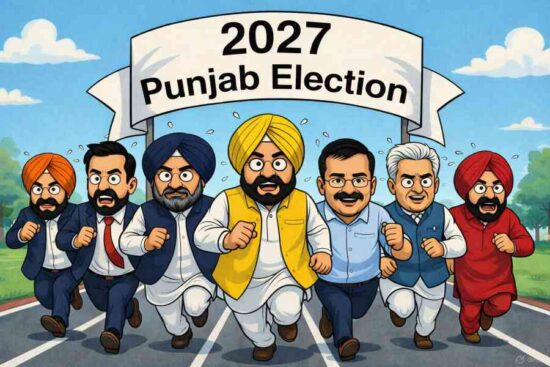
 Punjab’s political landscape is heating up in ways not seen since the Aam Aadmi Party’s historic 2022 landslide. AAP won 92 of 117 seats in 2022, obliterating both the Congress and Shiromani Akali Dal in a single election cycle, a result that gave Chief Minister Bhagwant Mann’s government a working majority that looked near-unassailable on paper. But three years into its tenure, the cracks are unmistakable. Legislative assembly elections are expected to be held in Punjab in February 2027, and the incumbent Chief Minister remains Bhagwant Mann, though the road to re-election looks significantly bumpier than it did even a year ago.
The most dramatic political earthquake in recent months came in late April 2026. In a seismic shift in Punjab’s political landscape, seven of AAP’s ten Rajya Sabha members, led by senior leader Raghav Chadha, announced their decision to join the BJP. Key defectors included Sandeep Pathak, Ashok Mittal, Harbhajan Singh, Swati Maliwal, Vikramjit Singh Sahni, and Rajender Gupta. Notably, this exodus followed an Enforcement Directorate (ED) raid at the Jalandhar residence of Ashok Mittal on April 15. Chadha’s departure was especially stinging. He was one of the principal architects of AAP’s historic 2022 Punjab sweep, and his move has been widely read as a signal that the party’s national leadership may be deprioritising Punjab, raising the very real risk of further defections or quiet alignments ahead of 2027.
Emboldened by these defections and by sweeping electoral victories elsewhere in India in 2026, the BJP is now aggressively targeting the state. BJP working chief Ashwani Sharma launched a sharp attack on the AAP government, accusing it of misusing state machinery, weakening democratic institutions, and attempting to divert public attention from corruption allegations against its leaders. Drawing parallels with West Bengal, Sharma warned that the AAP government was attempting to create an atmosphere of fear and political violence in Punjab. State BJP leaders have openly declared: “If Bengal can change, then why not Punjab?” a pointed reference to their recent national momentum.
Beyond the political theatre, AAP faces deeper structural challenges. The party staked its Punjab identity on governance delivery free electricity, mohalla clinics, education reform but has struggled to translate Delhi-model promises into Punjab’s structurally different economy, with its dominant agricultural sector and entrenched subsidy politics. The party’s national standing has also taken a serious hit. AAP was routed in the February 2025 Delhi assembly elections, surrendering power to the BJP after a decade steadily eroding its aura of invincibility. These blows, one after another, have transformed what was once the freshest political story in India into a party fighting for its survival on multiple fronts.
The tensions have spilled visibly into the legislature itself. During a special Labour Day session in the Punjab Assembly, the opposition accused Chief Minister Bhagwant Mann of arriving drunk. The matter intensified when Leader of the Opposition Pratap Singh Bajwa demanded that all MLAs undergo a test to identify those under the influence of alcohol. Bhagwant Mann subsequently walked out of the House, after which Congress MLAs entered the well in protest before staging their own walkout. AAP pushed back hard, calling such accusations politically motivated. AAP Punjab State President Aman Arora criticised both BJP and Congress, stating the session was convened to discuss critical pro-people issues including laws to prevent sacrilege and workers’ rights, but BJP remained absent while Congress disrupted proceedings.
The traditional opposition parties Congress and the Shiromani Akali Dal meanwhile continue to struggle to mount a truly coherent challenge of their own. Congress leaders warned AAP that its current predicament is a consequence of prioritising wealth and influence over ideological consistency during Rajya Sabha nominations, expressing concern that the trend of defections could soon trigger a larger exodus among AAP MLAs. The Akali Dal, still recovering from its own catastrophic 2022 collapse, is equally eager to project an image of AAP’s inevitable decline. Leaders from the Shiromani Akali Dal described the Rajya Sabha defections as just the “beginning” of a wider exodus, predicting the trend would spread to AAP’s legislative ranks and endanger the stability of the Bhagwant Mann-led government.
The next round of major elections comes in 2027, when Uttar Pradesh, Gujarat, Uttarakhand, Punjab, Himachal Pradesh, Goa, and Manipur will vote. For Punjab, this creates an intense pre-election environment with over a year still remaining on the clock. Three things will define how the situation unfolds: whether Raghav Chadha publicly clarifies his full political position, how the BJP formally responds to potential further crossovers, and most critically, AAP’s candidate list and campaign leadership announcement for Punjab 2027. Punjab has never been an easy state to govern sandwiched between a volatile border, a complex agricultural economy, and deep religious sensitivities. Whether Bhagwant Mann can consolidate his position, and whether AAP can reverse the narrative of disarray, will determine whether the state that gave the party its greatest-ever mandate also becomes the graveyard of its national ambitions.
Referance:Model Diplomat, Wikipedia, Social News XYZ, The Week, The Week Rozana Spokesman, UniIndia,