
 The reorganisation of Punjab on November 1, 1966, was supposed to be a moment of justice, the creation of a Punjabi-speaking state for its people. Instead, it planted the seeds of some of the most enduring and bitter political disputes in post-independence India. The result of the 1966 reorganisation left many unresolved issues, including the allocation of the capital city of Chandigarh as a union territory, significant Punjabi-speaking areas left out of the state, and the distribution of river waters. Sixty years later, not a single one of these core issues has been conclusively resolved and the question must be asked: why not, and who is responsible?
The Capital That Was Never Returned
The most symbolically painful issue is Chandigarh. After the partition of 1947, as Lahore, the capital of undivided Punjab during the colonial period, became a part of Pakistan, the post-partition state of Punjab needed a new capital city. Prime Minister Jawaharlal Nehru initiated a project in 1948 to build the planned city of Chandigarh at the foothills of the Shivaliks, which would serve as Punjab’s capital. Punjab’s capital was officially transferred from Shimla to Chandigarh on September 21, 1953. It was, in every sense, Punjab’s city built by Punjab, for Punjab.
But when Haryana was carved out in 1966, the Centre could not decide who would keep the city, and so it took it for itself. The UT of Chandigarh became the common capital of both Punjab and Haryana, and properties were divided between the two states in the ratio 60:40. At that time, the Central government declared that the new state of Haryana would eventually get a separate capital and Chandigarh as a whole would be given back to Punjab. That promise was made in 1966. It has never been kept.
The commitment was formalised again in the Rajiv-Longowal Accord of 1985. Yet, despite the passage of four decades and multiple changes in government, Punjab continues to be without its own capital. This persistence of inaction is particularly striking given the extended periods during which the same political formation has exercised authority at the Centre. The Centre came closest to acting in 1985 but failed to follow through. Every government since Congress, BJP, United Front has made promises and done nothing. All parties in both states are united in their claim over the UT as it is connected to the emotive issue of state territorial rights, which means political convenience has repeatedly trumped constitutional justice for Punjab.
The River Waters Robbery
If Chandigarh is a wound to Punjab’s pride, the river waters dispute is a wound to its very survival. Punjab’s rivers the Ravi, Beas, and Sutlej are the lifeline of its agricultural economy. The Punjab river waters dispute emerged only after the state was re-organised in 1966, when the successor states of Punjab and Haryana were to reach an agreement on the sharing of the Ravi-Beas surplus waters as per Section 78(1) of the Punjab Reorganisation Act, within two years. However, the states failed to reach any accord within this period.
Into this vacuum stepped the central government, and it did so in a way that Punjab has never accepted as fair. In 1976, when the country was under an internal emergency, an executive order was issued by the Union government which allocated 4.3 billion m³ of water to both states while Delhi received the remaining 0.25 billion m³. The fact that this critical decision affecting Punjab’s agriculture was made during the Emergency when democratic opposition was suppressed is a historical injustice that has never been adequately acknowledged. Agreements such as the 1981 water-sharing arrangement, concluded under the leadership of Indira Gandhi, institutionalised allocations that have consistently been regarded by Punjab as the “loot of its waters.”
Making the situation even more unjust, Haryana has insisted on the construction of the SYL canal for the supply of river waters from Punjab because it was part of the erstwhile Punjab state — but it never talks about giving a share from the Yamuna river, which was also part of Punjab before its reorganisation in 1966. This glaring double standard has been pointed out repeatedly but never corrected by any government at the Centre.
The SYL Canal: A Construction That Divides a Nation
The proposed Sutlej-Yamuna Link (SYL) canal, meant to carry Haryana’s share of Punjab’s water into Haryana, has become one of the most politically explosive infrastructure projects in Indian history. Out of 214 km of the canal, 92 km in Haryana is completed, while 122 km in Punjab remains incomplete due to political opposition and threats from militants. The Supreme Court has repeatedly directed Punjab to complete the canal, but progress is stalled.
The construction was stopped in July 1990 after a chief engineer associated with its construction was shot dead by Khalistani militants. This tragic event cast a shadow over the issue, entangling it with the dark chapter of Punjab’s militancy. Since then, no government in Punjab whether Congress, Akali Dal, or AAP has dared to restart construction, knowing it would be political suicide. Yet the Supreme Court continues to press the issue, creating a constitutional standoff. When the Punjab Legislative Assembly sought to reassess these arrangements through its own legislation, the intervention of the judiciary culminating in the Supreme Court’s 2016 opinion effectively foreclosed unilateral remedies. The result is a constitutional impasse in which Punjab’s claims remain acknowledged, but unresolved.
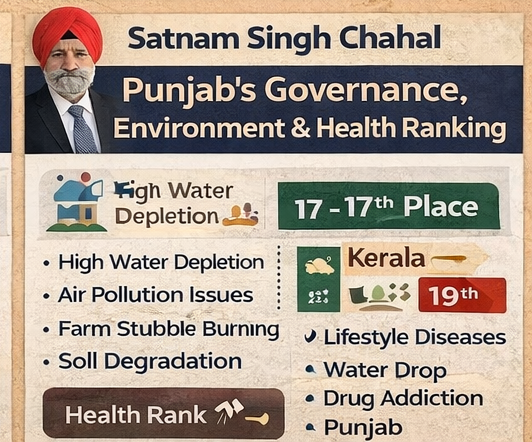
Meanwhile, the ecological consequences are catastrophic. Punjab draws 47% of its water from aquifers, leading to 79% of the state being water-stressed. The state is literally running dry while the river water dispute remains frozen in legal and political limbo.
Punjabi-Speaking Territories Left Behind
A less discussed but equally important grievance concerns the territories that were not included in Punjab after the 1966 reorganization. The 1961 census, which served as the basis for demarcation, recorded fewer Punjabi mother-tongue speakers due to an estimated 2.5 million Punjabi-speaking Hindus opting for Hindi a communal strategy interpreted by Sikhs as a deliberate denial of shared linguistic heritage. This resulted in the exclusion of contiguous Punjabi-speaking belts, fostering a sense of an incomplete cultural homeland that undermined the Act’s promise of identity preservation.
Towns like Ambala, Karnal, Hisar, and parts of what became Haryana had significant Punjabi-speaking populations that were left out through a census exercise widely regarded as politically manipulated. This demographic engineering at the time of reorganization has left deep resentment that no political party has genuinely attempted to address through any serious boundary review.
Who Is Responsible? Everyone and No One
The tragedy of Punjab’s unresolved issues is that responsibility is shared and therefore effectively owned by nobody. The Congress party, which held power at the Centre for most of the decades after 1966, made and broke promises repeatedly. It was Congress under Indira Gandhi that imposed the 1976 water order during the Emergency, and it was Congress under Rajiv Gandhi that signed the Rajiv-Longowal Accord in 1985 and then failed to implement it an act of political betrayal that many historians cite as a key factor in the escalation of Punjab’s militancy.
The Shiromani Akali Dal, the party that most loudly claims to champion Punjab’s interests, has governed the state multiple times but has itself been inconsistent starting SYL construction under Surjit Singh Barnala in the 1980s and then stopping it. The Akali Dal has used Punjab’s grievances as a permanent electoral tool while quietly accepting the status quo when in power. The BJP, which now claims it will “save Punjab’s waters,” has been in power at the Centre for about 12 years and should have given justice to Punjab with the stroke of a pen long ago. And AAP, the newest entrant, has been loud on rhetoric but has produced no concrete movement on any of the foundational issues.
Assertions that Chandigarh belongs to Punjab are not new. What remains absent is the translation of that assertion into policy. The gap between acknowledgment and implementation is the central issue. Every party raises these issues during election season and buries them immediately after. The reason is simple: resolving them would require political courage, federal negotiation, and a willingness to upset powerful constituencies in Haryana and Rajasthan states that also vote in national elections. Punjab’s justice has been sacrificed, election after election, on the altar of national coalition arithmetic.
The Cost of Six Decades of Neglect
The human cost of this political failure is immense. Punjab’s farmers draw water from a rapidly depleting water table because their river waters are tied up in legal disputes. The state runs its government from a city it does not own. Its cultural boundaries remain disputed. And the unresolved anger over these issues contributed directly to the militancy of the 1980s a decade of bloodshed that traumatized a generation and from which Punjab is still healing.
Punjab’s history has been marked by generous contribution to national food security, to economic development and to collective resilience. Its expectation, therefore, is not of concession but of justice: the consistent application of constitutional principles to its own case. A state that fed the nation through the Green Revolution, that contributed disproportionately to India’s defense forces, and that bore the brunt of partition’s violence deserves better than six decades of broken promises. The unresolved issues of 1966 are not historical footnotes they are living wounds, and until India’s political class finds the courage to address them honestly, Punjab will remain a state perpetually short-changed by the republic it helped build.
Referance:Wikipedia,ORF Online, The Tribune,PWOnlyIAS,Grokipedia