
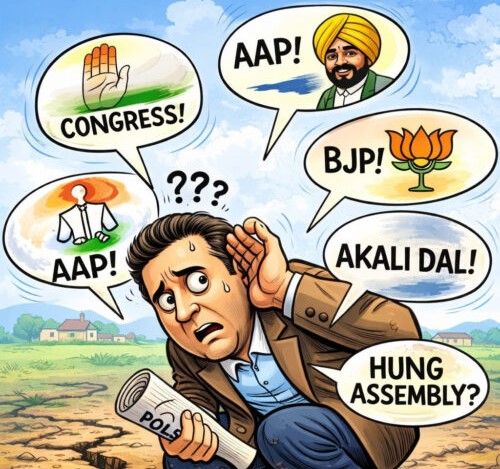
 There was a time when politics in Punjab was not only fought with slogans, resolutions and arrests, sometimes it was fought with jokes, sarcasm and one-line missiles that hit harder than speeches. During the days when Sant Fateh Singh was leading the Akali Dal, political stages often looked half like conferences and half like travelling comedy theatres. Leaders spoke seriously, crowds shouted slogans loudly, and then came the “humorous poets” whose duty was to sprinkle chilli powder on the government’s reputation.
One such famous character was Narendra Bagi. At that time, when many of us were still students trying to pass seventh standard mathematics without divine intervention, Bagi Sahib would arrive on stage with the confidence of a man who had personally audited every government department. His favourite line would echo across the pandal: “The government has eaten the coir, cement has eaten the gravel, and nobody knows what is left for the people!” The audience laughed loudly, some clapped emotionally, while children sitting in the back wondered whether ministers actually sat in offices chewing stones, gravel and construction material like goats with political power.
Back then, these statements sounded exaggerated and funny. One would think, “Surely this poet is adding too much masala.” After all, who could imagine governments swallowing cement, digesting roads, and drinking development funds like lassi? But time is the greatest tuition teacher. As years passed, scandals started appearing one after another like sequel movies nobody asked for. Suddenly, Bagi’s jokes no longer looked like jokes; they looked like warning notices.
Today, when bridges collapse before inauguration, roads develop potholes faster than mushrooms in monsoon season, and public projects cost three times more than planned, one begins to understand the deep philosophy hidden inside Bagi’s comedy. The man was not merely cracking jokes he was performing an early forensic audit through poetry. Modern anti-corruption agencies use files, raids and investigations. Bagi Sahib used rhyming couplets.
In those days, political humour had a strange innocence. Leaders attacked each other with wit instead of twenty-four-hour social media warfare. Nobody carried armies of online trolls. A poet on stage could embarrass an entire administration more effectively than today’s ten press conferences. One sentence from Bagi would travel from village tea stalls to bus stands by evening. Farmers repeated it, shopkeepers decorated conversations with it, and even government supporters secretly smiled because somewhere they also knew that “cement eating” was not entirely fictional.
The funniest part is that Punjab’s political culture has changed, but Bagi’s vocabulary remains evergreen. Only the menu has expanded. Earlier people accused governments of eating cement and gravel. Now citizens joke that files, tenders, flyovers, scholarships, cables, liquor contracts and even parking lots have all become part of the political buffet system. Corruption has become so modern that if Narendra Bagi returned today, he might need PowerPoint presentations instead of poetry to list everything allegedly consumed by the system.
Looking back now, one realizes that satire often tells the truth earlier than official reports do. Humorous poets were not simply entertainers filling time before the main speech. They were public mood detectors. They said openly what ordinary people whispered privately. The crowd laughed because laughter is sometimes the safest way to express frustration.
And perhaps that is why Narendra Bagi’s old lines still survive in memory. At that time they sounded absurd. Today they sound like archived government records written in poetic form