
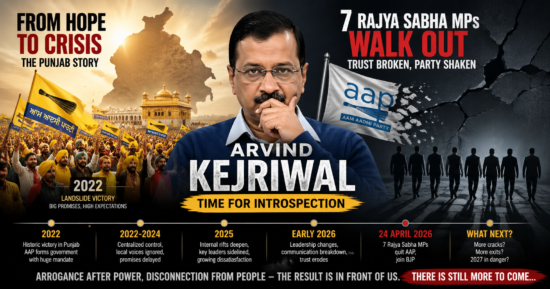
 When the Aam Aadmi Party formed the government in Punjab in March 2022 under Chief Minister Bhagwant Mann, people across the state expected a new era of clean governance, transparency, and strict action against corruption. The party had campaigned aggressively against traditional political parties, accusing previous governments of protecting corrupt leaders and powerful officials. However, within months of forming the government, allegations involving corruption, bribery, sexual harassment, molestation, and abuse of power began surfacing against some ministers, MLAs, party leaders, and officers connected to the administration. These controversies created political embarrassment for the ruling party and raised questions about whether Punjab’s political culture was truly changing or simply repeating old patterns under a new government.
The first major controversy came in May 2022, when Health Minister Vijay Singla was removed from the cabinet after allegations that he demanded a commission on government contracts. The Punjab Vigilance Bureau later arrested him in a corruption case. At that time, the government projected the action as proof that no minister would be spared if found involved in corruption. Supporters of the government praised the decision, saying no previous Punjab government had acted so quickly against its own cabinet minister. However, opposition parties argued that the scandal itself showed corruption had entered the system only weeks after the government took office. Even today, many people remember the Vijay Singla case as the first big shock to the “clean politics” image promoted by AAP during the election campaign.
In February 2023, another controversy emerged when Bathinda Rural MLA Amit Rattan Kotfatta was arrested in connection with an alleged bribery and corruption case. The allegations concerned government grant approvals and the misuse of political influence. The arrest created another major embarrassment because the ruling party had repeatedly claimed that corruption networks would be completely dismantled under its rule. Although the MLA later secured bail and continued legal proceedings, the case strengthened opposition attacks against the government. Critics argued that the anti-corruption promises made before the elections were slowly losing credibility among ordinary citizens.
Over the following years, several other allegations involving ruling-party leaders and government-linked officials continued appearing in headlines. In Jalandhar, MLA Raman Arora faced vigilance scrutiny and allegations linked to corruption and extortion matters. Raids and investigations against him became a major political issue in Punjab. While legal proceedings continued, opposition leaders accused the government of protecting politically influential figures. Supporters of the government, however, claimed that investigations themselves proved that the administration was willing to examine complaints even against members of the ruling party.
The most controversial and politically damaging allegations involved sexual harassment and rape accusations against certain leaders. In 2025, Punjab Health Minister Dr. Balbir Singh faced a sexual harassment complaint filed by a former women’s wing functionary associated with AAP. The complainant accused the minister of harassment, intimidation, and misuse of political power. The minister denied all allegations and described them as politically motivated attempts to damage his reputation. The matter became widely discussed across Punjab because the ruling party had strongly spoken about women’s safety and respect during election campaigns. The case also sparked debates about whether women connected to political organizations feel safe reporting complaints against powerful leaders.
Another major controversy erupted when AAP MLA Harmeet Singh Pathanmajra was booked in a rape and cheating case after a woman accused him of sexual exploitation and misleading her regarding his marital status. Reports related to the case created huge public debate, especially after allegations surfaced that the MLA escaped police custody during arrest proceedings. Opposition parties used the incident to question the government’s seriousness regarding women’s safety and law enforcement. The matter remains under legal proceedings, and no final court verdict has been delivered yet. Nevertheless, the controversy caused significant damage to the public image of the ruling party.
One of the most serious legal developments came in the case involving AAP MLA Manjinder Singh Lalpura. In connection with an older molestation and assault case involving a Dalit woman, the MLA was later convicted by a court and sentenced to imprisonment. This case became particularly significant because it resulted in an actual conviction rather than only allegations or investigations. Political opponents claimed the conviction exposed serious failures in candidate selection and moral accountability within political parties. Many citizens also questioned why individuals facing such allegations continue receiving political support and election tickets in Punjab politics.
Apart from politicians, several officers and government employees working under different departments also faced allegations related to bribery, illegal mining protection, recruitment scams, tender irregularities, extortion, and misuse of office. Punjab Vigilance Bureau investigations increased during this period, and many raids were conducted across the state. However, critics alleged that action often focused on lower-level officers while politically connected individuals managed to avoid serious punishment. Others argued that legal cases in Punjab move extremely slowly, allowing many accused persons to continue in public office or political activity while investigations remain incomplete for years.
A common pattern visible in many of these cases is that allegations are announced publicly, FIRs are registered, raids are conducted, and arrests sometimes take place, but final convictions remain limited. Several accused leaders later secure bail and continue active political life. Some claim they were falsely implicated for political reasons, while others argue that investigations weaken over time because of political pressure or lack of evidence. As a result, the public often becomes confused about whether justice is truly being delivered or whether controversies simply disappear after media attention fades.
These controversies have had a strong political impact on Punjab. Opposition parties such as the Indian National Congress, Shiromani Akali Dal, and Bharatiya Janata Party regularly use these scandals to attack the Bhagwant Mann government. They argue that despite promises of honesty and transparency, Punjab continues witnessing corruption scandals, abuse of power, and misconduct allegations involving influential people. On the other hand, AAP supporters argue that accusations alone should not be treated as proof of guilt and that courts must independently decide every case according to law.
For ordinary citizens, however, the larger concern goes beyond individual cases. Many people in Punjab now openly question why political parties continue giving tickets to controversial candidates, why corruption allegations repeatedly surface in every government, and why powerful leaders often avoid speedy punishment. Citizens also ask why some accused leaders are removed immediately while others remain protected politically. These questions have become part of a broader public debate about governance, accountability, law enforcement, and moral standards in Punjab politics.
The situation has also damaged public trust in political institutions. Many voters who supported change in 2022 now feel disappointed seeing repeated controversies involving ministers, MLAs, party leaders, and officials. Others still hope that stronger investigations and court action in future could improve accountability. But one reality has become increasingly clear: Punjab’s political system continues struggling with allegations of corruption, misuse of authority, and misconduct regardless of which party forms the government. The demand for transparent governance and equal application of law remains one of the biggest expectations among the people of Punjab today.