
 On 31 October 1984, I was a young pre-engineering student at DAV College, Chandigarh. Like many young men of my generation in Punjab, I was living through a time when history had stopped being something written in books; it had entered our homes, our streets, our conversations and our fears.
Punjab was already wounded. Barely four months earlier, Operation Blue Star had shaken the Sikh psyche to its core. The Army’s entry into Sri Harmandir Sahib had left behind anger, grief and disbelief. June 1984 was not an event that ended in June. It lingered in the air, in the silence of families, in the eyes of an entire generation that suddenly felt the relationship between Punjab and the Indian state had changed forever.
My father, Bhupinder Singh Mann, was not in Punjab that day. He was in Maharashtra, addressing a massive farmers’ rally at Tehere in Nashik district under the leadership of late Sharad Joshi. Tens of thousands of farmers had gathered there. It was an era when farmers’ movements still rose above political parties, state boundaries and language. Punjab’s Bharti Kisan Union and Maharashtra’s Shetkari Sanghatana represented a larger awakening of the Indian farmer.
Only months earlier, in March 1984, the unified Bharti Kisan Union under the leadership of S. Bhupinder Singh Mann had laid siege to Punjab Raj Bhavan for nearly seven days. Tens of thousands of farmers participated. Several demands were accepted and a committee under the chairmanship of the eminent agricultural economist Sardar Singh Johal was constituted.
That was a different BKU — united, powerful, feared and respected. Not the fragmented landscape of today, where people jokingly say there are over a hundred BKUs. The farmers’ movement had become a force to reckon with. Political parties, especially the Akali Dal, felt threatened by its growing influence.
BKU gave a call that from May 1 to 7, farmers would not bring wheat into the mandis. Not even a grain arrived. Then came the call to block the “wheat specials” — trains carrying Punjab’s wheat outside the state. Alarmed by BKU’s growing popularity, the Akali Dal hurriedly announced a similar agitation to stop wheat movement from FCI godowns. The competition to occupy the farmers’ political space had begun. The government became nervous enough to drop pamphlets from small aircraft, warning that any stoppage of wheat movement would not be tolerated.
Then came Operation Blue Star.
And Punjab was never the same again.
On 31 October, while my father was addressing the rally at Tehere, someone approached the stage and whispered into his ear: “Indira Gandhi has been shot.”
The speech stopped immediately. My father announced the news. Soon, confirmation arrived that Prime Minister Indira Gandhi was dead.
In that instant, the atmosphere changed.
The Sikh leaders present there were no longer merely guests, speakers or farmer representatives. They had suddenly become vulnerable men in a country rapidly losing its moral balance.
The Train Not Taken
My father and four of his associates were scheduled to board a train to Delhi the following day. But by then, horrifying reports had begun arriving: violence had erupted in Delhi. Sikhs were being attacked. Men were being dragged out of vehicles. Homes and shops were being burnt.
At that critical moment, Bhaskar Baraoke of the Shetkari Sanghatana refused to allow them to travel. Instead, he took them to his farm and kept them hidden for almost seven days, cut off from the outside world. Later, arrangements were made for them to fly from Pune to Amritsar.
The train they were originally supposed to board later passed through areas where Sikh passengers were attacked and butchered.
Back home in Punjab, we had no information about them for nearly three days. Those days felt endless. Every knock at the door brought fear. Every rumour felt real. Then finally came a trunk call informing us they were alive and safe.
That is how thin the line between life and death was in those days. A changed train journey. A friend’s courage. A farmer’s shelter. Such small decisions determined who survived and who did not.
In the darkness of 1984, there were Indians who killed. There were Indians who watched silently. But there were also Indians who saved lives at great personal risk. The story of Bhaskar Baraoke and others like him deserves remembrance because it reminds us that even when institutions failed, humanity did not entirely disappear.
Why “Riot” Is a Lie
What happened in Delhi and several other parts of India after 31 October 1984 was not a riot.
It was not spontaneous street anger. It was not an uncontrolled clash between communities.
It was targeted mass violence against Sikhs.
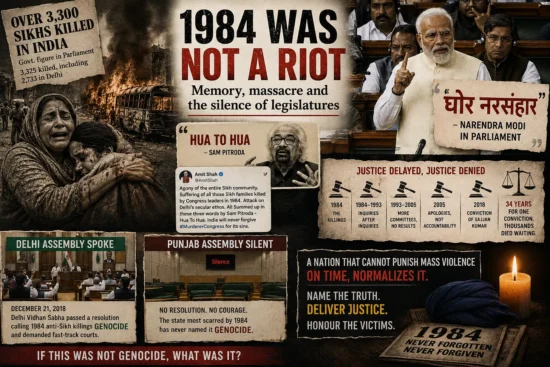
The Government of India itself later informed Parliament that 3,325 people were killed across the country, including 2,733 in Delhi alone. These are official figures. The actual wound, of course, cannot be measured merely in numbers. Every number was a father, son, husband, brother or neighbour.
The Nanavati Commission later described the violence as “organized carnage.” It recorded that mobs were transported, inflammable material was supplied, Sikh homes and businesses were identified, passengers were pulled out of buses and trains, and the police failed shamefully — by omission in some places and by something worse in others.
Years later, while convicting Sajjan Kumar, the Delhi High Court described the killings as “crimes against humanity.” The Court also pointed to a serious gap in Indian law: genocide and crimes against humanity are still not adequately incorporated into domestic criminal law.
That finding should have shaken Parliament.
But India has a strange ability to absorb moral shocks without institutional change.
We continued calling it “riots.”
The word “riot” is convenient. It reduces organized cruelty into public disorder. It dilutes responsibility. It creates the impression of chaos when the historical record clearly shows planning and design.
A riot has no architect.
1984 had many.
Justice That Came Too Late
Perhaps the deepest wound after the killings was the failure of justice.
For decades, many of those accused of leading or instigating the violence remained politically powerful. Survivors moved endlessly between commissions, affidavits and courtrooms while cases collapsed, witnesses weakened and investigations failed.
India saw inquiry after inquiry, yet meaningful accountability came painfully late. The conviction of Sajjan Kumar came thirty-four years after the killings. By then, countless survivors and parents had already died waiting for justice.
Justice delayed on such a scale becomes more than legal failure — it becomes moral failure.
The tragedy of 1984 was not only that thousands of Sikhs were killed, but that many who were accused of orchestrating the violence escaped punishment for most of their lives, while survivors carried fear, grief and silence across generations.
Why I Am Writing This Today
I am writing this today because Mandeep Dhaliwal, a Canadian MLA from Surrey North in British Columbia, has moved a motion seeking formal recognition of the 1984 anti-Sikh killings as genocide.
That development forced me to revisit India’s own legislative record.
Has the Indian Parliament ever formally recognized 1984 as genocide?
Has the Punjab Vidhan Sabha — the legislature of the state most deeply scarred by those events — ever officially called it genocide?
The answer is deeply disturbing.
Even after four decades, there appears to be no adopted resolution of the Indian Parliament formally recognizing the 1984 killings as genocide.
There have been speeches. Debates. Expressions of regret.
Prime Minister Manmohan Singh offered an unconditional apology in Parliament in 2005, bowing his head “in shame.” Sonia Gandhi expressed regret over the tragedy. Rahul Gandhi later acknowledged that the Congress party had made historic mistakes and that responsibility could not be denied.
Prime Minister Narendra Modi referred to 1984 as a “bhayankar narsanhar” — a terrible genocide — while attacking Congress over Sam Pitroda’s controversial “hua to hua” remarks. Amit Shah called those remarks an insult to the agony of Sikh families and India’s secular ethos.
But speeches are not resolutions.
Regret is not recognition.
Political rhetoric is not institutional memory.
The word genocide has entered Parliament’s air, but not Parliament’s formal record through an adopted resolution.
Delhi Spoke. Punjab Did Not.
The most significant legislative recognition came not from Parliament and not from Punjab, but from Delhi.
In December 2018, the Delhi Vidhan Sabha adopted a resolution moved by MLA Jarnail Singh explicitly calling the 1984 killings genocide. The resolution demanded fast-track courts and urged that genocide and crimes against humanity be incorporated into Indian criminal law.
Delhi — where the largest number of Sikhs were killed — at least found the courage to name the crime.
Punjab did not.
That silence is painful.
I found reports of attempts to move such a resolution in Punjab Assembly in 2017. But I could find no confirmation that any such resolution was actually adopted.
That silence is not merely procedural. It is historical.
Punjab has carried 1984 in its bones. Every Sikh family knows what happened. The Akal Takht declared the killings genocide in 2010. The Sikh community never needed legislative certification to understand what it suffered.
But the state must speak not because victims are confused, but because the Republic must be honest.
And here the role of the Akali Dal cannot be ignored. The party ruled Punjab for more than two decades after 1984. It built much of its politics around Sikh identity, Sikh rights and Sikh hurt. Yet during its long years in power, no formal Punjab Assembly resolution recognizing 1984 as genocide appears to have been passed.
Why?
Was it political caution? Fear of Delhi? Coalition compulsions? Or the old habit of using Sikh pain electorally while avoiding institutional courage?
These questions deserve answers.
The Duty to Name
The demand to call 1984 a genocide is not a demand for revenge. It is not a call for communal bitterness. Nor is it an attempt to reopen wounds for political gain.
It is a demand for truth.
A nation cannot heal what it refuses to name.
Words matter because words become history. They enter textbooks, shape legal thinking and define collective memory. They determine whether future generations understand an event as a disturbance, a riot, a massacre, a pogrom, a crime against humanity — or genocide.
Survivors already know the truth. But the Republic owes them more than compensation files, commissions of inquiry and delayed convictions. It owes them moral clarity.
If legislative bodies can pass resolutions on injustices across the world, surely they can speak honestly about one of the darkest crimes committed in independent India.
Two Indias in 1984
Whenever I think of 1984, I think of two Indias.
One India dragged Sikhs out of trains, distributed kerosene, burnt homes, used lists, shouted slogans and transformed grief into organized vengeance.
The other India hid Sikh leaders on farms, protected neighbours, opened doors, risked lives and refused to join the mob.
My father survived because that second India existed.
Thousands died because the first India was allowed to rule the streets.
A mature Republic must remember both. It must honour the rescuers. But it must also name the crime honestly.
Today, when legislatures abroad debate whether 1984 should be recognized as genocide, India should not react with irritation. It should look inward.
The embarrassment is not that others are speaking.
The embarrassment is that we still hesitate to speak with sufficient honesty ourselves.
Forty-two years later, 1984 remains not only an unpunished crime and an unhealed wound, but also an officially undernamed truth.
And until Parliament and the Punjab Vidhan Sabha find the courage to say plainly what survivors have known for decades, the ghosts of 1984 will continue asking one uncomfortable question:
If this was not genocide, then what was it?