
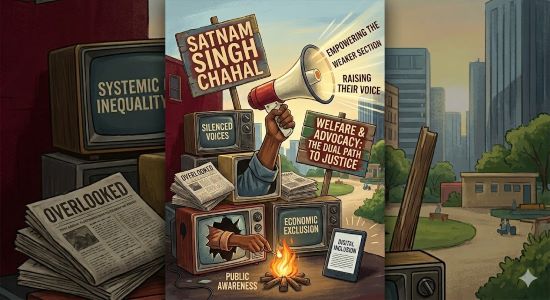
 In today’s world, the role of media is more important than ever. Media is often called the fourth pillar of democracy because it has the power to raise the voice of ordinary people, expose injustice, and bring attention to the real problems faced by society. But unfortunately, a large section of modern media appears more interested in promoting celebrity weddings, fashion shows, and Bollywood gossip than highlighting the struggles of common people who are fighting daily for survival.
Every day, millions of hardworking people wake up early in the morning worrying about how they will earn enough money to feed their families. Farmers are struggling with debt, labourers are searching for work, youth are suffering from unemployment, small businessmen are facing financial pressure, and many families are unable to afford education or healthcare. These are the issues that directly affect society. These are the stories that deserve headlines and national debates.
Instead, many television channels and social media platforms spend hours discussing the marriage functions of Bollywood stars, the clothes they wear, the luxury hotels they stay in, and the expensive gifts exchanged during celebrity events. One must ask an important question: how does this information help the ordinary citizen? How does a celebrity wedding improve the life of a farmer in Punjab, a worker in Delhi, or a struggling family in a village or city?
Media should become the mirror of society, not the marketing agency of celebrities. When people are suffering from inflation, unemployment, drug abuse, corruption, crime, and lack of justice, the media should stand with the public and bring these issues to the forefront. Journalism was never meant to entertain people all day while ignoring the pain of the nation. Its duty is to inform, educate, and awaken society.
There was a time when journalists were respected because they risked their lives to expose corruption and injustice. Investigative journalism helped society understand the truth and forced governments to answer difficult questions. Today, however, sensationalism and TRP competition have weakened the true spirit of journalism. Emotional debates, celebrity gossip, and political drama often receive more coverage than the real issues of schools, hospitals, farmers, workers, and rising crime.
Social media has also changed public priorities. Many people are unknowingly becoming addicted to celebrity culture while slowly losing sensitivity toward the struggles happening around them. A poor family losing their home due to financial hardship may not receive even two minutes of attention, while a celebrity wedding can dominate headlines for weeks. This imbalance reflects a serious moral and social crisis.
The media must understand that its responsibility is not only to gain views and advertisements but also to serve society. If media organizations genuinely want to contribute to the nation, they should focus more on public welfare issues such as unemployment, drug addiction, education, healthcare, farmer suicides, corruption, women’s safety, and justice for victims. Highlighting these issues can create awareness, pressure authorities to act, and inspire positive change.
The public also has a responsibility. People should support responsible journalism instead of blindly consuming meaningless entertainment content. If viewers demand serious reporting and stop encouraging unnecessary sensationalism, media houses will eventually be forced to change their priorities.
A society becomes stronger when its media speaks for the weak, the poor, and the unheard. The real heroes of society are not always movie stars or celebrities. Sometimes, they are farmers feeding the nation, labourers building cities, teachers educating children, and ordinary citizens struggling honestly to survive. Their stories deserve respect, attention, and recognition.
The true purpose of media should be to serve humanity, strengthen democracy, and become the voice of the common people — not merely to celebrate glamour while ignoring the suffering of society.