
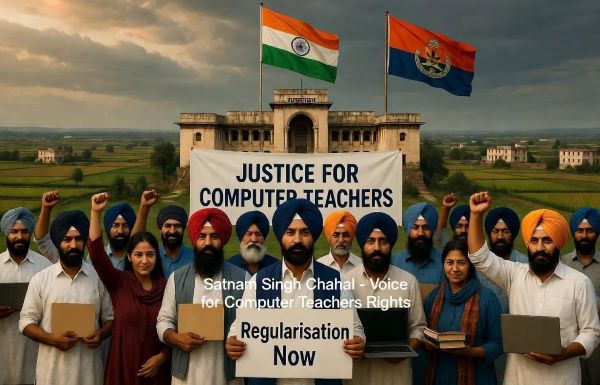
 Computer teachers employed in Punjab’s government schools through the Punjab Information and Communication Technology Education Society (PICTES) have been at the forefront of sustained protests for several years, demanding job regularization, pay parity, and full government employee benefits. Recruited since around 2011 to support ICT education, these teachers have served for over a decade delivering essential digital learning but continue to face contractual or semi-regular status despite performing regular teaching duties. Core demands include full absorption under Punjab Civil Services Rules, merger into the Education Department, implementation of the Sixth Pay Commission benefits instead of the Fifth, revised dearness allowance, timely salary releases, exemption from non-academic duties such as preparing Chief Minister Health Insurance Cards, and other service benefits like death coverage and medical reimbursement.
Protests have intensified from 2024 into 2026, featuring hunger strikes, dharnas near Chief Minister Bhagwant Mann’s residence, rallies in districts like Ludhiana, Mohali, and Phagwara, gheraos, and threats of larger actions including in Delhi. Unions such as the Computer Teachers Union Punjab and Computer Adhyapak Sangharsh Committee have coordinated these efforts, highlighting salary delays of several months, unfulfilled promises from meetings with the Education Minister, and the impact on teacher morale and students’ digital education quality. The Punjab and Haryana High Court has affirmed their status as government employees entitled to Civil Services rules, yet implementation remains slow, leading to accusations of administrative lethargy and broken commitments despite the AAP government’s 2022 manifesto pledges.
The Punjab government under CM Bhagwant Mann has engaged in dialogues and taken partial steps, such as some regularization notifications, dearness allowance revisions, and assurances during meetings, but has not fully accepted or implemented the comprehensive demands. Key reasons include significant financial implications for thousands of teachers involving higher pay scales, full benefits, and long-term liabilities, which strain the state’s fiscal resources amid other priorities like infrastructure and education schemes. Administrative and bureaucratic hurdles in processing salaries through the multi-layered PICTES-treasury-district system, along with policy preferences for maintaining flexibility in contractual models, have contributed to delays. Officials cite ongoing processes and resource constraints, while teachers argue that high-visibility digital initiatives overlook frontline educators who drive them.
This prolonged stalemate reflects broader systemic challenges in Punjab’s education sector, including the contractualization of specialized staff and gaps in integrating them into mainstream services. The agitations not only affect teacher welfare but also risk undermining the state’s push for technological advancement in schools, particularly in rural areas. Resolution through a clear, time-bound government notification addressing financial, administrative, and structural bottlenecks via continued dialogue would help restore trust, stabilize the teaching workforce, and support quality ICT education for Punjab’s students. As protests continue, the situation underscores the need for balanced policies that value long-serving educators while managing public finances prudently.
Why the Punjab Government Has Not Fully Accepted Computer Teachers’ Demands
The AAP government under Chief Minister Bhagwant Mann has engaged with computer teachers’ unions through meetings and made some assurances, but full acceptance and implementation of core demands such as complete regularization under Punjab Civil Services Rules, merger into the Education Department, full Sixth Pay Commission benefits, timely salaries, and exemption from non-academic duties remain pending as of mid-2026. Teachers describe this as “deliberate delay,” while the government points to administrative, financial, and procedural complexities. 
Key Reasons for Delay (From Reports and Protests)
1. Administrative and Bureaucratic Hurdles: Salaries are processed through a multi-layered system (PICTES → Treasury → District Education Officers Schools), causing frequent delays of months. Even after partial regularization orders (e.g., in 2025 for some teachers effective from 2011 but still within PICTES), full integration and benefit parity have not materialized due to “administrative lethargy.” Teachers remain treated as PICTES/contractual staff for many purposes despite court affirmations of their government employee status.
2. Financial Implications: Implementing the Sixth Pay Commission, revised DA, full medical reimbursement, death benefits, and parity with regular teachers involves significant additional expenditure for thousands of teachers. The state government faces broader fiscal pressures, including commitments to other employee groups, education schemes, and infrastructure projects. Partial steps like DA hikes (e.g., from 148% to 181% effective 2025) have been announced, but comprehensive rollout is stalled.
3. Structural/Policy Issues: Full merger into the Education Department and absorption under Civil Services Rules would alter service conditions permanently. Governments (including previous ones) have historically preferred contractual or society-based models for flexibility and lower long-term liability. Despite promises in the 2022 AAP manifesto and by Education Minister Harjot Singh Bains (e.g., Diwali “gift” in 2022), concrete notifications and implementation have lagged.
4. Political and Prioritization Factors: Critics argue the government prioritizes high-visibility schemes (e.g., school upgrades, digital initiatives) over resolving frontline staff grievances. Protests highlight unfulfilled meeting outcomes and lack of time-bound roadmaps. Teachers have intensified actions hunger strikes, dharnas, rallies — accusing the government of ignoring their contributions to digital education while assigning them non-teaching tasks like CM Health Insurance Card work. The government has held dialogues, issued some regularization notifications, and implemented select benefits like DA revisions. Officials often cite ongoing processes and resource constraints. However, unions say acknowledgments during meetings have not translated into action, leading to accusations of broken promises. 
Referance: Reports from The Tribune, Hindustan Times, and union statements.