
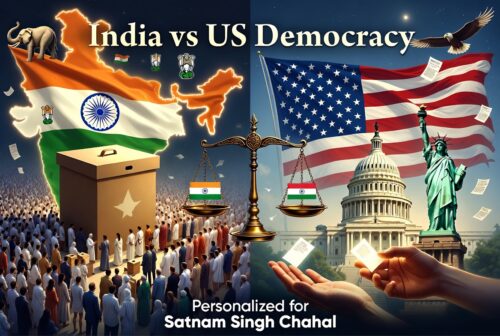
 India’s democracy stands out as a remarkable electoral success, particularly when viewed through the lens of its citizens. According to a 2025 Pew Research Center survey across 23 countries, around 74% of Indian adults express satisfaction with how democracy is working in their country. This places India among the highest in public approval, second only to Sweden, and well above the global median of 42% satisfied. In sharp contrast, satisfaction is much lower in many established democracies, such as the United States at about 31%. This high domestic contentment in India is often linked to strong voter participation, the scale of the world’s largest elections, and positive perceptions of economic and national progress.
However, when assessed by independent expert indices, India’s democratic performance receives more mixed evaluations. Organisations like V-Dem classify India as an “electoral autocracy” with notable declines in liberal democratic standards since around 2008. Its liberal democracy score hovers around 0.26, significantly lower than Nordic countries which often exceed 0.8. Freedom House rates India as “Partly Free” with a score in the low 60s out of 100, citing concerns over civil liberties, media freedom, and institutional independence. Similarly, the Economist Intelligence Unit’s 2025 Democracy Index places India in the “flawed democracy” category with a score of approximately 6.96 out of 10, reflecting a slight decline and positioning it behind many Western nations but ahead of several authoritarian states. India’s strengths lie primarily in its robust multiparty electoral system, regular elections with massive turnout, and the possibility of power alternations, as seen in the 2024 national results. These features enable vibrant political competition, especially at the state level.
In comparison to neighbors like China or Pakistan, India clearly offers far greater democratic space through genuine electoral contests. Yet, relative to consolidated democracies in Europe or North America, India scores lower on protections for freedom of expression, minority rights, judicial autonomy, and checks on executive power. International monitors frequently highlight issues such as selective enforcement against opposition figures, media constraints, and challenges to institutional neutrality.Overall, India excels in delivering large-scale electoral democracy and enjoys strong public support from its citizens, but it lags in liberal democratic safeguards according to global expert assessments. This creates a notable gap between how Indians themselves view their democracy predominantly positive and how external analysts evaluate its health. While global democracy trends showed some stabilization in 2025, India’s trajectory reflects both the resilience of its electoral model and ongoing debates about deepening institutional protections. This pattern is not unique, as several other large developing democracies also show similar divergences between public sentiment and expert ratings.
Public satisfaction with democracy remains markedly higher in India than in the United States. According to the 2025 Pew Research Center survey, around 74% of Indian adults express satisfaction with how democracy is working in their country, placing India near the top among surveyed nations. In contrast, only about 30-31% of Americans say they are satisfied, with roughly 69% expressing dissatisfaction. This significant gap reflects differing national contexts: many Indians link their positive view to the scale of elections, high voter turnout, and perceived national progress, while Americans often cite polarization, institutional gridlock, and governance challenges as sources of frustration.When evaluated through expert indices, the picture shows both countries facing democratic strains but in different ways.
In the V-Dem 2026 report, India is classified as an electoral autocracy with a liberal democracy score of approximately 0.26, having experienced steady declines since around 2008. The United States, meanwhile, holds a higher liberal democracy score of 0.57 but has lost its long-held liberal democracy status and recorded a sharp recent drop, falling to levels last seen in 1965. On electoral democracy measures, the US performs better at around 0.74 compared to India’s 0.38. Freedom House rates the US as “Free” with a score of 81 out of 100, while India is categorized as “Partly Free” at around 62/100. The Economist Intelligence Unit’s 2025 Democracy Index places both in the “flawed democracy” category, with the US scoring higher at about 7.65/10 versus India’s 6.96/10.
India’s democratic strengths lie primarily in its massive electoral machinery, regular multiparty competitions, and strong public engagement, as demonstrated by power shifts in the 2024 elections. It outperforms many nations in sheer scale and participation. The United States retains advantages in institutional safeguards, rule of law, judicial independence, and protections for civil liberties, even after recent erosion. However, both countries face notable criticisms: India on issues of media freedom, minority rights, and institutional neutrality, and the US on polarization, executive overreach, and declining trust in core institutions.Overall, India excels in delivering large-scale electoral democracy with robust domestic legitimacy, while the US maintains a stronger foundation in liberal democratic norms despite recent declines. The contrast highlights how public perception in India is far more positive than expert assessments, whereas in the US both citizens and analysts express concern. These two major democracies continue to shape global trends, each grappling with distinct challenges to their systems