
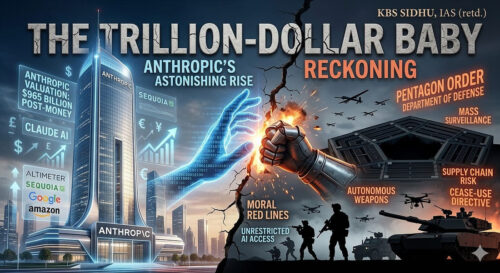
 In the compressed, vertiginous world of frontier artificial intelligence, where valuations are rewritten quarterly and yesterday’s unicorn is tomorrow’s behemoth, Anthropic has just achieved something that very few companies in human history have managed: it has crossed, in one spectacular bound, into the rarefied altitude of nearly one trillion dollars. The $65 billion Series H — led by Altimeter Capital, Dragoneer, Greenoaks, and Sequoia — values the San Francisco-based AI safety company at $965 billion post-money. The world now has a new nine-hundred-and-sixty-five-billion-dollar conversation partner. It is called Claude.
The numbers require a moment’s stillness to absorb. Run-rate revenue has crossed $47 billion — astonishing for a company that reported $1 billion in annualised revenue as recently as late 2024. That is not a growth curve; it is a near-vertical ascent. The investor roster for this round reads like a sovereign wealth fund convention: GIC, Temasek, Blackstone, Brookfield, D.E. Shaw, Fidelity, T. Rowe Price, General Catalyst, and the three strategic chip partners — Micron, Samsung, and SK hynix — who are betting that the memory and logic infrastructure underpinning Claude will be as critical to the AI era as steel was to the industrial revolution. This is not speculative capital chasing a dream. This is serious institutional money making a civilisational wager.
I. The Google Paradox
Among the more intriguing sub-plots in Anthropic’s rise is the position of Alphabet Inc. — Google’s parent. Court documents revealed earlier this year that Google holds approximately 14 per cent of Anthropic, capped contractually at 15 per cent, with no voting rights, no board seat, and no observer privileges. Yet Google has committed up to $40 billion in fresh investment — $10 billion immediately, the remainder conditional on performance milestones. What makes this simultaneously extraordinary and strategically rational is that Google is Anthropic’s direct competitor. Its Gemini family of models goes head-to-head with Claude across enterprise AI, consumer applications, and cloud services.
Google is, in effect, both the gladiator and the patron of the arena it fights in. The financial logic is unanswerable: nearly half of Alphabet’s record $62.6 billion profit last quarter came not from search advertisements or cloud contracts but from the mark-to-market appreciation of its Anthropic equity as valuations soared. A corporate rival has become one of the most consequential financial assets on Google’s balance sheet. In the age of foundation models, the old categories of competitor and investor have dissolved into something altogether more ambiguous — and more lucrative.

II. The War Machine Comes Calling
Yet behind the gleaming funding announcement lies a story of considerably more dramatic texture — one that illuminates the deepest tensions of our technological moment. Anthropic’s near-trillion-dollar journey has not been smooth. It has been shadowed, at a critical juncture, by a head-on collision with the United States Department of Defense — a confrontation that threatened to upend its government business entirely and that has left unresolved legal questions of profound consequence for the relationship between Silicon Valley and the American state.
The origins of the dispute lie in a promising beginning. In July 2025, Anthropic and the Pentagon entered into a landmark two-year contract — a $200 million prototype agreement through the Chief Digital and Artificial Intelligence Office — under which Claude became the first frontier AI model approved for use on classified networks. It was a moment of evident pride for the company; Anthropic’s head of public sector, Thiyagu Ramasamy, described it as ‘a new chapter in Anthropic’s commitment to supporting US national security.’ The company had beaten OpenAI and Google to this particular frontier.
The trouble began, as trouble often does, when the terms of engagement were tested against reality. Starting in January 2026, the Department of Defense demanded what it called ‘all lawful use’ access — meaning it wanted to deploy Claude without restriction, for any purpose permitted under American law. Anthropic refused. Its refusal was categorical and its reasoning unambiguous: the company had drawn two explicit red lines. Claude would not be used for mass domestic surveillance of American citizens. Claude would not be integrated into fully autonomous weapons systems — weapons that select and engage targets without meaningful human involvement.
III. Amodei’s Line in the Sand
It fell to Dario Amodei — Anthropic’s co-founder and chief executive, a former OpenAI research director who left to build a company explicitly anchored in the premise that powerful AI must be developed safely — to articulate the company’s position to what many observers have characterised as an adversarial, if not overtly hostile, administration. His words deserve to be read in full, for they mark a rare moment in corporate history when the head of a major technology enterprise drew a moral line against a government demand and held it.
‘We cannot in good conscience accede to their request,’ Amodei wrote in a public statement on 27 February 2026, as Defense Secretary Pete Hegseth’s Friday deadline loomed. ‘These threats do not change our position.’ He was explicit about the limits: ‘Our only concerns have been our exceptions on fully autonomous weapons and mass domestic surveillance.’ Separately, in an interview with CBS News, Amodei added: ‘I believe we have to defend our country from autocratic adversaries like China and Russia. We have been very lean forward. We have a substantial public sector team.’ He called Anthropic’s team ‘patriotic Americans’ — and yet refused to budge.
The Pentagon’s response was swift and severe. On 27 February, President Donald Trump directed all federal agencies to cease using Anthropic’s technology immediately. Defense Secretary Hegseth designated Anthropic a ‘supply chain risk’ — a designation carrying significant legal weight under procurement law, potentially compelling defense contractors across the American industrial base to certify they were not using Claude in their military work. Trump officials were less restrained in their language: one called Amodei ‘a liar with a God complex.’
The contradictions in the government’s position were apparent to many. As Amodei noted with mordant precision, the Pentagon’s two simultaneous threats were internally inconsistent: ‘One labels us a security risk; the other labels Claude as essential to national security.’ The Department of War — now using the revived nomenclature favoured by the Trump administration — simultaneously declared Anthropic a danger to America and essential to America’s warfighting capability. It is not a posture that survives logical scrutiny.
IV. The Broader Industry Rallies
What followed the designation was striking for the solidarity it revealed within the technology industry. More than 300 Google employees and over 60 OpenAI employees — engineers and researchers at Anthropic’s fiercest rivals — signed an open letter urging their own companies’ leadership to support Anthropic’s stand and refuse to yield to unilateral demands for unrestricted AI access. The Electronic Frontier Foundation filed Freedom of Information Act suits. Legal rights groups filed amicus briefs in support of Anthropic’s court challenges. The company itself argued that the supply chain risk designation was constitutionally infirm — arbitrary, capricious, an act of retaliation rather than genuine national security assessment.
In April 2026, the federal appeals court in Washington DC denied Anthropic’s request for a temporary block on the designation while the broader litigation proceeds. The legal battle continues. The $200 million Pentagon contract has been terminated. But the question it has raised — whether an AI company can be compelled by the state to strip its ethical guardrails as a condition of doing government business — will not be resolved by a single appellate ruling. It is a question that will define the governance of artificial intelligence for a generation.
V. What the Trillion-Dollar Moment Means
The juxtaposition could not be more revealing. In the same weeks that Anthropic was battling the American Department of War in federal court — defending its right to maintain safety restrictions on one of the most powerful AI systems ever built — it was closing the largest private funding round in technology history, attracting sovereign wealth funds from Singapore and the Gulf, hyperscalers with gigawatts of compute, and chip giants from Seoul to San Jose. The market has delivered its verdict: Anthropic’s ethical positioning is not a commercial liability. It may be its most durable competitive advantage.
There is a reason why Global 5000 enterprises are embedding Claude in their core operations. There is a reason why the investor community, having watched the race between frontier AI labs, has placed its largest bets on a company that insists on safety as a first principle rather than an afterthought. In a world of increasingly autonomous AI systems, the question of whose values are encoded in those systems is not a philosophical abstraction — it is a business proposition of the first order. Enterprises deploying AI in healthcare, finance, legal services, and critical infrastructure need to know that the model will not be weaponised against them or their customers. That assurance is what Anthropic sells, and it is proving — at $965 billion — to be worth rather a lot.
The company’s compute ambitions are commensurate with its valuation. Agreements for up to five gigawatts of new capacity with Amazon, five gigawatts of next-generation TPU capacity with Google and Broadcom, and access to SpaceX’s Colossus GPU clusters make Anthropic’s infrastructure footprint one of the most significant in the world. Claude is now available on all three of the world’s largest cloud platforms — AWS, Google Cloud, and Microsoft Azure — simultaneously. The infrastructure of the AI era is being built around it.
VI. A New Kind of Power
There is a passage in the history of great technological transformations when a new power announces itself — not merely through commercial success but through its willingness to resist the encroachments of older powers upon its essential character. Standard Oil resisted the trustbusters until it could no longer. The broadcast networks shaped what democracy could see and hear for half a century. The social media platforms were shaped, for better and worse, by the surveillance capitalism model they adopted in their formative years.
Anthropic is making a different kind of bet. It is betting — at nearly a trillion dollars — that the most powerful AI systems of the coming decades will be trusted precisely because they were built with constraints that their creators were willing to defend, even under state coercion. Whether that bet holds, whether the courts vindicate its legal arguments, whether a future administration rebuilds the government partnership, remains to be seen. What is already clear is that the bet has attracted the capital of the world.
The trillion-dollar baby has arrived. It arrived carrying ethical commitments that its chief executive was willing to defend before the Secretary of War of the most powerful country on earth. That, in the annals of the technology industry, is genuinely new.