
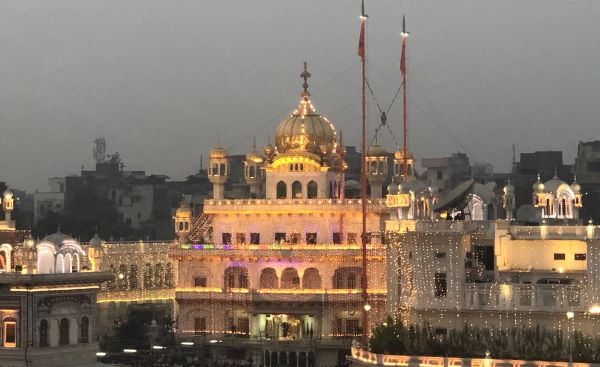
 Forty-two years ago this week, the Indian Army entered the precincts of Sri Harimandar Sahib — the Golden Temple — in Amritsar. The assault lasted several days. The casualties ran into hundreds, including innocent pilgrims who had come to observe the martyrdom anniversary of Guru Arjan Dev Ji and found themselves trapped in a military operation they had nothing to do with. Sri Akal Takht Sahib, the temporal seat of Sikh sovereignty built by the Sixth Guru himself, was reduced to rubble.
I joined the Indian Administrative Service in 1984 — the same year as the tragedy. It was not a coincidence I could easily set aside. It has shadowed my entire administrative life, and it shadows this reflection.
The Sikh community worldwide pauses every June. We grieve. We remember. And then — and this, I believe, is the most profound statement we make — we return to the work of living.
What History Has Decided
If Operation Blue Star was intended to break the Sikh spirit, history has delivered its verdict: it failed. Not partially. Completely.
What rose from those blood-soaked courtyards was not a defeated people nursing grievance in silence. It was a civilisation gathering itself, dusting the rubble from its shoulders, and walking forward — turbaned, unbroken, and increasingly irreplaceable to the world.
Consider what forty-two years have produced. Punjabi farmers — Sikh farmers — continue to feed a nation of 1.4 billion people. The Green Revolution was seeded in this soil, by these hands. Through drought and debt, through decades of policy neglect and market distortion, through the heartbreak of agrarian distress, the Punjabi kisaan has never stopped sowing. That is not stubbornness. It is theology made practical — Kirat Karo, the Guru’s commandment to labour with dignity, without complaint and without surrender.
Consider Dr. Manmohan Singh — a turbaned Sikh boy who crossed the Partition as a refugee carrying nothing but a family’s hope, and rose to become Prime Minister of India. Twice. In the years after 1984, when Sikh identity in the national imagination had been made synonymous with suspicion, Manmohan Singh sat at the apex of the Republic. He wore his turban at every summit, every address to Parliament. He did not hide. He governed. His passing in December 2024 was mourned across the world, and rightly so. He embodied something the Gurus taught: that intellectual humility and moral seriousness are not liabilities in the arena of power. They are its rarest strengths.
Consider the Sikh diaspora — now among the most consequential communities on earth. In Canada, Jagmeet Singh led a national political party wearing a dastar and speaking of love and courage. Harjit Sajjan served as Defence Minister. In Britain, Sikhs sit in both Houses of Parliament. In boardrooms, hospitals, universities, and legislatures across four continents, Sikhs hold ground and earn respect. The Guru’s langar — that ancient institution of free, universal, dignified food — fed the homeless in London, the flood-displaced in Louisiana, the earthquake survivors in Turkey, asking nothing in return. That is Sikhi’s answer to the world’s cruelty. The world has noticed.
The Panth breathes. It builds. It governs. It leads.
The Constitution Is Not Our Enemy
I joined the IAS as a Sikh who took an oath to uphold the Constitution of India. In forty years of public service, I never found that oath in contradiction with my faith. In fact, I found the opposite.
The Constitution that some have condemned is, read carefully, among the few in the world that explicitly grants certain Fundamental Rights exclusively to minorities. Articles 29 and 30 enshrine the cultural and educational rights of religious and linguistic minorities — rights not equally vested in the majority community. Article 25, which Sikh leaders publicly burned copies of in 1982 protesting the clubbing of Sikhism with Hinduism, contains in Explanation I an explicit constitutional guarantee of the Sikh’s right to wear the Kirpan as part of their essential religious practice. That is not hostility. That is legal acknowledgment of Sikh distinctiveness, written into the founding document of the Republic.
The wounds of 1984 come from Congress and its leadership — they must be named clearly, without deflection. The anti-Sikh pogram in Delhi in October-November 1984, following Indira Gandhi’s assassination, was organised and Congress-abetted. Justice has been delayed scandalously, denied in many cases entirely. That reckoning is not complete and must not be allowed to lapse. But let us not conflate the wound with the Constitution it violated.
A Sikh who understands what the Constitution actually says — not what political actors have distorted it into — will find more protection than adversity within it.
What We Owe Ourselves: An Honest Reckoning
Yet we would be dishonest — and the Gurus named dishonesty explicitly as sin — if we did not pause and look inward.
The Panth carries fractures that, if left unattended, will cost us dearly. The SGPC, the institutional parliament of the Sikhs, has not held a general election since 2011. Over 70 lakh Sehajdhari Sikhs remain disenfranchised by a retrospective parliamentary amendment pushed through in 2016. Sri Akal Takht Sahib continues to speak with moral authority — as it demonstrated powerfully in the confrontation with the Punjab AAP government over the Jaagat Jot SGGS Satkar Act earlier this year — but its authority is undermined when the democratic foundations beneath it are left to rot.
Punjab’s drug crisis is not a law enforcement failure alone. It is a civilisational warning signal. Our youth — brilliant, restless, globally mobile — are leaving not merely for opportunity but from despair. The agriculture that our ancestors made legendary now struggles to sustain subsistence on subdivided, indebted holdings. Indigenous business families from Ludhiana invest in Madhya Pradesh because approvals are faster and political interference is less. These are not abstractions. They are symptoms of a state that has drifted from its own best potential.
We argue ferociously on social media. We organise inadequately on the ground. We produce heat without light, passion without programme.
The “Khalistan” Question: Honesty Over Comfort
There is one subject on which I will not offer comfort where clarity is needed.
The Khalistan demand — as it is currently pursued, primarily from abroad, by a small but vocal minority — serves neither the Panth nor Punjab. It serves, above all, those who have made it their profession, their identity, and their political currency in adopted homelands far from the fields they claim to be fighting for. I will not honour them by naming them — whether they operate from the United States, Canada, the United Kingdom, or even from within Punjab itself. They know who they are. The Panth knows who they are.
The overwhelming majority of Sikhs in Punjab do not want Khalistan. They want justice for 1984. They want a fair MSP. They want their children to have futures that don’t require selling ancestral land to fund a Canadian study visa. These are legitimate, urgent, entirely achievable demands. They have nothing to do with a territorial project that lacks international legitimacy, internal consensus, and any coherent strategic depth.
The Gurus never taught us to fight battles we cannot win when the same energies could secure the dignity, rights, and flourishing of the Panth where we already live and lead. A territorial demand pursued without the conditions that made other national movements succeed risks consuming our most vital energies while delivering our adversaries a convenient narrative with which to delegitimise every legitimate Sikh grievance.
And now, even the world outside is sending this message. On 23 May 2026, Prime Minister Mark Carney of Canada issued a formal statement on the 112th anniversary of the Komagata Maru, calling it “one of the darkest chapters in our history — a moment where Canada failed to uphold our values.” That acknowledgment matters and deserves to be received with dignity. But Carney’s Canada has also made clear, through the trajectory of his government, that it intends to be a country where its citizens — including its Sikh citizens — build their futures as Canadians. His administration has sought warmer ties with India, quietly managed down the crisis his predecessor ignited, and signalled unmistakably that Canada’s Sikh diaspora is welcome as contributors to a united, inclusive Canada — not as proxies for a territorial dispute on the subcontinent.
The message, heard across capitals, is consistent: take your grievances through democratic channels, build institutions, earn influence through excellence — and leave the politics of partition in the past where it belongs.
The Architecture of Continuity
We must learn — without shame and without the anxiety of comparison — from the Jewish experience. Not their statecraft, which carries its own moral complexities, but their architecture of continuity: the insistence on education as sacred, the global network of institutions that speaks in one coherent voice when it must, the meticulous investment in historical documentation so that memory cannot be falsified, the understanding that diaspora and homeland are not in competition but in covenant.
Sikhs number perhaps 30 million worldwide. We have produced Prime Ministers, Defence Ministers, generals, Nobel-calibre economists, globally celebrated physicians, and artists whose work has crossed every cultural frontier. The lesson from the Jewish example is not in numbers. It is in organisation, in institutional depth, in the willingness to fund ideas as seriously as we fund langars.
What the Panth needs is not another talking forum. It needs a globally networked Sikh institution with research capacity, legal standing, diplomatic relationships, and the discipline to distinguish between what is strategically wise and what is merely emotionally satisfying.
Justice for 1984. Democratic elections for the SGPC, immediately. A thriving Punjab built on indigenous entrepreneurship — with the diaspora as angel investors, not merely donors. A globally coherent Sikh voice that speaks for the whole Panth, not for factional interest. These are not smaller ambitions than Khalistan. They are harder ones. And they are the ones that will endure.
And Yet — Here We Are
Muhammad Iqbal — that great poet of the soul who loved the Guru’s Bani as deeply as his own Persian verse — wrote of a people who refused to be extinguished:
Kuch baat hai ke hasti mit-ti nahin hamari,
Sadiyon raha hai dushman daur-e-zamana hamara.
There is something in us that will not be erased —
For centuries, the age itself has been our adversary.
Forty-two years on, we remember with tears and we rise with resolve. We carry our dead with us — not as weight, but as witness. We carry Sri Guru Granth Sahib Ji’s sovereign word as our convenant, our compass, and our comfort.