
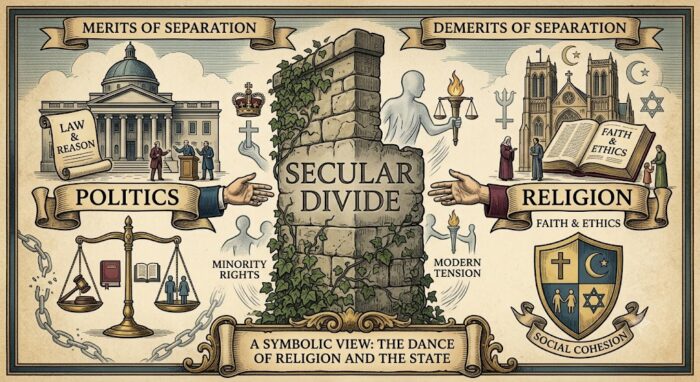
 The separation of religion and politics, often referred to as secularism, is a foundational pillar of modern democratic governance. While the concept traces its roots back to the Enlightenment, its application varies wildly across the globe. Today, dozens of major countries explicitly or implicitly mandate a division between church and state, while others integrate them completely. Understanding how many nations practice this separation, and weighing the consequences of doing so, reveals the complex balancing act of modern statecraft.
Out of the roughly 195 sovereign states in the world, approximately 100 to 110 countries identify as secular or structurally separate religion from political governance. Among the world’s major geopolitical players, several prominent examples stand out, each utilising a different model of separation:
The United States: Governed by the Establishment Clause of the First Amendment, which prevents the government from establishing a national religion or favouring one over another, though religion still heavily influences political rhetoric.France: Practices a strict form of secularism known as laïcité, which completely removes religious symbols and influence from public institutions and government spaces.India: A uniquely pluralistic secular state where the government does not have an official religion but constitutionally steps in to protect and treat all religious communities equally.Japan and South Korea: Both nations maintain strict constitutional boundaries prohibiting the state from participating in religious education or granting privileges to religious organizations.
Conversely, many major nations explicitly reject this separation, such as Saudi Arabia and Iran (theocracies), or the United Kingdom, where the Church of England remains the officially established state religion, though its political power is largely ceremonial today.The primary advantage of secular governance is the preservation of equality. When a government remains neutral, it ensures that religious minorities, agnostics, and atheists are not reduced to second-class citizens. Laws are passed based on civic need rather than the dogma of a majority faith, preventing the state-sponsored persecution of minority groups.
History is replete with bloody conflicts fueled by religious factions vying for political power. Separating the two serves as a peace-keeping mechanism. By removing religion from the political arena, the state reduces the risk of sectarian violence, as no single religious group can weaponize the government’s legal and military power against another.
A secular political framework allows public policy, education, and healthcare to be guided by empirical science, logic, and human rights rather than theological restrictions. This separation historically accelerates advancements in fields like medical research, women’s rights, and freedom of expression, which might otherwise be stifled by religious orthodoxy.
Critics of strict secularism argue that stripping religion from politics can lead to a society devoid of a shared moral compass. For billions of people, faith provides the ultimate foundation for justice, charity, and human dignity. Without religious principles guiding lawmakers, some argue that politics can become purely transactional, utilitarian, and detached from deeper ethical obligations.
When secularism is enforced too rigidly such as France’s bans on conspicuous religious clothing in public schools it can alienate deeply religious citizens. Believers may feel that the state is actively hostile toward their identity, leading to societal fragmentation, resentment, and a rise in religious fundamentalism as a reactionary counter-movement.
In highly religious societies, a strictly secular government can create a disconnect between the rulers and the ruled. If the vast majority of a population holds values shaped by their faith, preventing those values from influencing public policy can feel undemocratic. It raises the philosophical question of whether a government is truly representative if it bars the core motivations of its populace from the legislative process.
Disclaimer: The photographic elements used in the accompanying graphic are for symbolic and illustrative purposes only. The individuals depicted do not imply actual endorsement, involvement, or association with substance