
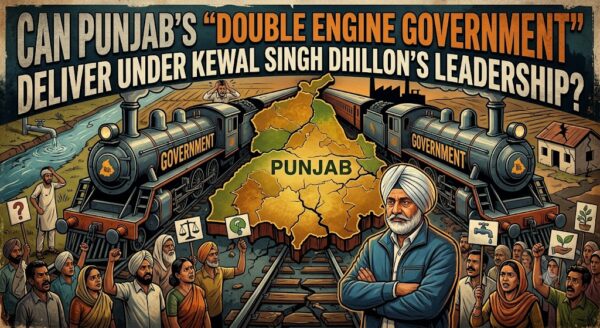
 Punjab has entered a new political phase with the appointment of Kewal Singh Dhillon as the president of the Punjab unit of the Bharatiya Janata Party. His appointment is being viewed as a strategic move by the BJP to strengthen its presence in Punjab ahead of the 2027 Assembly elections and to project a stronger Sikh leadership within the party. Political observers believe that the BJP is attempting to create conditions for a stronger coordination between the Central Government and Punjab, often described as a “double engine government” model.
Kewal Singh Dhillon has publicly stated that his priorities include farmers’ welfare, youth employment, industrial revival, and tackling the drug menace. He has also expressed confidence that the BJP can emerge as a major political force in Punjab in the coming years.
The real challenge before Dhillon, however, is not merely organizational expansion of the BJP but addressing Punjab’s long-pending issues that have remained unresolved for decades. The people of Punjab will judge leaders not by speeches or political slogans but by their ability to provide practical solutions.
One of the biggest issues facing Punjab today is the growing debt burden. The state’s debt has continued to increase over the years, placing tremendous pressure on public finances. Questions are being raised about how future governments will generate sufficient revenue to fund development projects, improve infrastructure, and create employment opportunities. Economic revival remains one of Punjab’s most urgent priorities.
Agriculture, the backbone of Punjab’s economy, is also facing a serious crisis. Farmers continue to struggle with rising input costs, declining groundwater levels, shrinking profit margins, and uncertainty regarding crop diversification. While Minimum Support Price (MSP) remains an important concern, many experts argue that Punjab requires a comprehensive agricultural policy that ensures sustainable farming and long-term income security for farmers.
Unemployment among educated youth remains another major challenge. Thousands of young Punjabis continue to prepare for government jobs while many others seek opportunities abroad. The lack of large-scale industrial investment has limited employment opportunities within the state. If Kewal Singh Dhillon wishes to make a meaningful impact, attracting industries and generating jobs must remain a top priority.
Punjab’s drug problem continues to concern families across the state. Despite repeated campaigns by successive governments, drug trafficking and addiction remain major social issues. The challenge requires strict law enforcement, border security, rehabilitation programs, and community participation. Dhillon himself has identified the fight against drugs as one of his key priorities.
Law and order is another issue that frequently dominates public discussions. Incidents of gang violence, extortion threats, and targeted crimes have created concerns regarding public safety. Citizens expect political leaders to work towards strengthening policing and ensuring a secure environment for ordinary people.
Punjab’s industrial sector has also witnessed a gradual decline compared to several neighboring states. Industrialists have often raised concerns regarding high power costs, taxation issues, and regulatory hurdles. Reviving industrial hubs such as Ludhiana, Jalandhar, Mandi Gobindgarh, and Batala could create significant employment opportunities and strengthen the state’s economy.
The issue of migration also deserves attention. Every year, thousands of Punjabi youth leave for countries such as Canada, Australia, the United Kingdom, and the United States in search of better opportunities. While overseas Punjabis contribute significantly to the state’s economy, the continuous outflow of skilled youth raises concerns about Punjab’s long-term development.
Punjab also faces serious environmental challenges. Groundwater depletion has reached alarming levels in many districts. Pollution of rivers and improper waste management continue to affect public health. Sustainable development policies will be essential if Punjab is to secure its future generations.
Border security remains another critical issue due to Punjab’s international border with Pakistan. Concerns regarding cross-border smuggling, narcotics trafficking, and drone-based deliveries have increased in recent years. Effective coordination between the state and the Centre is essential to address these challenges.
Another unresolved issue relates to the demands of various employee unions, contractual workers, unemployed youth organizations, pensioners, and farmers’ groups. Successive governments have faced protests from these sections regarding jobs, wages, regularization of services, pensions, and welfare measures. Any political leader aspiring to lead Punjab must engage constructively with these groups.
The question before Punjab now is whether Kewal Singh Dhillon can move beyond political rhetoric and become a bridge between the state and the Central Government. If a genuine “double engine” approach is to succeed, it must result in visible improvements in employment, agriculture, industry, law and order, infrastructure, and social welfare rather than remaining merely an electoral slogan.
Punjab does not suffer from a shortage of political promises. What it needs is effective governance, economic revival, and a clear roadmap for the future. The coming months will reveal whether Kewal Singh Dhillon can translate his stated commitment to farmers, youth, and industrial development into tangible results for the people of Punjab
Disclaimer: The photographic elements used in the accompanying graphic are for symbolic and illustrative purposes only. The individuals depicted do not imply actual endorsement, involvement, or association with substance