
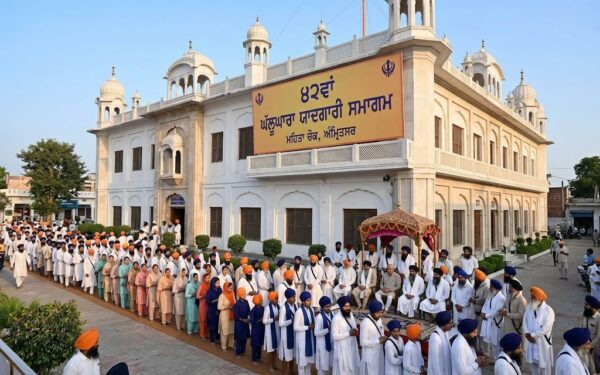
The attendance of senior BJP leader and Maharashtra minister Girish Mahajan at the 42nd anniversary commemoration of Operation Bluestar at Damdami Taksal has generated considerable political discussion across Punjab. Political observers have described the move as significant because it marked the first time the BJP officially sent a representative to a function commemorating one of the most sensitive and emotional events in modern Sikh history. Mahajan shared the stage with Taksal chief Baba Harnam Singh Khalsa Dhuma and senior Sikh religious leaders at Mehta Chowk near Amritsar.
Operation Bluestar remains a deeply painful chapter for Sikhs worldwide. The June 1984 military operation carried out at Sri Darbar Sahib and the Akal Takht continues to influence Sikh political and religious discourse more than four decades later. Every year, Sikh organizations and institutions organize commemorative events to remember those who lost their lives during the operation.
Analysts view Mahajan’s participation as part of the BJP’s broader effort to strengthen its independent presence in Punjab after the breakdown of its long-standing alliance with the Shiromani Akali Dal. Since the alliance ended, the BJP has been searching for ways to connect directly with Sikh voters and religious institutions rather than relying on traditional political partnerships. By participating in an event associated with Sikh historical memory and identity, the party appears to be signalling a willingness to engage more directly with Punjab’s religious and Panthic constituencies.
The significance of the event is further amplified because Damdami Taksal has historically held considerable influence within Sikh society. The institution is closely associated with Sikh religious education and was once led by Jarnail Singh Bhindranwale, making it a powerful symbol within Sikh political and religious discourse. BJP leaders had traditionally maintained a distance from such commemorations, making Mahajan’s presence a noticeable departure from previous political practice.
Supporters of the BJP’s outreach argue that engagement and dialogue are necessary for improving relations between Punjab and the national political mainstream. They contend that participation in commemorative events demonstrates respect for Sikh sentiments and historical experiences. Critics, however, view the move as a political strategy aimed at expanding the party’s electoral footprint in Punjab rather than a substantive shift in policy. The differing interpretations reflect the complexity of Punjab’s political landscape, where religion, history, and politics often intersect.
The development also places pressure on other political parties operating in Punjab. As the BJP seeks to create its own space among Sikh voters, traditional Panthic parties may face increased competition for influence within religious and community institutions. Whether this outreach translates into lasting political gains remains uncertain, but it has undoubtedly opened a new discussion about the BJP’s future strategy in Punjab and its relationship with Sikh institutions.
Ultimately, Girish Mahajan’s appearance at the Operation Bluestar anniversary event represents more than a symbolic visit. It signals an evolving political approach by the BJP toward Punjab, one that seeks direct engagement with influential Sikh organizations and attempts to reshape political relationships in a state where historical memory continues to play a central role in public life.
Referance:The Tribune