
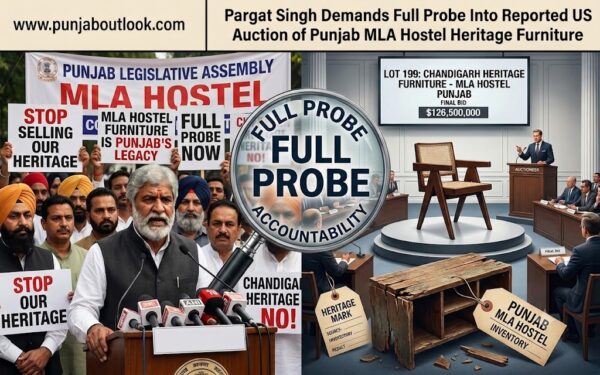
 Senior Congress leader and MLA Pargat Singh has demanded a comprehensive investigation after reports emerged that furniture allegedly belonging to the Punjab MLA Hostel was auctioned in the United States for more than ₹59 lakh. The issue has sparked a political controversy in Punjab, with questions being raised about the protection of public assets, preservation of legislative heritage, and the procedures followed before such items reportedly left the country.
In a strongly worded statement, Pargat Singh alleged that after burdening Punjab with increasing debt and selling the state’s resources, the ruling Aam Aadmi Party government has now allowed Punjab’s legislative heritage to be sold on the international market. He expressed concern that furniture reportedly carrying inventory markings of the Punjab MLA Hostel had surfaced at an auction house in the United States and fetched a substantial amount from buyers abroad.
The Congress leader argued that the controversy goes beyond the sale of old furniture and touches upon the dignity and heritage of Punjab’s democratic institutions. According to him, assets associated with the Punjab Legislative Assembly and MLA Hostel are part of the state’s institutional legacy and should be treated with the utmost care. He maintained that such items represent an important chapter of Punjab’s political and legislative history and should not be allowed to disappear without proper accountability.
Pargat Singh raised a series of questions that he believes require immediate answers from the Punjab Government and concerned authorities. He asked who authorized the movement and sale of the furniture, under what circumstances the items were removed from government custody, and whether proper records were maintained throughout the process. He further questioned how furniture bearing Punjab MLA Hostel inventory markings allegedly reached an auction house thousands of miles away in the United States.
Another major concern highlighted by the MLA relates to the legal process involved in exporting such items. He sought clarification on whether all necessary permissions, clearances, and approvals were obtained before the furniture left India. He argued that if the items were indeed government property, authorities must disclose the procedure under which they were declared surplus, disposed of, and exported. Any failure to follow established rules, he said, would raise serious concerns about administrative accountability.
The controversy also raises broader questions about the management of government assets. Public property owned by government departments and legislative institutions is generally subject to strict inventory controls and disposal procedures. If the furniture was officially auctioned or sold, investigators may have to determine whether proper approvals were obtained, whether fair market value was realized, and whether all financial transactions were properly documented. If the items left government custody without authorization, the matter could become even more serious.
Political observers note that while old government furniture may not always qualify as protected heritage under law, objects connected to important public institutions often carry symbolic and historical significance. The Punjab MLA Hostel has been associated with generations of legislators, ministers, and public representatives. For many, items linked to such institutions form part of Punjab’s political heritage and deserve preservation rather than disposal without public knowledge.
Pargat Singh has also called upon Speaker Kultar Singh Sandhwan to take immediate notice of the issue. He believes that the Punjab Legislative Assembly has a responsibility to safeguard assets connected with the state’s democratic institutions and to ensure complete transparency regarding their management. He has urged the Speaker to support an independent inquiry and place all relevant facts before the public.
The Congress leader has further demanded that both the Punjab Government led by Chief Minister Bhagwant Mann and the BJP-led Central Government explain how assets allegedly linked to Punjab’s legislative institutions were allowed to leave India and appear in an international auction. According to him, the matter involves not only state authorities but also agencies responsible for customs, exports, and the protection of public property.
At present, no official findings have been released confirming whether the auctioned furniture indeed belonged to the Punjab MLA Hostel or whether all procedures were followed in its disposal and export. However, the allegations have generated significant public interest and political debate. Opposition parties are expected to continue pressing for answers, while many citizens are seeking clarity on how government-owned items reportedly reached an overseas auction platform.
As demands for transparency grow, the controversy is likely to remain a subject of discussion in Punjab’s political circles. The central questions remain unanswered: Did the furniture belong to the Punjab MLA Hostel? Who authorized its disposal? How did it reach the United States? And were all legal and administrative requirements followed? Until these questions are addressed through an official inquiry, the issue is expected to continue generating scrutiny and debate across the state.