
 Non-Resident Indians (NRIs) have long been recognised as one of India’s greatest assets. Spread across North America, Europe, Australia, the Middle East, Africa, and Asia, the Indian diaspora has contributed immensely to the economic, social, and cultural development of both India and their adopted countries. Through remittances, investments, philanthropy, business ventures, and advocacy, NRIs continue to play a vital role in strengthening India’s global standing.
However, despite their achievements and contributions, NRIs face a wide range of challenges both in India and abroad. Many of these concerns have remained unresolved for years, creating frustration among members of the overseas Indian community who continue to maintain strong emotional, cultural, and financial ties with their homeland.
One of the most serious concerns for NRIs is the safety and security of their properties in India. Thousands of overseas Indians own ancestral land, houses, commercial properties, and agricultural land in various states. Unfortunately, many face illegal occupation, fraudulent property transfers, forged documents, encroachments, and lengthy legal disputes. In numerous cases, NRIs discover that their properties have been occupied by relatives, neighbors, or land mafias while they reside abroad. Recovering such properties often requires years of litigation and substantial financial resources.
Another major issue is the increasing number of crimes targeting NRIs visiting India. Cases involving robbery, kidnapping, fraud, extortion, assault, and even murder have generated widespread concern within the diaspora community. Many incidents reveal that perpetrators are frequently individuals known to the victims, including relatives, business associates, or acquaintances. Such incidents damage confidence among overseas Indians who wish to visit or invest in their homeland.
The judicial process itself presents another challenge. NRIs involved in legal disputes often struggle with delayed court proceedings, repeated adjournments, bureaucratic complexities, and the need for frequent travel to India. The absence of specialized fast-track mechanisms for NRI-related cases often leaves victims waiting years for justice.
Fraudulent immigration consultants and travel agents continue to exploit aspiring immigrants and overseas families. Every year, countless individuals lose substantial sums of money to fake job offers, fraudulent visa schemes, forged documents, and human trafficking networks. Families often approach NRI organizations and government agencies seeking assistance after becoming victims of such scams.
Many NRIs also face difficulties when dealing with government offices in India. Issues related to land records, inheritance matters, power of attorney documentation, banking services, taxation, and investment regulations can become time-consuming and frustrating. While digitization has improved some services, many overseas Indians still report challenges in obtaining efficient administrative support.
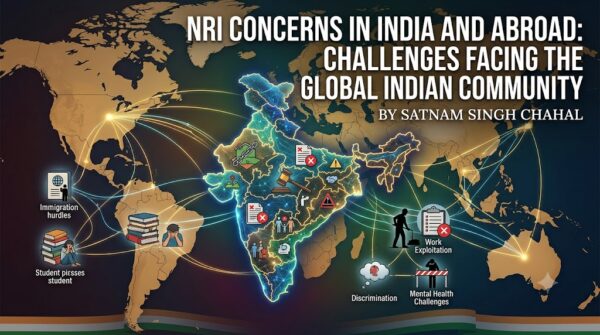
In foreign countries, NRIs encounter a different set of concerns. Immigration policy changes, visa restrictions, work permit regulations, and citizenship requirements often create uncertainty. Skilled professionals, international students, and temporary workers frequently face evolving legal frameworks that affect their long-term settlement plans.
Indian students studying abroad face increasing pressures related to tuition costs, housing expenses, employment opportunities, and mental health challenges. Many students struggle with loneliness, cultural adjustment, academic stress, and financial burdens. Tragically, incidents involving attacks, discrimination, and unexplained deaths of Indian students abroad occasionally raise concerns among families in India.
Racism and discrimination remain concerns in certain regions. Although most NRIs are highly respected members of their communities, incidents involving racial profiling, hate crimes, workplace discrimination, and social exclusion continue to occur. Such incidents can create fear and insecurity, particularly among new immigrants and international students.
Another growing concern is the exploitation of migrant workers in some countries. Many workers employed in construction, domestic service, transportation, and labor-intensive sectors report poor working conditions, wage disputes, passport confiscation, and inadequate legal protection. Governments must continue strengthening mechanisms to protect vulnerable overseas workers.
Mental health has emerged as a significant issue among diaspora communities. The pressures of migration, separation from family, cultural adaptation, financial obligations, and professional competition can contribute to anxiety, depression, and social isolation. These challenges often remain unaddressed due to stigma surrounding mental health discussions.
For elderly NRIs, retirement-related concerns are becoming increasingly important. Many senior citizens who divide their time between India and foreign countries face issues related to healthcare access, pension management, insurance coverage, taxation, and long-term care arrangements. As the first generation of large-scale Indian immigrants enters retirement, these concerns are likely to grow.
Investment security is another major area of concern. NRIs contribute billions of dollars to India’s economy through investments in real estate, businesses, financial instruments, and charitable initiatives. However, concerns regarding regulatory uncertainty, fraud, delayed approvals, and legal complications sometimes discourage greater investment.
The emotional connection between NRIs and India remains strong despite these challenges. Overseas Indians continue to support educational institutions, healthcare projects, religious organizations, disaster relief efforts, and community development initiatives across the country. Their contributions extend far beyond financial remittances and reflect a deep commitment to India’s progress.
Addressing NRI concerns requires coordinated efforts by both the Central and State Governments. Stronger property protection laws, dedicated NRI courts, improved police response mechanisms, efficient grievance redressal systems, and enhanced consular support can significantly improve confidence among overseas Indians. At the same time, foreign governments must continue working with Indian authorities to ensure the safety, rights, and well-being of Indian citizens living abroad.
The global Indian community represents one of the world’s most successful diasporas. Ensuring its security, dignity, and confidence is not merely an administrative responsibility it is an investment in India’s future. By addressing the concerns of NRIs both in India and abroad, policymakers can strengthen the bond between the nation and millions of Indians who continue to serve as ambassadors of Indian culture, enterprise, and achievement across the world.
Ref:New India express and Indian express Disclaimer: The photographic elements used in the accompanying graphic are for symbolic and illustrative purposes only. The individuals depicted do not imply actual endorsement, involvement, or association with substance