
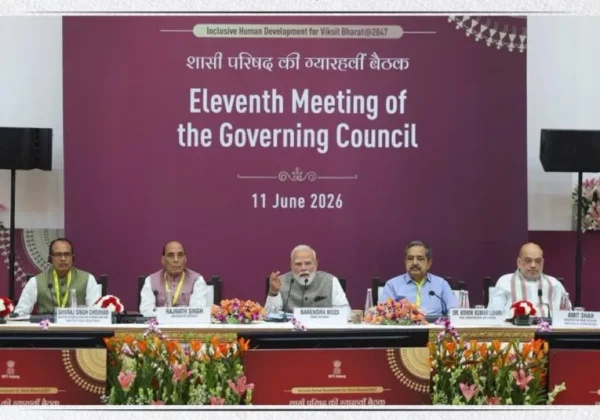
 There is something both reassuring and formulaic about a NITI Aayog Governing Council meeting. The setting is grand — Rashtrapati Bhavan Cultural Centre, no less. The theme is aspirational. The attendees are impeccably listed. And the communiqué, when it arrives, speaks movingly of convergence, cooperation, and a developed India by 2047. The 11th meeting, held today under Prime Minister Narendra Modi’s chairmanship, was true to form — and that, precisely, is the problem.
Let us begin with what deserves acknowledgment. The four-pillar framework — foundational human capital and future-ready skills; productive employment, entrepreneurship and decentralised growth; health, nutrition and wellbeing; equity and dignity for all — is a thoughtful construction. It is not the language of the Planning Commission era, focused on outlays and targets. It is the language of human development, a framework closer in spirit to Amartya Sen’s capabilities approach than to the old Five-Year Plan vocabulary. That is an intellectual advance.
The incorporation of recommendations from the 5th National Conference of Chief Secretaries — covering early childhood education, schooling, skilling, higher education and sports — is also significant. Chief Secretaries’ conferences rarely produce operational follow-through; their folding into the Governing Council agenda at least creates a formal accountability link. If the structured tracking mechanism — covering short, medium and long-term outcomes — is genuinely operationalised, it would mark a departure from the Aayog’s earlier reputation as a think-tank that thinks but does not do.
The attendance pattern was itself politically instructive. That Bhagwant Mann of Punjab attended — reversing his boycott of the 8th meeting — signals either pragmatic recalibration or a desire to use the platform for Punjab’s festering Centre-state grievances: unpaid MGNREGS dues, the unresolved GST compensation trail, the Ravi-Beas waters dispute. That Tamil Nadu’s newly elected CM Vijay and Karnataka’s DK Shivakumar sat in the same room as the Prime Minister, barely weeks after their respective electoral victories, suggests that the arithmetic of cooperative federalism has shifted since 2023.
PM Modi’s own remarks were carefully calibrated. Women-led development as a cornerstone of Viksit Bharat; the demographic dividend as a historic opportunity; free trade agreements as export engines — these are not empty phrases. They reflect real policy directions: the Lakhpati Didi programme, the PLI scheme, the recently concluded FTAs with the UAE, UK and the Gulf Cooperation Council. The Prime Minister was, in effect, presenting a coherent economic philosophy to the assembled Chief Ministers. The question is whether they left with marching orders or merely with motivation.
The Digital Public Infrastructure emphasis — UPI, ONDC, Ayushman Bharat Digital Mission, and the emerging AI corridor at Jamnagar, Visakhapatnam and the Quantum Valley — is welcome. India’s DPI stack is genuinely world-class, and its federal propagation to states remains uneven. A Governing Council that seriously focuses on closing the DPI adoption gap between, say, Gujarat and Jharkhand, or between urban Punjab and its border districts, would be doing real work.
This is the better half of today’s story. It is the half that will appear in the PIB release, quoted approvingly in editorials, and cited in the next NITI Aayog progress report. It deserves its credit.
Part II: The Agenda This Meeting Did Not Have — But India Desperately Needs
And then there is the other half. The half defined not by what was discussed, but by what was absent. Five silences, in particular, deserve to be named.
1. Artificial Intelligence: A Federal Vacuum in a National Emergency
India is in the middle of an AI infrastructure boom — Reliance’s Jamnagar data centre, the Vizag supercomputing hub, the Union Budget’s Quantum Valley allocation. The IndiaAI Mission has been announced. Yet there is no federal AI governance framework, no agreement between the Centre and the states on data sovereignty, no protocol on AI deployment in welfare delivery — a domain in which state governments are the primary actors.
A Governing Council that speaks of Digital Public Infrastructure without placing Artificial Intelligence at the centre of its human development framework is missing the most consequential technology inflection point since the mobile internet. AI will reshape school teaching, primary healthcare diagnostics, agricultural extension services and the MSME credit chain — all of them state subjects or shared-list items. The Centre can build compute; it cannot deploy welfare AI without the states. That compact was not forged today.
More urgently: the Governing Council said nothing about the regulatory and ethical dimensions of AI in governance. Algorithmic welfare exclusion — where AI-driven systems wrongly deny rations, pensions or scholarships to eligible citizens — is already a documented problem in several states. A Viksit Bharat whose citizens are turned away from entitlements by a biased model is not a developed nation; it is a surveillance state with better branding.
2. Youth Unemployment: The Demographic Dividend Has an Expiry Date
The Prime Minister said, correctly, that India’s demographic dividend is a historic opportunity we cannot afford to lose. But the Periodic Labour Force Survey tells a less comfortable story: youth unemployment (15–29 years) in urban India remains stubbornly above 16 percent; in states like Punjab, Haryana and Kerala, graduate unemployment co-exists with severe skill mismatches in industry. The skilling pillar in the Governing Council’s framework is necessary — but it addresses supply. The demand side — where are the jobs, in which sectors, at what wages — received no structural answer.
India’s manufacturing employment has not recovered to pre-pandemic levels in many labour-intensive sectors. The gig economy absorbs millions but offers no social security floor. The PLI scheme has created capacity but not commensurate jobs in the states that need them most — Bihar, UP, Odisha. A Governing Council serious about the demographic dividend would have put on the table a federal compact on job creation: state-level employment guarantees for formal sector entry-level jobs, apprenticeship mandates on large industry, or a redesigned MGNREGS that bridges the rural-to-urban transition. None of this appeared in the agenda.
3. The Drug Crisis: A National Emergency Hiding Behind State Boundaries
Punjab is the most visible face of India’s narcotics catastrophe, but it is not the only face. Manipur’s methamphetamine crisis is a public health emergency intertwined with ethnic conflict. Synthetic opioids — fentanyl analogues, tramadol, nitazenes — are entering India through ports and dark-web supply chains that no single state can interdict alone. The National Drug Demand Reduction Policy (2021) is a document; it is not a federal action plan.
The health, nutrition and wellbeing pillar of today’s framework was silent on narcotics. This is not an oversight — it is a governance failure. Drug rehabilitation is a state subject. Narcotics interdiction is shared. De-addiction health infrastructure is woefully underfunded in every state. A Governing Council that places health at the centre of its human development vision but does not discuss the single largest preventable cause of premature death and disability among young Indians — substance abuse — has chosen comfort over consequence.
Punjab alone has over 2.5 lakh registered addicts and an estimated 6 lakh unregistered users. Every Chief Minister in that room from a border state knows this. The question is whether NITI Aayog has the courage to make it a Governing Council agenda item — or whether it remains forever a law-and-order issue dressed in health vocabulary.
4. Internal Security: The Federal Architecture Is Cracking
In the wake of Operation Sindoor and the most serious cross-border escalation in a generation, one might have expected the Governing Council to address the internal security architecture of a nation that is simultaneously post-conflict and pre-election. Left Wing Extremism in Chhattisgarh and Jharkhand is in its terminal phase — but the transition from security operations to development delivery in these districts requires a federal compact that has not been struck. Manipur’s ethnic fault lines remain unresolved. J&K’s political reconstruction is incomplete.
Internal security is not merely a Union subject. Police is Entry 2 of List II. Intelligence sharing between state police and central agencies is structurally dysfunctional. The fractures exposed by the Pahalgam attack — in spite of a massive security infrastructure — were partly fractures of federal intelligence architecture. A Governing Council that takes ‘equity and dignity for all’ seriously must address the communities — tribal, border-dwelling, minority — who experience the state primarily through its coercive rather than its welfare face.
5. Startup Culture and Deep Tech: The Next Trillion Is Being Left to Chance
India has the third-largest startup ecosystem in the world. It has produced over 110 unicorns. It has an IIT-IIM pipeline that increasingly chooses entrepreneurship over employment. And yet the federal architecture for startup support is a patchwork: Startup India is a Union scheme; state industrial policies vary from the sophisticated (Karnataka, Maharashtra, Telangana) to the vestigial (most of the Hindi heartland). There is no Governing Council compact on what constitutes a state’s obligations to its startup ecosystem — no agreed floor on seed funding access, no inter-state portability of startup benefits, no federal framework for deep tech research commercialisation.
The next frontier — space tech, quantum computing, semiconductor design, green hydrogen, advanced materials — requires a Centre-state partnership that is currently non-existent in any operational sense. ISRO is central; space startups need state-level land, utilities and regulatory clearances. Semiconductor fabs need both Union incentives and state infrastructure. The Governing Council’s ‘entrepreneurship and decentralised growth’ pillar could have been the occasion to construct this architecture. Instead, it remained a heading.
There is a deeper issue here. India’s startup culture is fundamentally metropolitan — Bengaluru, Hyderabad, Pune, Delhi-NCR. The Tier-2 and Tier-3 city startup ecosystem is embryonic. The ‘decentralised growth’ aspiration in today’s framework will remain aspirational unless the Governing Council can agree on what states must actually do to make Ranchi, Patna, Amritsar and Kochi credible startup destinations. That requires federal investment compacts, university-industry linkage mandates and regulatory harmonisation. None of this was on the table.
The Institutional Question Behind All Five Silences
Behind each of these silences is a structural question about NITI Aayog itself. The Governing Council has no fiscal authority. It cannot transfer funds, mandate state expenditure or enforce the outcome-tracking mechanism it has just promised. The Planning Commission — whatever its faults — had the power of plan allocations. NITI Aayog has the power of persuasion and the Prime Minister’s chairmanship. These are not nothing, but they are not a federal compact.
The 11th Governing Council meeting was a well-curated event. Its theme was timely. Its framework was coherent. Its attendance — near-complete, with both opposition and NDA chief ministers present — was politically significant. PM Modi’s emphasis on women-led development, trade agreements and the demographic dividend reflected a government that has a story to tell about India’s trajectory.
But a meeting of 36 Chief Ministers and Lieutenant Governors, chaired by the Prime Minister of a nation that aspires to be the world’s third-largest economy by 2030, cannot afford to be merely inspiring. It must be operationally specific. It must engage the hardest problems — the drug epidemic, the AI governance vacuum, the youth employment crisis, the startup desert outside six cities, the cracking federal security architecture — with the same rigour it brings to human development frameworks.
Viksit Bharat by 2047 is twenty-one years away. That is exactly the age of a child born today — a child who will be looking for a job, navigating an AI-transformed economy, living in a state whose drug problem may or may not have been addressed, whose startup dreams may or may not have federal support. Whether that child finds a developed India or a well-documented aspiration will depend not on the quality of Governing Council themes, but on the quality of Governing Council decisions.
Today, the themes were excellent. The decisions are yet to be seen, after which the nation will be looking for expeditious execution.