
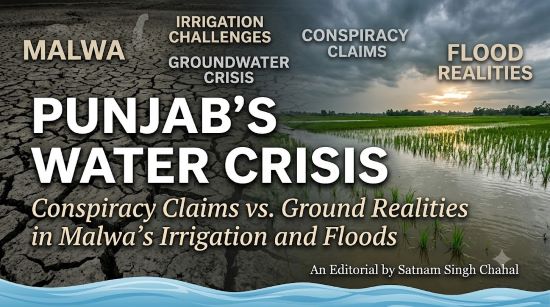
 Punjab, known as India’s breadbasket, faces serious challenges with its irrigation network, especially in the Malwa region covering southern districts like Bathinda, Faridkot, Muktsar, and Ferozepur. Claims of a deliberate conspiracy involving excess water releases in canals to destroy Malwa’s agriculture have circulated widely on social media and in political circles.
These narratives suggest that breaches, overflows, and floods are part of a planned attack rather than mismanagement. However, there is no credible evidence from investigations or expert reports to support such claims. Instead, the issues stem from a combination of extreme monsoon rains intensified by climate change, ageing British-era canal infrastructure suffering from siltation and poor maintenance, weak embankments, encroachments on floodplains, and coordination gaps in dam releases from structures like Bhakra and Pong.
In 2025, severe floods devastated thousands of acres, particularly paddy fields, due to heavy rainfall and river swelling, leading to canal breaches such as in the Sirhind distributary. While these events caused significant crop losses, sand deposition, and economic hardship for farmers, they reflect recurring historical problems seen in past floods rather than targeted sabotage. The AAP government under CM Bhagwant Mann has actively worked to strengthen irrigation in Malwa through the proposed Malwa Canal project (around 150 km to irrigate additional acres), early water releases, and pipeline initiatives aimed at recharging groundwater and reducing tubewell dependence. These efforts indicate a focus on improvement, not destruction. Political accusations and regional grievances in Malwa, which has faced tail-end water shortages, amplify the conspiracy narrative, but experts emphasise addressing root causes like better desilting, embankment strengthening, modern drainage, and transparent flood management for long-term resilience.
Punjab is confronting a severe groundwater crisis marked by rapid depletion and widespread contamination, hitting the Malwa region particularly hard. Extraction rates exceed recharge by over 150%, with most blocks over-exploited due to intensive paddy cultivation supported by free electricity and millions of tubewells.
According to Central Ground Water Board reports, contamination is alarming: uranium levels are the highest in India, with a large percentage of samples exceeding safe limits, alongside elevated arsenic, nitrates from fertilizers, fluoride, and iron. This has turned shallow wells unfit for drinking or irrigation in many areas.
The causes include over-extraction that concentrates pollutants, agricultural runoff leaching chemicals, and natural geogenic factors from underlying rocks, worsened by industrial activities and poor drainage.
Health impacts are devastating, with Malwa known for high cancer rates often called the “cancer train” route linked to uranium’s effects on kidneys and bones, plus other contaminants causing various diseases. Farmers face reduced soil health, lower yields, and mounting medical costs.Government responses include promoting canal water use for recharge, crop diversification pilots, and efficient irrigation subsidies, but implementation gaps remain. A sustainable path forward requires urgent actions like accelerating the Malwa Canal, enforcing regulations, investing in treatment plants and rainwater harvesting, and shifting to less water-intensive crops. Without coordinated efforts, Punjab’s agricultural heartland risks deeper ecological and health disasters.