
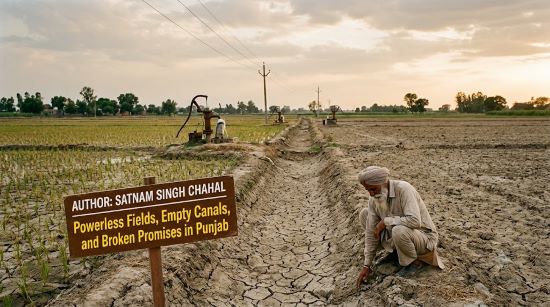
 As Punjab’s farmers struggle to save their paddy crop, one uncomfortable question confronts the state government: How can anyone expect a good harvest when fields are receiving neither adequate electricity nor sufficient canal water? Agriculture is not driven by political speeches or social media campaign it survives on uninterrupted irrigation. When tube wells remain silent due to power cuts and canals run dry, the inevitable victim is the farmer, followed by the state’s agricultural economy.
Across Punjab, farmers are reporting irregular power supply during the most crucial period of paddy cultivation. Many are forced to stay awake throughout the night, waiting for electricity to operate their tube wells. Even when electricity arrives, the duration is often insufficient to irrigate their fields properly. At the same time, thousands of acres dependent on canal irrigation are receiving inadequate water because of poor management, outdated infrastructure, and inefficient distribution. Farmers are being pushed into a situation where they are paying more to produce less.
The consequences are obvious. Paddy is a water-intensive crop that requires timely irrigation. A delay of even a few days during critical growth stages can significantly reduce productivity. Lower yields translate directly into financial losses for farmers who are already burdened by rising prices of seeds, fertilizers, pesticides, diesel, and labour. If production declines, Punjab’s contribution to the national food grain pool will also suffer.
The present crisis did not emerge overnight. Electricity demand in Punjab has been rising continuously due to increasing agricultural mechanization, industrial growth, urban expansion, and domestic consumption. Every year, experts warn that the state’s peak demand is setting new records. Yet successive governments have largely ignored the need to expand Punjab’s own electricity generation capacity.
The Aam Aadmi Party government has now been in power for several years, but not a single new major thermal power plant has been established during its tenure. Even during the previous Congress government, no significant addition was made to Punjab’s thermal power infrastructure. Most of the state’s existing thermal power plants were established during the tenure of the Shiromani Akali Dal-led government. Whether one agrees with its politics or not, those projects continue to form the backbone of Punjab’s electricity generation even today.
Since then, electricity demand has increased dramatically, but power generation capacity has failed to keep pace. Instead of building long-term infrastructure, successive governments have depended heavily on purchasing electricity from outside the state whenever demand peaks. Such short-term arrangements may help avoid an immediate crisis but cannot replace the need for permanent investment in dependable power generation and transmission infrastructure.
The irrigation sector presents an equally disappointing picture. Punjab’s canal system requires modernization, desilting, proper maintenance, and scientific water management. Instead, farmers frequently complain that canal water fails to reach tail-end villages, forcing them to rely entirely on groundwater. This increases dependence on tube wells, which in turn raises electricity demand even further. It is a cycle that governments have allowed to continue year after year without meaningful structural reforms.
Ironically, political leaders are often quick to celebrate procurement figures after harvest but remain silent when farmers struggle to save the crop itself. Announcements, advertisements, and publicity campaigns cannot substitute for electricity flowing through transmission lines or water flowing through canals. Farmers judge governments not by slogans but by whether their crops survive.
Punjab’s agricultural future demands serious planning rather than seasonal firefighting. The state requires investment in new power generation capacity, modernization of existing thermal plants, expansion of renewable energy with reliable backup systems, strengthening of the transmission network, renovation of canal infrastructure, and effective groundwater conservation. Without these reforms, every paddy season will bring the same crisis, the same excuses, and the same suffering for farmers.
Punjab earned the title of India’s food bowl because generations of farmers worked tirelessly with the support of strong agricultural infrastructure. That foundation is now showing signs of stress. If governments continue to neglect power generation and irrigation while expecting farmers to produce record harvests, they are ignoring the basic realities of agriculture.
A field without electricity and water cannot produce miracles. Unless Punjab’s policymakers recognize this simple truth and act decisively, declining paddy yields, shrinking farm incomes, and growing rural distress may become the defining legacy of years of missed opportunities.
Disclaimer: This article and accompanying images are for informational and illustrative purposes only. Some visuals may be AI-generated or digitally enhanced and may not depict actual events or persons.Views expressed are based on publicly available information and analysis.