
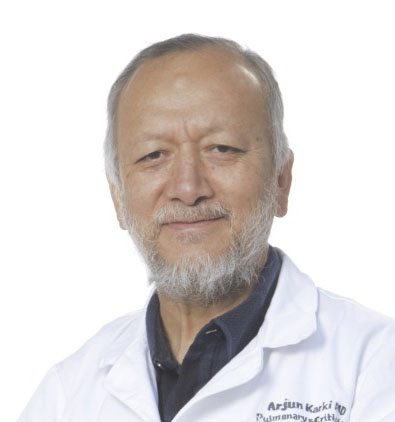
Professor Dr Rajesh Nath Gongal is an academic and healthcare leader whose career blends surgical expertise with visionary institutional management. As a Professor of Surgery at the Patan Academy of Health Sciences (PAHS), Dr Gongal has played a pivotal role in shaping medical education in Nepal. He is deeply committed to developing innovative curricula that produce socially responsible health care professionals. His academic contributions extend to research, including studies on empathy development among medical students and palliative care awareness, reflecting his commitment to both clinical excellence and humanistic medicine. Dr Gongal has held several key managerial positions: he served as Medical Director of Patan Hospital, later became founding Dean, Rector and Vice-Chancellor of the Academy.
He is the Founding President of Hospice Nepal, the country’s first palliative care center, and the Founding President of Nepal Ambulance Service, which introduced Emergency Medical Technician (EMT)-based emergency response through a three-digit number system. By initiating programs like Primary Trauma Care (PTC) training in Nepal, he has strengthened emergency medical preparedness across the nation. His academic leadership and managerial innovations have profoundly advanced Nepal’s medical education, healthcare delivery, and emergency response systems. The Journal of Patan Academy of Health Sciences extends its sincere gratitude to Professor Dr. Gongal for his generous and thoughtful engagement in answering the written questions prepared for this interview.
Q.1. Could you tell us about your educatonal background and what inspired you to pursue a career in Medicine, and later in Surgery? Answer: I completed my schooling at St Xavier’s School in Kathmandu and Intermediate from Amrit Science College. I was fortunate to be selected under the Colombo Plan Scholarship to study Medicine. By strange hand of fate, of all the medical schools in India, I was desned to study in Darbhanga Medical College in Bihar, which was also the College that my Father had completed MBBS from. So, 25 years aſter graduaton, he took me to his alma mater for admission. It took me eight long years to complete my studies- not because I failed, but because classes were frequently suspended sine die due to student infightng.
Aſter returning to Nepal in late 1989, I worked in the Department of Surgery and Emergency at Bir Hospital. During that time, I completed the first part of the FRCS exam, which was then held in Kathmandu. This paved the way for me to begin surgical training in the UK in early 1992. There I successfully completed the FRCS from the Royal College of Surgeons of England on my second atempt. I had always wanted to be a surgeon since my childhood. It must be because of my father. I had the opportunity to visit Bir Hospital from me to me and I found the operatng theatre exciting. Later, I became interested in Palliatve care and aſter completing my tenure as the Dean, I did a fellowship as well as an MSc in Palliatve Medicine from Northern Ireland in 2015-2016. In 2019, I received a Fellowship from the Royal College of Physicians of Edinburgh.
Q.2. How did your professional journey begin at Patan Hospital? What were the key opportunies and challenges you faced as the Medical Director? Answer: I worked in the UK for almost seven years and I enjoyed the me. The training was good. However, I never felt at home there. I had worked in Bir Hospital for two years before leaving for the UK. Although it was hard work and very challenging, I thoroughly enjoyed this me. I felt at home and everyone around me seemed like family. Aſter almost seven years in the UK, I decided to return to Nepal. In the process, I came in contact with Professor Dr. Jagdish Lal Baidya who was the Head of Department of Surgery at Patan Hospital and through him with Dr. Mark Zimmerman, the Medical Director who helped me join Patan Hospital in late 1998.
It was probably the best decision of my life as it provided me with challenges and opportunities in health care delivery, hospital administraon, health professional educaton and many other areas to grow. I found the efficiency at Patan Hospital very similar to that of hospitals in the UK; we used to start surgery at 8 am on the dot and the list used to go on until 6-7 pm. There was no formal atendance system, as in the UK; however, everyone used to arrive on time. Patan Hospital (PH) was run by United Mission to Nepal since its incepon as Shanta Bhawan Hospital. Around year 2000, there was an indication that UMN would cease to run the hospital in few years. From that me onwards there was a lot of discussion on the future directon of the hospital. A group of physicians and several staff members including myself saw this as an opportunity to develop it into a Medical School as we felt that Patan Hospital was the right instituton if we are going to produce technically competent as well as compassionate physicians because of the ethos that was embedded in Patan Hospital.
When we got a proposal from Kathmandu University Medical School (KUMS) to become their teaching site, this seemed an opportunity to realize our goal without too much investment. Lot of headway was made in this direction. To avoid repetition, I would like to refer to Dr Arjun Karki’s interview where this process has been very well documented. When the talks fell through and Dr Arjun Karki joined Patan Hospital, we started the process of developing Patan Hospital to its own Medical School. Aſter UMN handed over the hospital to the Government and functioned as the Development Commitee (Bikas Samiti), Dr Kundu Yangzom became Acting Medical Director. Initially I had no intention of taking up administrative responsibility, but because of the need to spearhead the process of transforming Patan Hospital into an academic enterprise, I decided to take the responsibility as a Medical Director in 2007. Although we had a Chief Executive Officer (CEO) in the hospital, the Medical Director was responsible for most of the major decisions.
As a Medical Director, I had two major challenges. One was to bring the hospital staff to a consensus to develop the hospital into an academic institution, and the second was to upgrade it into a modern thriving teaching hospital. Within Patan Hospital, there was a group of people who were convinced that for long-term sustainability of the hospital, becoming an academic instution was the wisest path forward. Although Nepal had many medical schools, the rural-urban disparity remained very stark with most graduates disinclined to work in rural areas, the public trust in the medical profession was eroding as evidenced by regularly recurring an- physician, an-insttuton demonstratons and the majority of graduates opting to leave the country for greener grass. So, we felt Patan Hospital had that ethos which could be put to good use to develop a technically competent but at the same me a socially responsible and compassionate physicians.
We also felt we had a responsibility to help reduce the rural urban disparity in health sector which was one of the reasons the nation had to go through the painful armed conflict of maoist insurgency. There was also a significant opposition to the idea of becoming a medical school among staff, including many physicians. This barrier had to be broken. We were able to do this over time by involving staff in many training programs and many discussions, respecng many views that came across. Regarding the second challenge, Patan Hospital was a very efficient hospital but also very basic. We had only basic lab, basic radiology with an X-ray machine, Ultrasound machine. We did not have CT scan. The operang theatre had only basic facilites. So, it was