
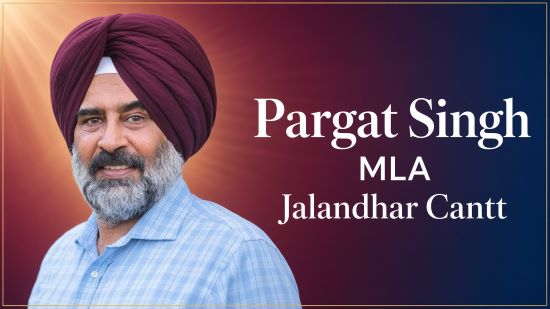
 CHANDIGARH: Senior Congress MLA and former Olympian Pargat Singh has launched a sharp attack on the Punjab government over the passage of nine Bills in a single day, accusing the ruling Aam Aadmi Party government of reducing the Punjab Vidhan Sabha to a “rubber stamp” and undermining the very purpose of legislative debate.The controversy erupted on the final day of the ongoing Assembly session, when the House passed nine Bills amid Opposition objections that lawmakers were not being given adequate time to examine, scrutinise and debate the proposed legislation. Reports from Chandigarh confirmed that nine key Bills were passed by the Punjab Vidhan Sabha on August 10.
Pargat Singh’s criticism goes to the heart of parliamentary democracy: a legislative assembly is not merely a voting machine where Bills are introduced, numbers are mobilised and legislation is pushed through. Its fundamental responsibility is to examine laws clause by clause, hear opposing viewpoints, identify their consequences and ensure that legislation serves the public interest.The Congress MLA’s charge assumes greater significance because concerns over rushed legislative business have surfaced repeatedly in the Punjab Assembly. Official Assembly records from previous sessions show instances where Bills were taken up for consideration “at once” and passed after relatively limited debate.
Nine Bills, One Day: Is Debate Becoming an Obstacle?
The passage of nine Bills in one day has raised a fundamental question: how much meaningful scrutiny can legislation receive when lawmakers are expected to process such a large volume of legislative business within a few hours?Bills can have consequences extending far beyond the political life of the government that introduces them. They can affect farmers, businesses, employees, students, local bodies, taxation, administration and ordinary citizens. Once enacted, correcting a poorly examined law can become far more difficult than scrutinising it properly before passage.That is why the Opposition’s demand for adequate discussion is not simply a political demand. It is an essential part of the legislative process.Congress MLA Sukhpal Singh Khaira had already urged the Punjab government and the Speaker to extend the Assembly session so that newly proposed Bills could receive proper examination and debate.
From Legislature to Formality?
Pargat Singh’s criticism raises an even larger issue about the functioning of the Punjab Assembly.If the ruling party possesses the numbers to pass every Bill, the Opposition’s role becomes even more important—not because it can necessarily defeat legislation, but because it can question the government, expose weaknesses, demand explanations and place alternative arguments on record.Majority rule cannot mean the disappearance of debate.A government may legitimately use its majority to enact its programme, but democratic legitimacy is strengthened—not weakened—when legislation survives rigorous scrutiny inside the House.The concern is particularly serious when Bills are introduced and passed in rapid succession. Members need time to read the provisions, consult stakeholders, understand financial implications and consider whether the proposed law conflicts with existing legislation.
Assembly Should Not Become an Event-Management Exercise
Pargat Singh has previously criticised what he described as the government’s tendency to turn Assembly proceedings into political spectacle rather than meaningful legislative work. In 2025, he accused the government of running the Assembly like an “event management company,” arguing that the House should focus on substantive governance rather than political gimmicks.His latest criticism therefore fits into a broader argument: the Punjab Vidhan Sabha must remain a forum for accountability, not simply a venue for government announcements and formal approval of executive decisions.The question is not whether the government has the constitutional right to introduce legislation. It does. The question is whether the legislation deserves sufficient time for democratic scrutiny before it becomes law.
What Happened to Parliamentary Accountability?
The Speaker occupies a particularly important position in this debate.The Speaker is expected to protect the dignity and functioning of the House and ensure that legislative business is conducted according to parliamentary principles. The Opposition may be politically outnumbered, but it should not be procedurally silenced.A healthy Assembly requires the government to answer uncomfortable questions and the Opposition to receive reasonable opportunities to put those questions on record.If nine major Bills can be passed in a single day with limited discussion, the public has every right to ask whether the Assembly is functioning as a deliberative legislature—or merely as a rubber stamp for the executive.
Democracy Is More Than Counting Votes
The Punjab government’s majority may allow it to win votes, but democracy is not simply about counting heads.Democracy is also about listening, questioning, examining and correcting.The Assembly is supposed to be the place where government proposals face their toughest scrutiny before they affect the lives of millions of Punjabis. If legislation is rushed through because the government has the numbers, the institution itself becomes weaker.The controversy surrounding the nine Bills should therefore not be reduced to another Congress-versus-AAP political confrontation.
It should be viewed as a larger institutional question:
How much time does Punjab’s democracy deserve before a Bill becomes law?
Pargat Singh’s warning is ultimately a warning about the health of the legislature itself. A powerful government does not need a weak Assembly. Punjab needs an Assembly strong enough to question the government, examine every Bill and protect the public interest—even when the ruling party has an overwhelming majority.The passage of nine Bills in one day has now placed that principle squarely in the spotlight