
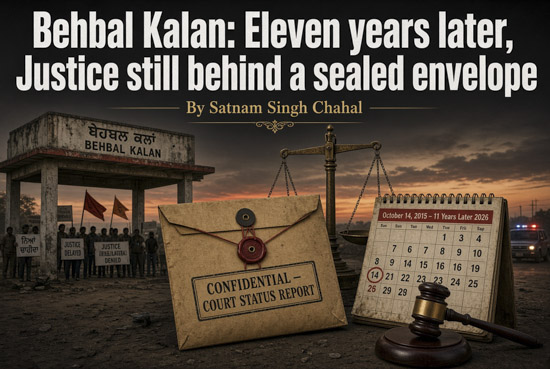
 The Behbal Kalan police firing has become one of the most painful symbols of Punjab’s prolonged struggle for accountability and justice. Nearly eleven years after two Sikh protesters, Krishan Bhagwan Singh and Gurjit Singh, were killed during protests following the 2015 sacrilege incidents, the investigation continues to generate new court proceedings, new summonses, and now another status report — this time placed before the court in a sealed envelope.
The latest development is significant but also raises a fundamental question: How much longer must the families of the dead wait before they are told what the investigation has actually established? According to the latest court proceedings, the prosecution submitted its status reports on August 1, 2026, concerning the pending investigations in the Behbal Kalan and Kotkapura firing cases. The court recorded that the reports had been submitted in sealed-cover envelopes.
A sealed report may be appropriate where sensitive investigative material has to be protected. But when a case has remained unresolved for almost eleven years, secrecy can also deepen public suspicion unless it is followed by visible and meaningful judicial progress. The families of those killed do not merely need another report to be placed on a court file. They need to know who was responsible, who gave the orders, who fired, whether the use of force was lawful, and why the case has taken so long to reach a definitive conclusion.
The tragedy of October 2015
The Behbal Kalan firing cannot be viewed in isolation. It was part of a chain of events that shook Punjab in 2015 following the alleged desecration of Guru Granth Sahib Ji at Bargari and the subsequent protests.On October 14, 2015, police firing took place during protests at Kotkapura and Behbal Kalan. Two protesters Krishan Bhagwan Singh of Niamiwala and Gurjit Singh of Sarawan were killed at Behbal Kalan, while several people were injured in the wider police action. The incident triggered enormous public anger across Punjab.
For the Sikh community, the issue was never simply about a police firing. It became a question of state accountability, protection of religious dignity, police conduct and the right of citizens to demand justice through peaceful protest.
Timeline:Eleven years of investigation and delay
June 1, 2015 — The chain of events begins
A copy of Guru Granth Sahib Ji was reported stolen from Gurdwara Singh Sabha at Burj Jawahar Singh Wala. Subsequent events, including derogatory posters and the discovery of torn pages of the scripture at Bargari, generated widespread outrage and protests.
October 12, 2015 — Bargari becomes the centre of Punjab’s anger
The discovery of torn pages of Guru Granth Sahib Ji at Bargari intensified protests and demands for action against those responsible.
October 14, 2015 — Police firing
Police action took place against protesters at Kotkapura and Behbal Kalan. At Behbal Kalan, two protesters, Krishan Bhagwan Singh and Gurjit Singh, were killed. The incident transformed the sacrilege controversy into a much larger question of governmental and police accountability.
October 21, 2015 — Murder case registered
Following the firing, a murder case against unidentified police personnel was registered at Bajakhana police station. An early SIT was constituted to investigate the incident. According to contemporary reporting, the SIT recommended registration of a murder case against unidentified policemen and referred to the police party being led by then Moga SSP Charanjit Singh Sharma.
2016–2017 — Investigation struggles to identify responsibility
The investigation moved slowly. By early 2018, more than two years after the firing, investigators had still not conclusively identified the police personnel who opened fire or the weapon used, according to reports at the time.
February 2018 — Investigation shifted
The Punjab government’s Bureau of Investigation shifted the inquiry from Faridkot to Ferozepur police, after more than two years of investigation. The move itself demonstrated how difficult it had been for the authorities to establish responsibility for the firing.
June 30, 2018 — Justice Ranjit Singh Commission report
The Justice Ranjit Singh Commission submitted its report to the Punjab government. The report recommended action against four police officials in connection with the Behbal Kalan firing.
January 2019 — High Court orders an SIT probe
The Punjab and Haryana High Court dismissed petitions challenging the Justice Ranjit Singh Commission report and directed the Punjab Police SIT to conduct an expedited investigation into the 2015 sacrilege incidents and the killings at Behbal Kalan.
Importantly, the High Court stressed that the SIT should conduct a fair and independent investigation and should not be influenced either by political considerations or automatically by the observations of the Commission.
2021 — New SIT
After developments surrounding the earlier investigation, the Punjab government constituted a new SIT in May 2021, headed by IGP Naunihal Singh, to investigate the Behbal Kalan firing.
2022 — Further investigation report
A substantial investigation report was subsequently submitted, while multiple chargesheets had already been filed in the Behbal Kalan case. However, the process still failed to deliver the final judicial resolution that victims’ families had been demanding.
August 2022 — High Court seeks further investigation report
The Punjab and Haryana High Court directed the prosecution to submit a report concerning further investigation to the trial court at the earliest. The direction reflected the continuing concern over the unfinished investigation.
2024 — Case moves to Chandigarh
The Behbal Kalan firing case was transferred from Faridkot to Chandigarh, a development that was expected to facilitate more coordinated proceedings in the interconnected sacrilege and firing cases. The transfer, however, also generated concerns about the impact on the related Kotkapura proceedings.
April 2024 — SIT still had not completed the supplementary investigation
Nearly nine years after the firing, reports indicated that the SIT had still not concluded its investigation and filed the supplementary chargesheet despite being reconstituted years earlier. The previous SIT had filed five chargesheets against seven accused in the Behbal Kalan case.
2025 — Legal proceedings remain complicated
The wider sacrilege cases continued to face legal complications and delays. Proceedings involving the related sacrilege cases have been affected by litigation concerning the transfer of investigations from the CBI and subsequent judicial orders. These complications have contributed to the broader delay surrounding the 2015 cases.
June 2026 — SIT summons prominent figures
In another significant development, the SIT investigating the Behbal Kalan firing summoned former Union minister and BJP leader Vijay Sampla, former Faridkot deputy commissioner Malwinder Singh Jaggi and former OSD to then Chief Minister Parkash Singh Badal, Gagandeep Singh Brar, for questioning.
The summons demonstrated that investigators were still examining the wider administrative and political circumstances surrounding the incident more than a decade later.
August 1, 2026 — Status reports submitted in sealed envelopes
The latest chapter came when the prosecution submitted status reports concerning the pending investigations in the Behbal Kalan and Kotkapura firing cases. The reports were submitted in sealed covers before the court.And that brings Punjab back to the central question: after nearly eleven years, what exactly does the investigation now reveal?
A sealed report can not become a sealed justice system
The court has every right to receive sensitive investigative material confidentially where necessary. But confidentiality of an investigation cannot become a substitute for accountability.The people of Punjab have watched governments change, police officers retire, investigating teams change, commissions submit reports, FIRs evolve, chargesheets appear, cases move between courts and prominent individuals get summoned. Yet the fundamental demand remains unchanged: justice for the two men who died at Behbal Kalan.The passage of time itself is becoming an important issue. Witness memories fade. Documents become difficult to trace. Officials retire. Officers who were central to the events leave public service. Political circumstances change. And families that once demanded immediate justice grow older while continuing to attend court proceedings.Justice delayed does not automatically mean justice denied. But justice repeatedly delayed without a clear explanation creates a serious crisis of public confidence.
The political cost of delay
Every political party in Punjab has, at different times, spoken about the need to deliver justice in the sacrilege and firing cases. Governments have promised investigations. Opposition parties have demanded accountability. Leaders have visited victims’ families. Committees have been established. SITs have been formed and reconstituted.But the people are entitled to judge governments not by the number of committees they establish, but by the results those institutions produce.The Behbal Kalan case therefore represents a larger test of Punjab’s political culture. If governments can repeatedly promise justice but cannot complete investigations and trials within a reasonable period, then public confidence in institutions inevitably suffers.The issue should not be reduced to an AAP-versus-Akali, Congress-versus-BJP or government-versus-opposition political battle. The victims belong to Punjab, and accountability belongs to the state.
The families desrve more than dates
For the families of Krishan Bhagwan Singh and Gurjit Singh, this is not a political headline. It is a personal loss that has continued for almost eleven years.Every new hearing brings the possibility of progress. Every new investigation creates hope. Every adjournment brings disappointment.A family waiting for justice does not measure time in court orders. It measures time in birthdays missed, family occasions without a father or son, photographs left behind and unanswered questions that refuse to disappear.That is why the latest sealed status report should be treated as a step toward a conclusion, not another chapter in an endless investigation.
What should happen now?
The judicial process must be allowed to proceed independently and fairly. At the same time, the investigation should have a clearly defined completion pathway. The prosecution should identify what investigative steps remain, why they remain pending and what timeline is realistically required.The court should ensure that procedural delays do not become indefinite delays. Where the law permits disclosure, meaningful information about the progress of the investigation should ultimately become available to the victims and the public.Most importantly, accountability must be based on evidence and law not political convenience.Anyone found responsible should face the consequences under law, regardless of political affiliation, rank or former position. Conversely, anyone against whom the evidence does not establish criminal responsibility should not be condemned merely because of political pressure.That is what genuine justice means.
Eleven years and still waiting
Behbal Kalan is no longer merely a case file. It is a test of whether Punjab’s institutions can deliver justice in a matter that has deeply affected the state’s social and religious conscience.Nearly eleven years after the firing, Punjab Police has submitted another status report — this time behind a sealed cover.The envelope may be sealed.But the questions of Punjab cannot remain sealed forever.
Who ordered the firing?
Who opened fire?
Was the use of force lawful and proportionate?
Who was responsible for the deaths of Krishan Bhagwan Singh and Gurjit Singh?
Why did successive investigations take so long?
What remains pending today?
And, most importantly, when will the families finally receive justice?
The answers should not disappear into another file, another committee or another adjournment.Punjab has waited long enough. The victims’ families have waited long enough. Eleven years is not merely a number on a calendar it is a measure of how far justice still has to travel.
Disclaimer: This article and accompanying images are for informational and illustrative purposes only. Some visuals may be AI-generated or digitally enhanced and may not depict actual events or persons.Views expressed are based on publicly available information and analysis