
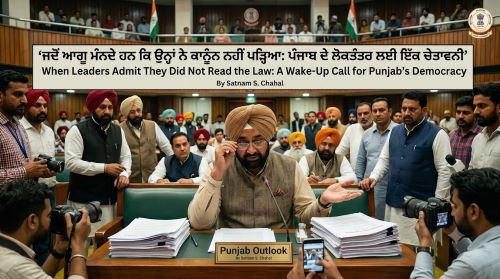
 Punjab has witnessed several occasions in recent decades when prominent Sikh political leaders have appeared before Sri Akal Takht Sahib to seek forgiveness, clarification, or religious guidance over decisions taken while holding public office. Such appearances have often reflected not only individual accountability but also the close relationship between politics and Sikh religious institutions. However, the latest developments have also raised a much broader and troubling question: if lawmakers themselves later admit that they passed legislation without fully understanding it, what does that say about the quality of governance in Punjab?
The recent controversy has sparked an intense public debate after several legislators reportedly acknowledged that they had supported a law without properly reading or fully comprehending its contents. Such admissions have shocked many citizens because Members of the Legislative Assembly (MLAs) are elected to carefully examine every Bill before voting on it. Their constitutional responsibility is not merely to raise their hands in support or opposition but to understand the legal, financial, and constitutional consequences of every law they approve.
Timeline
1984–1990s: Following the turbulent years in Punjab, several Sikh political leaders sought guidance or appeared before Sri Akal Takht Sahib over issues relating to political decisions, religious controversies, or public conduct.
1990s–2000s: Various political controversies involving Sikh leaders periodically resulted in appearances before Akal Takht, reflecting the institution’s continuing moral authority within the Sikh community.
2015: The pardon granted to Sirsa-based Dera chief Gurmeet Ram Rahim Singh by Sikh religious authorities triggered widespread protests. The controversy eventually led to several senior Akali leaders appearing before Akal Takht amid intense criticism.
2024–2025: Several senior Sikh political figures again appeared before Akal Takht in connection with decisions taken during their tenure in government, reinforcing the principle that political leadership remains subject to religious and public scrutiny.
2026: Public debate intensified after legislators acknowledged that legislation had been passed without adequate study or understanding, leading many observers to question whether Punjab’s legislative process had become increasingly dependent on party discipline rather than informed debate.
The controversy extends far beyond one particular law. It raises fundamental questions about the functioning of democracy. Every Bill introduced in the Vidhan Sabha undergoes multiple stages including introduction, discussion, committee examination where applicable, debate, and voting. MLAs receive copies of proposed legislation precisely so they can examine every provision, consult experts, seek clarification, and represent the interests of their constituents.
When elected representatives later state that they did not fully understand the legislation they approved, public confidence naturally suffers. Citizens expect legislators to exercise independent judgment rather than simply following party instructions. Democracy functions effectively only when elected representatives critically evaluate proposed laws instead of treating legislative approval as a routine political exercise.
The episode has also revived discussions about the quality of legislative debate in Punjab. Opposition parties, constitutional experts, retired bureaucrats, and legal scholars have repeatedly argued that many important Bills deserve greater scrutiny through legislative committees before being passed. Detailed committee review often identifies drafting errors, constitutional concerns, and unintended consequences before laws come into force.
For ordinary voters, the controversy serves as a reminder that elections are not simply about choosing political parties they are about selecting capable lawmakers who possess the knowledge, commitment, and independence necessary to legislate responsibly. An MLA’s primary responsibility is to read, understand, question, and improve legislation before casting a vote.
The incident should therefore become an opportunity for institutional reform rather than merely political criticism. Punjab needs stronger legislative research support for MLAs, more extensive committee scrutiny of Bills, longer debates on important legislation, and greater transparency so citizens can evaluate how their representatives perform inside the Assembly.
Disclaimer: This article and accompanying images are for informational and illustrative purposes only. Some visuals may be AI-generated or digitally enhanced and may not depict actual events or persons.Views expressed are based on publicly available information and analysis.